Showing posts with label "Gogol's Head". Show all posts

Friday, July 14, 2017

"ШИНЕЛЬ" VLADIMIR NABOKOV PRAISE FOR GOGOL'S "OVERCOAT" from epigraphs to book by U.R. Bowie, "GOGOL'S HEAD"


Postage Stamp Commemorating Publication of "The Overcoat" in 1842


The diver, the seeker for pearls, the man who prefers the monsters of the deep to the sunshades on the beach, will find in “The Overcoat” shadows linking our state of existence to those other states and modes that we dimly apprehend in our rare moments of irrational perception.

                                            … Vladimir Nabokov


Wednesday, July 12, 2017

GOGOL LOVES NOSES excerpt from U.R. Bowie novel, "GOGOL'S HEAD"


In March, 1837, Gogol moved on to Rome and immediately fell in love with the place. Rome remained with him an obsession for many years. Here is an excerpt from a letter linking Gogol’s nose motif in his writings and life to the beloved city: 

“What a spring! Lord God, what a spring! . . . . What air! Inhale deeply through your nose and you feel as if no less than seven hundred angels had come flying up your nasal nostrils. An amazing spring it is! I can’t get enough of admiring it. All of Rome is strewn these days with roses . . . . Believe me that frequently I feel the frenzied desire to turn into nothing but a nose, so that there would be nothing more of me—no eyes, no hands, no feet—just one gigantic nose, with nostrils as big as good-sized buckets, so that I could draw into my insides the maximum volume of aromas and of spring” 
(letter to Marya Balabina, April, 1838, with a heading that reads, “Rome. The month of April. Year 2588th since the founding of the city”).


Note the pleonasm in the phrase “nasal nostrils (носовые ноздри),” as if to suggest that there were other bodily nostrils in addition to the nasal ones. Such “errors” are typical of Gogol’s style, which, even in his best fiction, often is weirdly ragged, nonstandard. A famous example of another such pleonasm is a passage describing “Russian mouzhiks” at the beginning of Dead Souls, as if there were mouzhiks (Russian peasants) in countries other than Russia.

Tuesday, July 11, 2017

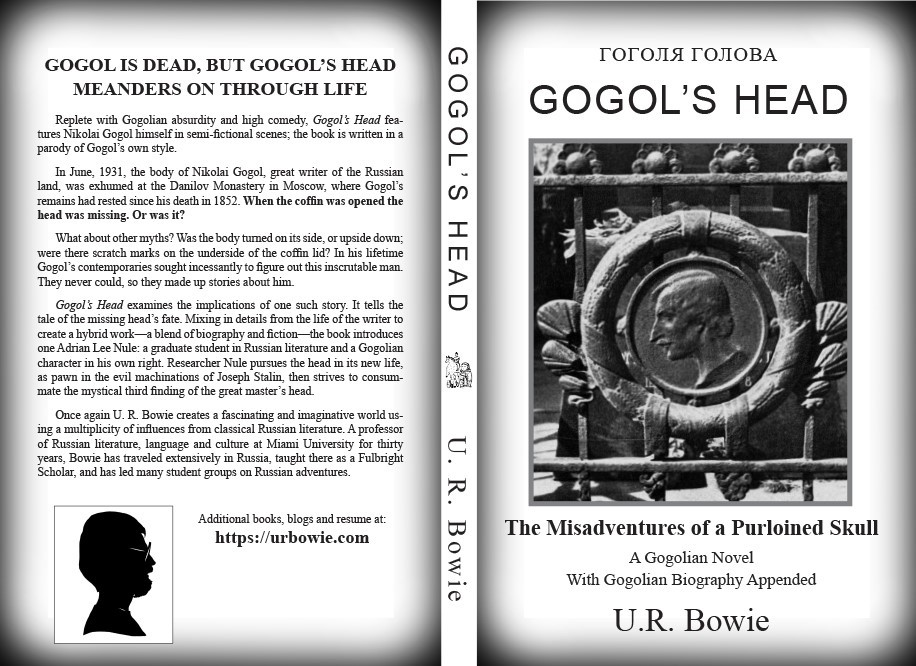
Cover art and front matter for new novel, "GOGOL'S HEAD," by U.R. Bowie


FRONT MATTER OF THE BOOK:


ГОГОЛЯ ГОЛОВА

GOGOL’S HEAD
Or
Skullduggery
Or
The Misadventures of a Purloined Skull


A Gogolian Novel
(With Gogolian Biography Appended)

U.R. Bowie
Series: The Collected Works of U.R. Bowie, Volume Eleven
Ogee Zakamora Publications, 2017


Copyright © 2017 by Robert Lee Bowie
All Rights Reserved
ISBN-13: 978-1548244149
ISBN-10: 1548244147

Front Cover Illustration:
N.A. Andreev, Medallion on Enclosure
of Nikolai Gogol’s Grave
(Danilov Monastery, Moscow, 1909)


Cover Design by Daniel Hime


                              ACKNOWLEDGEMENTS
Parts of this book have been workshopped through Gainesville Poets and Writers. Special thanks to my publicist Daniel Hime, who created the beautiful cover design. Also I am grateful to my copy editor D. C. Williams, and to my editor and publisher O.G. Zakamora. Once again Sergei Stadnik has helped me with proofreading the Cyrillic passages and refining my style in Russian. Благодарю!


                      NOTE ON CALENDARS
During the lifetime of Nikolai Gogol, Russia still operated according to the old Julian calendar, which, in the nineteenth century was twelve days behind the Gregorian calendar, then widely adopted in the countries of Western Europe. The differences can make for confusion. For example, Gogol’s friend, the poet Nikolai Yazykov, died in two different years: in December of 1846 by the Julian calendar, but in January, 1847 by the Gregorian. At the time of Lenin’s Socialist Revolution in 1917 Russia still ran on Julian dates, and, as a result, what the Soviets always referred to as “The Great October Revolution” took place in November.
Gogol, of course, spent much of his later life abroad, living by the Gregorian calendar. In the text of this book dates are given mostly by  Gregorian. In instances when the Julian calendar date is used, the initials OS (for Old Style) appear in parentheses.


For


THE READERS 
OF GOGOL


CONTENTS

In Lieu of an Introduction                                                                                                                                            
Biographical One: Freak Shows (Ukraine, 1822)                                                                  
Chapter One: The Exhumation                                                                                                                  
Biographical Two: Off to Meet Pushkin (St. Petersburg, Winter, 1829)          
Biographical Three: The Hans Fiasco, First Flight (May, 1829)                       
Chapter Two: Meet Adrian Nule                                                                                                               
Biographical Four: The Scrivener/Writer (St. Petersburg, 1829-1831) 
Chapter Three: Shoes Run Amuck                                                                                                                              
Biographical Five: Good Times (St. Petersburg, Moscow,1831-1834)  
Chapter Four: How It Began with Nule                                                                                                  Biographical Six: Performing (1835-1836)                                                                                            Chapter Five: More Skullduggery                                                                                                                               
Biographical Seven: Wandering, Borrowing Money (1836-1839)   
Chapter Six: Akaky Goes Out Partying                                                                                                      
Biographical Eight: In Search of A Living Soul (1839-1842)                                               
The Three-Handed (Moscow, February, 1842)                                                                    
Buttons (Bad Gastein, Austria, early October, 1842)                                                           
Chapter Seven: The Politburo and the Skull                                                                                          
Biographical Nine: Floundering on, Petering out (1842-1845)                         
Chapter Eight: Nule’s Head Maunders On                                                                                            
Biographical Ten: Final Flight of the Buffleheaded Goo-Goo Bird 
(1846-1852)
Dear Eyes Gone (Moscow, February, 1852)                                                                                         
Chapter Nine: An Eye for an Eye at the Hands of the Head                                             
In Lieu of a Conclusion: Masafuera                                                                                                            


If mere creative force is to be the standard of valuation, Gogol is the greatest of Russian writers. In this respect he need hardly fear comparison with Shakespeare, and can boldly stand by the side of Rabelais. Neither Pushkin nor Tolstoy possessed anything like that volcano of imaginative creativeness.
                                                               … D.S. Mirsky

Nobody can ever imagine what Gogol was really like. From beginning to end everything about him is incomprehensible. The individual features are blurred, inchoate—they refuse to add up to anything.
                                                                … Anna Akhmatova

What are you like? As a person you are secretive, egotistical, arrogant, and mistrustful, a man who sacrifices everything for fame. As a friend what are you like? But then, do you really have any friends?
                                       … Pletnyov letter to Gogol, October, 1844

Дорога, дорога—дорогая дорога—дорога мне дороже всего (The road, the road—the dear road—dearest of all to me is the road).
                                      … Gogol letter to Pogodin, October, 1840

The diver, the seeker for pearls, the man who prefers the monsters of the deep to the sunshades on the beach, will find in “The Overcoat” shadows linking our state of existence to those other states and modes that we dimly apprehend in our rare moments of irrational perception.

                                                           … Vladimir Nabokov


Вместо Предисловия
In Lieu of an Introduction

This is the story of a head, and the story of the man who lost his head, and the story of what happened to the lost head. We begin with background on the man. In the process of telling the story of the purloined head, we tell—in lieu of a biography—a truncated version of the life of the man. We cut through all the lies and establish the truth.
                                                                        Adrian Lee Nule, ABD
                                                                        Madison, Wisconsin,
                                                                        March 20, 2015
                                   
d


Monday, July 10, 2017

ТРОЕРУЧИЦА THE THREE-HANDED MOTHER OF GOD excerpt from u.r. bowie novel, GOGOL'S HEAD

Icon of the Three-Handed, St. Nicholas Cathedral, St. Petersburg


Троеручица (The Three-Handed)

Moscow, February, 1842


Ekaterina Mikhailovna, sister of the poet Nikolai Mikhailovich Yazykov, was no Russian beauty, but there was an aura of beatitude about her. She was only five years old when her father died. After that she grew up under the sole influence of her pious mother. She and her mother worshipped together, read through the long list of morning and evening prayers. They kept the fasts with utter diligence and spent hours every week bowing down before the icons of Eastern Orthodoxy: the Mother of God of Vladimir, the Three-Handed Theotokos, the healer St. Panteleimon.

As a small girl Katya Yazykova would read aloud, drunk with the sound of her own voice, of saints and martyrs and holy fools, who, despising all that was crass and earthly, embraced the ethereal, who lived in hovels out in the desert, mortifying their corrupt flesh with its passions and lusts. At age nine she wept for months on end, praying and keening, hoping to attain to “the gift of tears.” At ten she went on an extended fast, eating little but bread and water for forty days. This feat of zealotry alarmed even her mother, but the little girl said, “No, it’s all right, Mama. I want to fast my way through to a mantic dream; I hope to speak with the Holy Mother herself.”

It is not known whether Katya was ever vouchsafed to see the Mother of God in her dreams, but she seemed destined for a nunnery, at least until she met the renowned Slavophile philosopher and poet, Aleksei Khomyakov. After their marriage, in 1836, when she was nineteen, her life was centered largely on family and children, although the ideal of the fleshless existence never lost its appeal.

Ekaterina Mikhailovna became hostess for weekly gatherings of intellectuals and literary figures at the Khomyakov mansion in Moscow. Those who attended the meetings were like-minded Slavophiles, firm believers in Eastern Orthodoxy and the holy mission of Russia. Among them was the comic writer Nikolai Gogol, who had first met Ekaterina Mikhailovna and her husband through her brother, one of his closest friends.

On those brisk wintry evenings with the pallid yellow of streetlamps flickering on white frost, Gogol would come to call on the Khomyakovs. The famous author, thirty-three years old that winter, was short in stature, with a long pointed nose, a slender build and blond hair. He would smile at his hosts, toss off a few good-natured remarks, then walk across the drawing room with that peculiar rapid, herky-jerky gait of his. Standing in a corner, wearing his pale-blue vest and trousers of a mauve hue, he reminded one guest of the kind of stork you see in the Ukraine—perched on one leg high up on a roof, with a strangely pensive demeanor.

In Gogol’s personality there was something evasive, forced and constrained. He often appeared to be putting on an act, trying to make people laugh; no one ever seemed to know the real Gogol. Early in his career the literary luminaries of the day (Pushkin, Pletnyov) underestimated him, looked upon him as a figure of fun. The poet Zhukovsky fondly called him by a silly nickname, “Gogolyok.” Especially in the last ten years of his life his nerves were in perpetual disarray. But with her, with Ekaterina Mikhailovna, Gogol was almost natural.

Whenever he arrived he was inevitably drawn to her. Was the attraction sensual in any way? Hardly. In the whole of his solitary life Gogol apparently never lusted for women. What he loved in her was her aura of gentle piety. They would sit together in a corner, drinking tea, speaking in low voices. Gogol showed her little of the raucous, hilarious side of himself, the Gogol who could have people literally crawling on all fours, overcome with laughter. He never told her the off-color stories he loved to tell, most certainly never indulged his bent for scatology. With her he relaxed, he gazed into her lambent grey eyes. Pulled gently into the quiescence that she exuded, he bathed in its soft glow. Like her, he had been raised in Orthodox Christianity, and the longer he lived the more his religion took precedence over everything else.

The conversation tonight, as almost always, was one-sided. Gogol did the talking, while she listened to him, responded with her luminous eyes, her soft smile.
            “You know, for years I’ve been planning a pilgrimage to the Holy Land, to pray at the sepulchre of Jesus Christ, Our Lord.”
            
No answer. Just the smile, the light in her grey eyes. She looked at him, taking him in without judging him. “Judge not” (Не судите) were two words she repeated incessantly, silently to herself. Her mother had taught her to do that. Gogol’s long blond hair fell straight down from the temples almost to his shoulders, forming parentheses around his gaunt face. His eyes were small and brown; they would flash occasionally with merriment. His lips were soft, puffy beneath his clipped mustache, and the nose was bird-like. Now the mouth was moving again, and she watched it form words.

“I’ll go there for sure. Some day. Just now I don’t have the energy. My bowels are giving me fits again. Did I ever tell you that I was once examined by the best doctors of Paris, and they discovered that my stomach was upside down?”
            
He smiled wanly when he told her that, and, as so often with Gogol, she could not be sure if he was joking or in dead earnest.
            “I think you mentioned that to my brother,” she replied, unsmiling, touching his wrist with her hand.
            Silence. She was reciting the Jesus Prayer in her mind: “Lord Jesus Christ, Son of God, pray for me, a sinner.”
            “What are you thinking?” he asked her.
            “Nothing. I’m listening to what you say. I love your voice.”
            That dreamy expression on her face, the very look of her calmed his soul.
            “Maybe we could all go together—to Jerusalem—you and your husband, and your brother Nikolai. Would you like that?”
            (Smiling) “I think it’s a marvelous idea.”
            “Who on earth do I love more than you and Nikolai? No one. Some of my happiest memories consist of just his presence in my life. The time we’ve spent traveling together in Europe, or taking the waters. I treasure the memory of those moments.”
            “My brother loves being with you as well. He’s been quite ill you know, for some time, but you always cheer him up.”
            “I pray for him. Every day. I know that all will be well, for the Lord is merciful.”
            
She nodded but did not answer. He looked in her eyes again, then recalled a line from Nikolai Yazykov’s poetry and said it aloud, still gazing in her eyes and smiling: “Милы очи ваши ясны (Sweet they are, your clear pure eyes).”


Karl Gampeln portrait of E.M. Khomyakova

STEALING GOGOL'S SHOES, excerpt from U.R. Bowie novel, "GOGOL'S HEAD"


Chapter Three: Shoes Run Amuck

Башмаки вдребезги

1

Шаша в восторге
(Shasha Exultant)


Once it had been the resplendent Danilov Monastery, also known in English as the St. Daniel Monastery, founded in Moscow in the thirteenth century. When our story begins it was still called the Danilov Monastery, but there were no monks any more, no игумен (father superior)—just buildings in bad repair and a cemetery in desuetude. The monastery had been closed the year before; most of the monks were shot. On the evening of June 26, 1931, the custodian of the Danilov Monastery, Soviet factotum Aleksandr Khromov—a pudgy middle-aged bachelor with a big wart under one nostril, a man everyone called “Shasha”—sat in his Moscow flat near Sokolniki Park. Sat wrapped in exultation.

Why so wrapped? Because at the cemetery located on the monastery grounds they had dug all day long, and, had, finally, disinterred, among others, one of the great jewels of Russian literature, Nikolai Vasilievich Gogol. Dug his coffin up and even opened that coffin and looked upon the remains, pillaged them, and now Shasha Khromov was drinking vodka (Pshenichnaja brand), sitting around the small kitchen table with two of his regular drinking buddies, Tolik Bashmachkin and Zhenka [Last Name Lost]. He was toasting the beautifully preserved shoes that were perched on the wide windowsill next to a stuffed bird (a magpie). Gogol’s shoes.

--Today my luck has finally changed (said Shasha). These shoes will make me rich and famous. Even happy!
--Well, that’s a lot to assume (said dubious Zhenka Last Name Lost). What, after all, makes for true happiness?
He put on a plaintive look, sniffed at a hunk of black bread and stuffed it in his mouth.

Zhenka was a scruffy man of thirty-five, with a left eye that looked straight at you and a right eye that kept its own counsel. His friend Tolik, also thirty-five, resembled Zhenka, except that he was tall instead of short, and his right eye was the one that looked straight ahead.
Zhenka cast a sideways glance at the nineteenth-century style of the high-topped shoes, at the spot where a piece of worn leather was bent back from one of the soles. That spronged-out piece reminded him of an old man’s senescent tongue—sticking itself out at him.
--That this will make you happy is a maybe so and a maybe no (said Tolik Bashmachkin), averting his gaze from the buttons on the shoes. Those blue buttons were round and gleaming, like eyes.
--Kind of reminds me of my grandpa (said Zhenka). When I was lazing around the house, he’d look over at me and say, ‘Not worth a soaked boot sole; you twist it and it bends.’
--What do we have up to now in our little museum next to the cemetery (said upbeat Shasha Khromov)? We’ve got a few old icons, a few relics of saints, things left over from when there was a God. Who’s interested in looking at outmoded stuff like that? Nobody.
--This is the Soviet Union (said Zhenka proudly). We’re building Utopian Socialism, and God is superfluous!
--I’ll drink to that (said Shasha, raising his shot glass). To the God that never was, and is not now neither.
--To Comrade Stalin (said Tolik, raising his), who kicked God and all his saints off the ship of modernity.
--Down with God and up with the Revolution (said Zhenka).

They tossed off their shots; Shasha refilled the dram glasses.
--What sort of relics do you have there, in your museum (asked Zhenka)?
--We’ve got a fingernail from the left hand of St. Panteleimon the All-Merciful. Plus a piece of stone that was taken from a boulder standing near the holy sepulcher of John the Baptist.
--Was that in Jerusalem (asked Zhenka)?
--Can’t remember. I believe it was the place of the first finding of the head.
--The what?
--All that church folklore is illegal now, so best not to speak of it. Anyway, way back when, you may recall, they cut off John the Baptist’s head and gave it to some dancing girl. Then, later, it disappeared a time or two. For centuries each time. Whenever they found the head again, well, they made that day a church holiday.
--Gruesome. What was the holiday called?
--Something like ‘The First (or Second, or Third) Finding of the Head of the Forerunner.’ You weren’t allowed to eat watermelon on that day. Or anything round.
--Crazy stuff (said Tolik). He shrugged his shoulders, by way of removing the tingle that ran up his spine and centered itself at the base of his neck.
--We’re building Socialism now (said Zhenka proudly). Or Communism, one.
He tossed down his vodka, this time without a toast.
--Hold on there (said Tolik Bashmachkin)! You didn’t say what you’re drinking to.
Zhenka Last Name Lost held up his empty shot glass, addressed his left eye to its glitter.
--To our transcendence of all base superstitions. A toast in absentia.
--In absentia?
--Yes. The vodka in my glass is absent (I already drank it). The Lord God of Sabaoth is absent, being as He don’t exist anymore. And so is Nikolai Vasilievich Gogol absent in the flesh, but he’s here with us in spirit. Doing a Ukrainian hopak folk dance in them spiffy high-button brogans over there.

Zhenka winked with his good eye and gestured toward the shoes.
Tolik put on a frown: Yeah, I remember now; he came from Ukieland, Gogol did. Born and bred. Me, I never could stand the Ukies.
--That’s the damn God’s truth (agreed Zhenka). A Ukie is shrewd, brother. He’ll screw you out of your last kopeck; then, for good measure, he’ll make off with the shirt off your back. The day the Ukie was born, why, the Jew and the Georgian, they cried bitter tears.
Zhenka slowly shook his head, deploring the base treachery of the Ukrainian people.
--Did you have any trouble getting them shoes off his feet (Tolik suddenly asked)? He screwed up his lips to make a squeamish face.
--No trouble at all (said Shasha Khromov). No flesh to get in the way, just slippery bone.
He laughed, but his drinking buddies looked away. Nobody said anything for a minute or two. Zhenka peered around vacantly, stroking the wing of a stuffed parrot that stood on the small kitchen ice box.
--What was the point of it, anyway (asked Tolik morosely)? Digging him up, I mean.
--Somebody higher up decided to liquidate the cemetery out at our place. They’re transplanting Gogol and a few others. Putting them back in the ground at Novodevichy. We’ll be taking in juvenile delinquents now in our monastery buildings—setting up a reform school. 

Nobody said anything to that. 

Sunday, July 9, 2017

GOGOL READS FROM HIS WORKS, excerpt from U.R. Bowie novel, "GOGOL'S HEAD"


Head Detail from Andreev Statue of  Nikolai Gogol, Nikitsky Boulevard, Moscow


During the second half of the decade of the 1830s Gogol began doing what he did so well for the rest of his life: reading his works aloud to enthralled private audiences. One of his early performances took place in May, 1835, at the Moscow home of Pogodin, where he read an early draft of his comedy, The Marriage. S.T. Aksakov, who was to become one of Gogol’s most fervent admirers, was too ill to attend that event, but he reported on it secondhand.

“Gogol’s reading, or better to say acting out, of his play was so masterful that many people, those well-versed in such matters, are still saying to this day that—notwithstanding the excellent work of the actors on stage—this comedy remains not as complete, not as substantial, and far from being as funny as it is when read by its author . . . . The listeners laughed so hard that several of them almost became ill.” The host of the reading, Pogodin, who later became disillusioned with his “friend” Gogol, was equally full of praise in recalling the evening.

“At my house Gogol once read, to a large throng of listeners, his play “The Marriage.” He came to the part where the prospective groom and the bride are declaring their love—asking inane things like ‘What church did you go to last Sunday? What is your favorite color?’ Three times in a row there is an interval of silence between the questions, and he so masterfully expressed the silence, it so showed on his face and in his eyes that all of the listeners à la lettre went off into rollicking laughter. For a long time they could not restrain themselves, while he maintained that silence as if nothing were going on around him, and just let his eyes wander about the room.”


In January, 1836, Gogol gave another reading, this time of his Inspector General, at Zhukovsky’s residence in St. Petersburg. Among those attending were Pushkin, Count Vielgorsky— father of the young man who Gogol was later to nurse and cherish on his death bed in Rome, Josef Vielgorsky—and Prince P.A. Vyazemsky (1792-1878), poet and critic, a highly educated and cultivated man. Once again, Gogol read brilliantly, with great success. Possibly by this time Pushkin and Zhukovsky, who, in the beginning, had treated young Gogolyok largely as a figure of fun, were beginning to realize their mistake.

Sunday, July 2, 2017

NIKOLAI GOGOL IN PERFORMANCE excerpt from my forthcoming book, "GOGOL'S HEAD"


                                        GOGOL IN PERFORMANCE

(excerpt from forthcoming novel by U.R. Bowie, "Gogol's Head: The Misadventures of a Purloined Skull")

In October, 1839, Gogol travelled with members of the Aksakov family, by stagecoach from Moscow to St. Petersburg: S.T. Aksakov, his daughter Vera, and his fourteen-year-old son Misha—whom Aksakov planned to enroll in the page corps of the Tsar. Gogol spent most of the trip reading Shakespeare in French. When he was not reading Gogol was putting on a show, joking around and entertaining the others.

They stopped off in the city of Torzhok to eat the famous “Pozharsky cutlets,” what Troyat describes as “chopped-chicken croquettes.” When they were served they noticed immediately that the food was full of long blond hairs. The children began pulling out the hairs, holding them up, making funny faces, and Gogol started laughing. He conjured up a few imaginary scenes, episodes featuring the hairs and their former owners, describing how the hairs had made their way into the food. Everyone laughed.

--We’ll call for the waiter and complain (said Aksakov).
--Yes (said Gogol), but before he comes let me tell you what he’ll say.
Gogol drew himself up, looked down his nose and put on a different face, the face of a fastidious, self-important waiter, and they all laughed. Then he acted out the role, while his audience went on laughing.
--You say hairs in the food, my dear sir? What sort of hairs could there be, my dear sir? From where could there come any hairs? No, my dear sir, nothing of the sort, no hairs of any sort, my dear sir.

They called for the waiter. He approached the table, wearing the same face that Gogol had just put on. They laughed. They complained of the hairs in the food, and that’s when the waiter, Gogol’s involuntary straight man, proceeded to say exactly what Gogol had just said, using the same expressions and the same tone of voice. Everyone at the table roared with laughter, and that laughter was better for their insides than the best chicken croquettes could ever have been.

On another occasion, out on the street with Aksakov, Gogol stopped to buy some pryaniki (spice biscuits). Approaching the biscuit huckster, an old lady in a kerchief, wearing the usual sour face of the marketplace, Gogol went into his act.
--When were these biscuits baked?
--Just this morning, sir. Fresh as the daisies that bloom in spring.
--But it’s not spring now. It’s winter.
--It is, sir, indeed winter.
--And these look like pretty wintry biscuits to me.
No reply. Gogol screwed up his face, and the audience of one, Aksakov, smiled. Then Gogol went on.
--Let me have a look.
Contorting his mouth into a sideways grimace, Gogol picked up a pryanik and said “Ugh.” Then he said it again: “Ugh.” He put down the biscuit and wiped his hands on his trousers. He adopted an accusatory tone of voice.
--No, young lady, what you’re selling is not biscuits. What you’re selling is soap.
The appreciative audience of one began laughing.
--How do you mean, ‘soap,’ my dear sir (asked the straight woman huckster)?
--Soap, soap, indeed soap you’re selling, and nothing else on earth but soap.
--No, sir, these are fine pryaniki, baked only this morning, and you see—
Gogol interrupted, continuing on with the same stern tone of voice.
--No no no. Don’t try to tell me otherwise, young lady. What we have here is soap, soap soap, and not the best quality soap at that. How dare you sell soap and sponge it off on people as spice biscuits? I have known innocent people who’ve bought your soap, yes indeed. Some of them are my dear friends, and I have seen the soap bubbles on their lips, as they choke and gasp, young lady!

And so on.