Showing posts with label Raskolnikov. Show all posts

Friday, July 6, 2018

Notes on CRIME AND PUNISHMENT The Issue of Sensuality:Pedophiles and Perverts

Dostoevsky's Morbid Characters, Representatives of "The Sick World" of FMD


The Issue of Sensuality: Pedophiles and Perverts

Dostoevsky, to put it mildly, writes fiction about the dark side of the human soul. Dostoevsky’s fiction is often sick, and reading too much of it at a time can have a deleterious effect on the reader. If you read Crime and Punishment, thoroughly digest it, take some time off before diving into another long and gut-wrenching Dostoevsky novel.

As one critic, Geir Kjetsaa, has pointed out, “in his [Dostoevsky’s] eyes sexuality was the fundamental condition for the relationship between man and woman.” Kjetsaa quotes from a letter that Dostoevsky wrote to his second wife Anna late in his life: “You think perhaps that this is only one aspect of the matter, the coarsest one even. But there is nothing coarse about it; everything else is dependent on it.”

Pedophilia and the sexual designs of older men on young women are prominently featured in Dostoevsky’s fiction from the very beginning. In his first novel, Poor People, the heroine Varvara breaks the heart of the narrator Devushkin when she makes a marriage of convenience with a man named Bykov. This is much the same situation as that of Dunya and Luzhin in C and P, although Luzhin’s designs on Dunya are foiled and the marriage does not take place. 

Bykov, like Luzhin, is attracted by the idea of exerting sexual control over a young female. The fatuous socialist Lebezyatnikov has similar proclivities. While professing to be selflessly interested in “educating” Sonya Marmeladova in socialist doctrines, while pretending to be interested in her as a representative of the oppressed masses, he also has prurient designs on her.

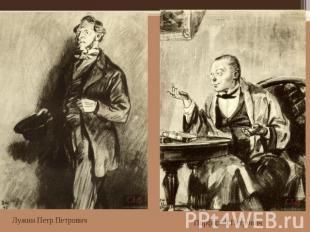
Probably the most negative character in C and P, Luzhin, a money grubber, incipient capitalist and social climber, is perversely attracted to the idea of possessing Dunya, a proud and attractive girl (she is eighteen). He will pull her, along with her family, out of poverty, so he thinks, and after their marriage she will be his love slave, totally submissive and grateful to him.

The genuine pedophiliac in the novel is Arkady Ivanovich Svidrigailov, who is sexually obsessed with Dunya, and, even worse, involved with very young girls from impoverished families. His first appearance in C and P is foreshadowed by a scene in Part 1, Ch. 4 (p. 39-43 in the Norton Critical Ed.), in which Raskolnikov sees a young drunken girl staggering down the street. She is followed by a plump fop with a lecherous gleam in his eye. Raskolnikov yells at him, “Hey, Svidrigailov, what do you want here?”

Svidrigailov’s actual appearance in the novel comes much later, at the very end of Part 3, when he almost seems to have been conjured up out of one of Raskolnikov’s violent nightmares. Raskolnikov dreams that he is striking the old woman—whom he has already murdered in the waking world—on the head with repetitive blows of the axe, but she just sits there laughing at him. He tries to run, wakes up, but “the dream seemed strangely to be continuing: his door was wide open and on the threshold stood a complete stranger, looking fixedly at him.”

This appearance of Svidrigailov as if out of the hero’s dream suggests that in some weird way he may be an extension of Raskolnikov’s personality, a part of his psyche. As has been emphasized by critics of Dostoevsky’s works, there are frequent doublings of characters. Svidrigailov and Sonya are both something of alter egos of Raskolnikov, she representing his good side, and he representing his evil side.

But in terms of sensuality Svidrigailov and Raskolnikov appear, at first glance, to have nothing in common. Svidrigailov is the supreme sensualist, who can find nothing to believe in except the flesh. He tells Raskolnikov at one point, “I have no confidence in anything but anatomy.” He has come to the conclusion that spirituality, morality, religion, and everything that most people cling to as a justification for living and behaving decently are mere abstractions. Debauchery is, in his ironic view, of positive value, as he tells Raskolnikov.

--Why should I give up women, if I have an inclination for them? It’s something to do, at any rate…
--So all you hope for is a spell of debauchery?
--Well, why not? Debauchery if you will! You seem to like the word! . . . . In ‘debauchery’ there is at least something constant, based on nature, indeed, and not subject to fantasy, something that exists in he blood as an eternal flame, always ready to set one on fire, and not to be readily extinguished, for a long time to come, perhaps for many years. You will agree that in its way it is an occupation (Part 6, Ch. 3).

As sometimes happens in a Hollywood film, a character actor steps into the narrative and begins stealing all the scenes. Svidrigailov steps into C and P very late in the action and almost steals all the attention from the main character Raskolnikov. Dostoevsky here has created probably the most in-depth and complex pedophile in the history of world literature.

Svidrigailov is aware that he is sick. “I agree that it [his pathological sensuality] is a disease.” In his past he is apparently responsible for the death of a deaf and dumb girl, whom Madam Resslich has procured for him, and whom he has abused (see p. 252, 429). He mentions to Raskolnikov his patronage of a thirteen-year-old girl and her mother, and, in the final part of the novel, he has become engaged to a fifteen-year-old. The description of how he visits his bride to be, then takes her up on his lap to fondle, are among the most perversely sensual of Dostoevsky’s writings, and they certainly provided Vladimir Nabokov with some of the material for his own treatment of pedophilia in Lolita. Even worse is Svidrigailov’s dream about a five-year-old girl whom he undresses, and who smiles lewdly at him.

Then again, Svidrigailov is not entirely a negative character. There is something even appealing about him at times. He finally has Dunya, after whom he lusts immeasurably, in his clutches, having lured her to his room with promises to tell her brother’s secret. But then, suppressing his own overwhelming feelings [“In the end I couldn’t bear even to hear the rustle of her dress. Really, I thought that I’d have a fit or something”], he lets her go. 

He provides money to help the Marmeladov orphans; he helps Sonya break free from prostitution. Then, as if realizing that there is no other way out for one whose amorality is an oppressive burden, he shoots himself.

But why do critics consider Svidrigailov a kind of double of Raskolnikov, who is extremely ascetic and appears almost non-sexed? You could approach this question by considering the character of Dunya, who is shown to be very similar to her brother. Svidrigailov tells Raskolnikov, “Avdotya Romanovna is terribly chaste, to a positively unheard-of degree . . . . . She is perhaps even morbidly chaste, and it will do her harm” (Part 6, Ch. 4). The implication is that morbid chastity, the obverse of morbid sensuality, represents another extreme condition. 

Complete renunciation of sexuality, Dostoevsky seems to suggest, is itself a kind of sexual impulse, and there is perhaps something perversely erotic in Dunya’s noble impulse to sacrifice herself by marrying the despicable Luzhin.

What about Raskolnikov, who is also “morbidly chaste”? In the first place, there are indications that Raskolnikov’s suppressed sexuality is not so dissimilar to Svidrigailov’s openly professed sexuality. This is especially apparent in brief mention of his one-time prospective bride, a sick and homely girl, daughter of his landlady. At one point Raskolnikov tells his mother that he “fell in love and wanted to be married.” But the impetus for this so-called “love” is sick and perverse, as only Dostoevsky’s characters seem capable of being.

“She was .  .  . very plain. I don’t really know what attracted me to her; I think it may have been that she was always ill… If she had been lame as well or hump-backed, I might very likely have loved her even more… (He smiled pensively). It was just because… Some kind of vernal delirium…”

So much for true love. There is something here fully as perverse in Raskolnikov’s morbid “love” as in Svidrigailov’s open profession of pathological sensuality and pedophilia. Lust is expressed in many ways, and the bottled-up libido will find an outlet. Some critics see the murder of the two women as a kind of rape, and act of subconscious sexual aggression on Raskolnikov’s part.

What about the love of Raskolnikov and Sonya? Not credible. In the first place, Sonya, the prostitute/nun in C and P is a character with little flesh on her bones. She is much less believable as a character than the lecherous Svidrigailov. And even much less interesting. What she is is Dostoevsky’s representative of the Christian message in the book. But Christian love is sexless, and there is never even a hint of sexuality between “the lovers” Raskolnikov and Sonya. They are, at some point we assume, to be married, but what kind of marriage will this turn out to be? Will Raskolnikov find an outlet for his own perverse sexuality by marrying, in effect, a nun?

Maybe so. We can only assume that in the years of the Russian Civil War Red soldiers—warriors for the cause of atheism—took great voluptuous pleasure in raping nuns. By that time Dostoevsky was no longer alive to write about such things, but had he still been alive he certainly would have been capable of expressing, in fictional art, the feelings of such men. Most important of all, he would have dared to write about such feelings, which more timid literary artists prefer not to touch.

In another novel, The Idiot, Dostoevsky attempted to portray the ideal man, a Christlike innocent devoid of sensuality. But at the end of that novel the hero fails utterly in his attempt to interact with his fellow man and woman; he degenerates into idiocy. There is no place for a sexless man in a world dominated by passion.

Want to see a good example of Dostoevsky’s influence on writers worldwide? Try reading Flannery O’Connor’s “Good Country People,” the story of a bible salesman in Georgia with perverse, Dostoevskian inclinations.


                   "Crime and Punishment" Beating a Horse to Death and Killing an Old Woman


Wednesday, July 4, 2018

Notes on CRIME AND PUNISHMENT Motivations for the Murder


Motivations

Why did he do it? This is the central question of C and P, which is a murder mystery, but not what they call a “whodunnit.” This novel is a “whydunnit,” or a “I-done-it-but-I-don’t-know-why-I-dunnit.” Of course, in all of Dostoevsky’s fiction characters are ruled by subconscious impulses that they themselves are unaware of. Raskolnikov is mired in the cyclical processes of human reasoning, which Dostoevsky, the great anti-rational rationalist, treats with suspicion.

So, as one critic, Phillip Rahv, has put it, Raskolnikov is “the criminal in search of his motive” (Norton Critical Ed., p. 540-41). Why did he do it? The full complexity of the issue becomes manifest only about halfway through the book (Part 3, Ch. 5; p. 218-25 in the Norton Critical Ed.), when, for the first time we hear about the article he has published on crime. Much to the surprise of Raskolnikov, who was not even aware that his article had been printed, the police inspector, Porfiry Petrovich tells him that he has read it. The central point of the article is that human beings are divided into the ordinary and the extraordinary. The ordinary are like sheep, baaing their way passively through life, but the extraordinary have the right to overstep the boundaries of morality and law, to commit immoral acts in furtherance of their majestic goals. This overstepping provides the title of the novel, Преступление и наказание—the word for ‘crime’ in Russian, at its root meaning, suggests a “stepping across,” akin to the word “transgression” in English.

In his conversation with Sonya (Part 5, Ch. 5; p. 348-54), Raskolnikov’s confusion about his motive becomes apparent, when he goes through nearly every possible motivation for his crime, rejecting or revising each of them on the fly. Svidrigailov, who is conveniently eavesdropping on this conversation, later recapitulates the motivations to Dunya (Part 6, Ch. 5, p. 415). Here is roughly how the process goes in Raskolnikov’s feverish mind.

I did it because I was poor and I needed money to launch my career, but no, what I really wanted was to help my mother and sister and, after all, I had just received a letter from my mother describing how my sister Dunya was about to prostitute herself by marrying a despicable character, sacrificing herself to help me, but no, it wasn’t really that, what I wanted was to get money so that I could go about doing good, working toward the eradication of human evil and social inequality on earth, and I figured that by killing one contemptible old woman, who nobody on earth needed and who soon would die anyway, I could get that money and then atone for this one transgressive act by doing great good for the rest of my life, and, besides that, I was, after all, insane, or nearly insane, going nuts lying here in that cramped coffin of a room and actually physically ill as well, feverish, not even aware of what I was doing, but no, it wasn’t really that, what I wanted to be was a great man, a man who can transcend commonplace vulgar morality and become a superman, prove that he is above the ethics of the stupid baaing herd, a Napoleon, and I really could have been a Napoleon, I’ve got the stuff for it, but no, really I’m just a common louse like everyone else, but I had to know, you see, it was an experiment, I had to find out if I was a man or a louse, I had to know whether I really could overstep the bounds, whether I could do something that ordinary men are not capable of doing, and I didn’t really care about my mother and sister or the money, it was just the principle of the thing, and you know what’s the most despicable thing of all? By collapsing emotionally and physically the way I have, all I’ve really proved is that I’m a louse after all, Napoleon would have done it without even thinking about the sleaze of it, the immorality, he wouldn’t have worried for a moment about the ethics of the thing, he was beyond mere morality, a superman, but me, I’m a louse, and yet maybe I judge myself too soon and too harshly, maybe I still have great things in me, maybe I’m not a louse after all, yes I am, no, you’re not, etc., etc., etc., the round and round goes on.

In addition to the reasons Raskolnikov himself lays out, only to keep rejecting, there are several other possibilities: (1) His mental illness as the primary motivation. Certainly he would not have committed murder had he been in a balanced state of mind; (2) The idea that he is consciously seeking suffering. The “punishment” of the title operates even before he commits the crime, and he is punished in his own agonizing mind long before he is convicted and sent to Siberia. In this novel, as in so much fiction that Dostoevsky wrote, much is made of suffering as a means of purification of soul. Marmeladov says that he drinks not to relieve himself of guilt, but in order to redouble his sufferings. The peasant Mikolka, though not guilty, confesses to the crime in order to “accept his suffering” and suffer his way through to some redemption. As Porfiry Petrovich remarks, Mikolka is a “religious schismatic,” which in Russian is “iz raskol’nikov.” The very similarity of the word ‘schismatic’ with Raskolnikov’s surname suggests that this character is an alter ego of Raskolnikov. In fact, in summing up the possible reasons why Mikolka confessed (Part 6, Ch. 2, p. 383), Porfiry recapitulates Raskolnikov’s reasons for committing the crime. He ends up, once again, with suffering:
“Do you, Rodion Romanovich, know what some of these people mean by ‘suffering’? It is not suffering for somebody’s sake, but simply ‘suffering is necessary’—the acceptance of suffering . . . . . .  Mikolka desires to ‘accept suffering’ or something of the sort . . . . . What, can’t you admit that such fantastic creatures are to be found among people of this kind?”

(3) The issue of suppressed sensuality. Some psychological critics of Dostoevsky have suggested that Raskolnikov is, above all, a passionate character who has suppressed his own libido. In the text of the novel he is certainly a prude, and he reacts with revulsion to Svidrigailov’s openly expressed sensuality, his love for anatomy above all else. These same critics assert that one way Raskolnikov has of working out his repressed sexuality is murder. They comment on the sexual symbolism of the murder of two women, calling this a kind of sublimated rape.

Maurice Beebe mentions the succession of events just prior to the murder: the episode in which Raskolnikov encounters a drunken girl on the street, and saves her from a lecherous dandy pursuing her, followed by the mare dream (murder of a female horse), followed by his own acts of murder:
“The progression from seduced girl to beaten horse to murdered pawnbroker [and her sister] tells us much about the strain of aggressive sexuality that lies within Raskolnikov, a taint which he himself denies on the conscious level” (Beebe in Norton Critical Ed., p. 591).


In the epilogue of the novel Raskolnikov still struggles with motivations for his act. He is still suffering his way through to some kind of redemption, but we do not know if he will ever get there, because Sonya’s God of meekness and love still struggles in his soul with the devil of his pride. At any rate, by this late point in the novel it seems clear that the “superman motive,” his fierce pride and desire to prove himself better than other mere men, has taken precedence over the many other motivations for his crime.


Tuesday, July 3, 2018

Notes on "Crime and Punishment" COINCIDENCE AND FYODOR DOSTOEVSY AS UTILITARIAN GOD OF THE NARRATIVE


Coincidence

With his strong Christian sentiments Dostoevsky believed thoroughly in human free will and taking responsibility for one’s deeds. So how do we square that with the overriding importance of coincidence in Part One of C and P? In carrying out his plan to commit murder, Raskolnikov does everything wrong, sets himself up to fail or be caught all along the line—and, miraculously succeeds. In fact, he has committed the perfect crime, and there is little or no chance that he will ever be charged. Then he proceeds to do lots of things to guarantee that he’ll be caught.

If you consider all the coincidences that operate in Raskolnikov’s favor in Part One, it is hard to remain unconvinced that some sort of supernatural power is (1) guiding him along like a blind man toward the crime, and (2) helping him escape afterwards. Sonya would say that this is the devil at work, but there are hints in the novel that it may be the Lord God.

Let’s trace all the most significant situations in which chance operates in Part One (p. 46-74 of the Norton Critical Edition C and P). We begin with the famous mare dream and Raskolnikov’s reaction to having had a dream in which he himself plays the role of a little boy watching peasants beat a horse to death. “I won’t do it, I won’t do it! [kill the old lady as he has planned] Lord, show me the way, that I may renounce this accursed fantasy of mine!” Next, he makes for home, but instead of going home by his usual route, he is led to cross Haymarket Square.

“Why, he used to ask himself later, did such an important and fateful encounter take place in the Haymarket (through which he had no reason to go) just at this time, just when his mood and circumstances were exactly those in which the meeting could have so fateful and decisive an influence on his destiny? It was almost as if fate had laid an ambush for him (52; my italics). 

What this refers to is the way he overhears the pawnbroker’s sister Lizaveta’s conversation in the Haymarket. From this conversation he learns that Lizaveta will not be at home the next day at 7:00 p.m., and “the old woman would be at home alone” (53).

“In later years he was always inclined to see something strange and mysterious in all the happenings of that time, as if special coincidences and influences were at work” (54).

Next coincidence: he stops off at a miserable little tavern and overhears his own theory of murder propagated by a student who uses as an example precisely the same old woman whom Raskolnikov has been planning to kill. In mouthing the same utilitarian principles that motivate Raskolnikov’s behavior—“you could murder the old lady, steal from her, and use the money to do good and benefit humanity”—the student demonstrates how unoriginal Raskolnikov’s ideas are; those notions are so much blowing in the wind of the day that two people speaking casually in a bar can give voice to them.

At this point, Dostoevsky, who goes out of his way to help the reader see the main idea, adds another amazed afterthought on the part of the hero: “This always seemed to him a strange coincidence. This casual public-house conversation had an extraordinary influence on the subsequent development of the matter, as if there were indeed something fateful and foreordained about it” (57; my italics).

From this point on everything that Raskolnikov does is flawed, but Fate (or the devil, or God) so helps things along that everything works out fine. While dreaming a dream about an Egyptian oasis, he nearly sleeps through the interval when he plans to commit the crime, but then a clock strikes just in time and wakes him up (58). Now he is in a total daze, sick and feverish, and his reactions are “almost completely mechanical, as though someone had taken his hand and pulled him along irresistibly, blindly, with supernatural strength” (60; my italics)

The servant girl Nastasya ends up being in the kitchen, so that he cannot pick up the axe he needs, but almost miraculously he comes upon an axe in the porter’s room: “It was not my planning, but the devil that accomplished that! he thought” (62).

Just as Raskolnikov turns into the gateway at the old pawnbroker’s building, “as if by design” a load of hay turns as well and screens him. Nobody sees him enter the courtyard. After he commits the murder he loses his head and does everything absolutely wrong. He even leaves the door open behind him, noticing this only after he has committed his second murder, of Lizaveta, who walks in at the wrong time.

A man arrives and knocks at the door, now locked. Soon another arrives. Raskolnikov has no way to get past these men and escape down the staircase, but, luckily, the man who is to remain at the door while the other goes for help decides to leave as well. As Raskolnikov descends the stairs he hears both of them returning. He has nowhere to hide; they are bound to see him, remember him. But, again luckily, two painters have temporarily left the apartment where they are working, and Raskolnikov ducks in there and conceals himself.

He escapes. Nobody sees him anywhere. He puts the axe back in its place. No one sees him; no problem. The perfect crime. If he is caught now, Raskolnikov has only himself to blame. So then he spends the rest of the novel getting himself caught, because, wallowing in contrition, he wants to get caught. Or at least one side of his split personality wants to be caught.

So was it really the devil helping him out continuously and guiding him inevitably toward the crime? And protecting him after the crime? Was it predestination? But Dostoevsky does not believe in predestination. For the rest of the novel Sonya’s God, or Jesus Christ seems to be guiding Raskolnikov though expiation of he crime and toward redemption.

Much is made of the spiritual benefits of suffering, not only in C and P, but also in much that Dostoevsky has written. There are implications that Raskolnikov may have a great future ahead of him, and that perhaps he has to suffer his way through to spiritual enlightenment before that future can be realized. The rather strange police inspector, Porfiry Petrovich, who sometimes acts almost as much as a father confessor to Raskolnikov as an investigator trying to solve a crime, suggests as much late in the novel.

Before the journey of suffering can begin, before the sufferer can work his way through to salvation, he must commit a horrible act. Following this logic—which is certainly hinted at in the narrative—the murder must be committed. So is it the Lord God setting up all the coincidences that lead Raskolnikov through the murder and escape? If so, the Lord God certainly works in mysterious ways. In fact, you could almost see the Lord as a kind of believer in the principles of Utilitarianism here. “Let’s kill off one old woman for the greater usefulness and good of our hero.”

A different and better way of looking at this issue is to assume that the god of the fiction here, Fyodor Dostoevsky himself, sets things up so as to make his narrative move along the way he wishes. Raskolnikov must commit the crime and must get away with it. If not, where would the book go as a whole, and how could the rest of it be written?


Monday, July 2, 2018

Notes to CRIME AND PUNISHMENT Radical-left Doctrines in the Novel: Utopian Socialism, Utilitarianism, Nihilism


Utopian Socialism, Utilitarianism, Nihilism

Dostoevsky the journalist and fiction writer was always deeply concerned with the social and political ideas of his time. In his younger days, he himself had been caught up in the fervor of Utopian Socialism—with its lofty ideals and conviction that human life on earth could be bettered for all. But after his return from Siberian prison and exile he spent the remainder of his days fighting a variety of political notions and social ideas—all of which, so he thought, depended too much on reason, and all of which were imported to Russia from Western Europe. 

He saw Western ideas as, basically, alien and dangerous on Russian soil, capable of producing highly unfavorable social and political changes. As it turned out, he was right, since the political system of Marxism-Leninism, which fueled the establishment of the new Soviet Union, ended up being a disaster for the Russian people, and even more of a disaster for peoples in a minority position in the U.S.S. R.

The Russian social and political situation in 1863-1865 was extremely complicated. For an in depth treatment of all its ramifications, the best place for the Anglophone reader to go is to Joseph Frank’s literary biography of Dostoevsky, Vol. III: Dostoevsky: The Miraculous Years, 1865-1871. Suffice it to say here that Raskolnikov’s deranged mind is much influenced by both (1) French Utopian Socialism (2) English Utilitarianism and (3) Russian Nihilism.

The spokesman for Utopian Socialism in C and P is the fatuous Lebezyatnikov, described as “a singularly commonplace and silly person.” In his empty-headedness he resembles the caricatures of radicals who are Bazarov’s “disciples” in Turgenev’s Fathers and Sons (Kukshina and Sitnikov). Lebezyatnikov espouses views that were already somewhat old-fashioned in Russia by the mid-sixties of the nineteenth century: glorification of the common people, free love, the necessity to organize communal living, beyond the restraints of traditional marriage. 

He also mouths the theory about how the environment that people live in determines their behavior. Dostoevsky uses one of the most positive characters in the novel, the generous, intelligent and impulsive Razumikhin, to criticize the environmental theory:
“they explain everything by the ‘deleterious influence of the environment’—and that’s all! Their favorite cliché . . . from that it follows that if society is properly organized all crimes will instantly disappear. . . Nature is not taken into account, nature is banished, nature is not supposed to exist! . . . . . . They have no use for the living soul. The living soul demands life, the living soul will not submit to mechanism, the living soul must be regarded with suspicion, the living soul is reactionary!” (Part 3, Ch. 5).

Here we have Dostoevsky’s insistence that the irrational ways of life often take precedence over the rational, that an overemphasis on reason can pervert life’s natural processes. His spokesman for such a view is a character whose very name reeks with reason: Razumikhin (Russian razum=reason).

At one point the dull-minded Lebezyatnikov explains to Raskolnikov modern methods of curing the mad by using logical persuasion: “madness is, so to speak, a logical mistake, a mistake of judgment, an incorrect view of things” (Part 5, Ch. 5). Katerina Ivanovna Marmeladova, who raves and rants all the way through the narrative, could be calmed (opines Lebezyatnikov), would stop crying if only she would listen to reason:

“what I mean is this: if you convinced a man logically that he had nothing to cry for, he would stop crying. That’s clear. Or are you of the opinion that he wouldn’t stop?”
“’That would make living too easy,’ answered Raskolnikov,” (Слишком легко тогда было бы жить).

Porfiry Petrovich, the police inspector, frequently emphasizes that evidence “cuts both ways” in the investigation of a crime. The Russian expression is “a stick with two ends” (палка о двух концах). But anyone reading much of Dostoevsky’s fiction soon discovers that the formula of the stick with two ends operates consistently. Despite his denigration of what he sees as a simplistic environmental theory, Dostoevsky does not deny the influence of the environment in motivating human behavior. 

One of his most intelligent characters, Porfiry Petrovich, assures Razumikhin at one point that environment can have a good deal to do with inspiring crime. Dostoevsky clearly illustrates how the squalid conditions in which Raskolnikov lives and the stifling, poisonous atmosphere of underclass Petersburg exacerbates his morbid state of mind. Frequent reference is made to his room, a horrible, cramped little cubbyhole that is compared to a coffin [see the cover art to the Norton Critical Edition of C and P, which depicts the view out the window from that room]. Environment is indeed important, but human beings cannot get away with rationalizing all their conduct by blaming it on their surroundings.

As for the ideas of English Utilitarianism, very popular in Russia in the mid-nineteenth century among the radical intelligentsia, Lebezyatnikov also mouths a few of these. Their most vocal spokesperson in Russia was Chernyshevsky, who was convinced that utilitarian theories could solve all problems of ethics and personal conduct. As Joseph Frank has written, “This has caused a great deal of confusion because only in Russia do we find the peculiar blend of French Utopian Socialism, with its belief in the possibility of a future world of love and moral perfection, held conjointly with a view of human nature stemming from the egoistic individualism [utilitarianism] of Bentham and Mill” (Norton Critical Ed., p. 563).

His “friend” Luzhin, perhaps the most despicable character in the novel, sniggers at Lebezyatnikov’s lectures on the utilitarian: “Everything that is useful to humanity is honorable, I understand only one word, useful!” (Part 5, Ch. 1). But Luzhin preaches the same utilitarian principles, using them to justify his own utter selfishness: “by the very act of devoting my gains solely and exclusively to myself, I am at the same time benefitting the whole community” (Part 2, Ch. 5).

Russian radicalism of the mid-1860s had advanced beyond the principles of Utopian Socialism. Utilizing the ideals of Utilitarianism and a love for the scientific method (positivism), the new radicals had arrived at so-called “Nihilism.’ The first important Nihilist in Russian literature was Bazarov in Turgenev’s Fathers and Sons, a man who has no great love for the common man, or for anyone else as well. He disdains what he sees as the sentimentality of Utopian Socialism; he sneers at over-idealization of the common man. He is an elitist who worries little about whose feelings he tramps on in his single-minded effort to change the social and political system.

While brought up with a Christian view of brotherly love, Raskolnikov has long since left the Orthodox religion behind. At the moment that C and P begins he is an atheist who has already gone beyond socialism and utilitarianism to his own nihilistic theory of the amoral “great man,” who can change the world if he is willing to trample upon generally accepted human morals.

Of course, one of Raskolnikov’s motivations for the crime is strictly utilitarian. He claims that he will make good use of the money he steals upon committing murder, devoting his life to serving humanity and changing the world for the better. But the error of his thinking—this being only one of many errors in his confused mind—is apparent in his own subconscious when he tells Luzhin what Luzhin’s doctrines of utilitarian “rational egoism” will lead to ultimately: “Carry to its logical conclusion what you were preaching just now, and it emerges that you can cut people’s throats” (Part 2, Ch. 5).

Such is the confusion of radical ideas that were in the air in the middle of the Russian nineteenth century, ideas that battle for ascendancy in the deranged mind of the main protagonist of C and P. The author Dostoevsky viewed all of these ideas as alien and dangerous. His great hope was that Russia and Russians could return to their roots, embracing the Russian earth and the Russian Orthodox doctrine of love, suffering their way through to a non-rational enlightenment.


"Cuts Both Ways" Caricature of Dostoevsky Sitting on an Axe, by Eugene Ivanov


                                                        Luzhin and Porfiry Petrovich


Saturday, June 30, 2018

Notes on CRIME AND PUNISHMENT Gogol Conjures up Raskolnikov Before He Exists


                                             Raskolnikov Conjured Up in "Dead Souls"

Sometimes it’s amazing how much influence Nikolai Gogol had on Dostoevsky. There’s a passage in Gogol’s Dead Souls, describing Chichikov’s return to the provincial town where he is staying, feeling in high spirits after his recent purchase of dead souls from the landowner Plewshkin.
So typical of Gogol’s style in his masterpiece, the action suddenly veers off out of Chichikov’s carriage, and we find ourselves in St. Petersburg, making the acquaintance of a young romantic dreamer who sticks his nose into the novel only this one time, and then vanishes like the wind.

“The thunderous rattling of the carriage and its leaps into the air made the occupant [Chichikov] notice that it had reached a paved way. The street lamps were not yet lit; only here and there had lights begun appearing in windows of the houses, while in the lanes and the blind alleys scenes and conversations were taking place inseparable from this time of day in all towns where there are many soldiers, cabbies, workmen, and beings of a peculiar species who look like ladies, wearing red shawls and shoes without stockings and who dart like bats over the street crossings at nightfall.

“Chichikov did not notice them, nor did he notice even the exceedingly slim petty officials with slender canes who, probably after taking a stroll beyond the town, were now returning to their homes. At rare intervals there would come floating to Chichikov’s ears such exclamations, apparently feminine, as ‘You lie, you drunkard, I never let him take no such liberties as that with me!’ or: ‘Don’t you be fighting, you ignoramus, but come along to the station house and I’ll show you what’s what!’ In brief, [and here we are suddenly in the northern capital, URB] such words as will suddenly scald, like so much boiling water, some youth of twenty as, lost in reveries, he is on his way home from the theater, his head filled with visions of a Spanish street, night, a wondrous feminine image with a guitar and ringlets.

“What doesn’t he have in that head of his and what dreams don’t come to him? He is soaring in the clouds and he may have just dropped in on Schiller for a chat, when suddenly, like thunder, the fatal words peal out over his head, and he perceives that he has come back to earth once more, and not only to earth, but actually to the Haymarket, and right by a pothouse, at that; and once more life has taken to strutting its stuff before him in its workaday fashion” [Dead Souls, Part I, near end of Ch. 6; I use the Guerney translation here].

Note the image of Friedrich Schiller (1759-1805), the German poet whom Russians of the nineteenth century considered the embodiment of romantic idealism. Schiller is mentioned several times in Crime and Punishment; at one point Svidrigailov calls Raskolnikov “a Schiller,” and in the hero’s mixed up personality there is certainly something of the romantic idealist.

Most fascinating about the Gogolian passage, however, is the way it seems to conjure up—some twenty years before Dostoevsky invented him—the dreamer Raskolnikov, wandering the Haymarket in a daze, amidst all the drunken squalor, trying to concentrate on the dreams and murderous schemes in his deranged head.


Raskolnikov Ascending