Showing posts with label russian literature. Show all posts

Friday, August 23, 2019

"Sama Seeker in the Time of the End Times" Novel by U.R. Bowie


Now available for purchase in two volumes, a spy novel: Sama Seeker in the Time of the End Times: Reminiscences of a Life in the Spook Trade, While in Search of Osama bin Laden

The year is 2002, the devastating attack of 911 in New York still reverberates. Osama bin Laden is in hiding. Defense Secretary Rumsfeld says, “If he’s alive, he’s somewhere?” The U.S. government marshals all its forces to find and kill him. Urell L. Buies, Ph.D., a college professor with a sideline of decades in low-level intelligence operations, is recruited to work with Russian intelligence in Central Asia. The Russians promise they can find Osama. While in Samarkand, Uzbekistan, doing little more than waiting for something to happen, Buies begins writing a long account of his years as a double agent. Or what he terms, ironically, “a double non-agent.” As the story of his life moves closer to present time, the narrative moves to the climactic point: the day the Russian helicopter goes in after Osama.


https://www.amazon.com/gp/product/1076653014/ref=dbs_a_def_rwt_hsch_vapi_taft_p1_i7

Tuesday, February 14, 2017

BOOK REVIEW David Bezmozgis, "The Free World"


BOOK REVIEW

David Bezmozgis, The Free World, (NY: Farrar, Straus and Giroux), 2011

As a child on his way to a new home in Canada, David Bezmozgis himself went the way of the fictitious characters in this novel. The book is set in 1978, and mention is frequently made of what is going on in the world at the time of the action. For example, “in Beirut, the Syrians were shelling the Christians, and Israel was massing troops on its northern border” (66). Meanwhile, “Begin was in America meeting with Carter and the Egyptian Sadat” (239).

The summit meetings between Sadat and Begin strike one as ancient history now, but the main characters in this book are even more anachronistic. They are denizens of the Soviet Union. Furthermore, the novel depicts a special category of Soviets, Jews who have renounced their Soviet citizenship and emigrated abroad as refugees. The standard Western image of such people is that of persecuted, and rather heroic defenders of freedom. Surely there were such types, but Bezmozgis shows us normal human beings with all their flaws.

He shows us, moreover, that the refugee Soviet Jews are still Soviet Russians—from the ways they think and act down to the very ways they hold their mouths as they walk the streets of the capitalist West. Here is a typical description: “a man in his middle thirties, balding, slightly flabby, and with the typical Russian look of fatigue—acquired in the womb, marinated in that broth of disappointments” (337).  Imagine how hard it is to slough off that Russian look on any Russian face, “acquired in the womb.”

The main narrative line features the Krasnansky family from Riga, Latvia: the patriarch Samuil and his wife Emma; their sons Alec and Karl; Alec’s wife Polina and Karl’s wife Rosa. All are Jews except Polina, who ends up being the most sympathetic character in the novel. They pass through Vienna first, then take a train to Rome, where Jewish relief agencies will help place them in a new life abroad. They debate over where to go, which country to choose. Israel is, of course, one choice, but only Rosa wants to go there. Other places are much preferable, apparently, to most of the Soviet Jews living temporarily in Rome. One big reason is the political unrest in Israel. “Alec, having successfully avoided the worst of Soviet military service, wasn’t aching to go from Ben Gurion Airport to boot camp. Getting killed or maimed in Lebanon, or Egypt, or wherever the bullets were flying, seemed to defeat the whole point of leaving the Soviet Union” (66). The Krasnanskies eventually pick Canada as their destination in the free world.

Of the brothers Alec has a somewhat problematic name. Is this the Russian name Олег (Oleg, pronounced roughly “A-lek”), masquerading in English as a nickname of Aleksandr? If the character were Aleksandr, his normal nickname would be Sasha.

The two brothers are polar opposites: “Alec would see a circus and want to join; Karl, meanwhile, would estimate the cost of feeding the elephants and conjecture that the acrobats suffered from venereal disease” (33). Karl is the standard Soviet pragmatist and simulator-manipulator. Among Soviet Russians, and surely even among post-Soviet Russians, his type is legion. At one point he speaks disparagingly of a bus driver with “a sad and trusting face,” adding that “my face is whatever it needs to be” (34). The reader wonders what kind of face he will put on to wear around Canada when he arrives there. Speaking of faces, another incidental character, the kind and generous Lyova—who has already lived in Israel but is looking for a way out of that chaotic country—describes his own face as follows: “Mine is the archetypal Jewish face. Like something formed on the run and in a panic. Nose, eyes, ears, mouth: finished” (127).

Only a month or two in Italy, while awaiting placement abroad, the thuggish Karl is already involved in several business enterprises, some illegal. He brokers apartments to other arriving refugees, does a bit of money changing, operates a shady auto repair shop and traffics icons smuggled out of the U.S.S.R. His wife Rosa (the most undeveloped character in the family) tolerates his boorishness and occasional infidelities, devoting her life mostly to their two sons.

Alec, age 26,  perhaps the main character in the book, is notable for his frivolous nature, the way he makes light of everything. While Karl is out hustling for money, Alec prefers hustling for women. Early in his life he has discovered that women like him. “In his presence they often became exaggerated versions of themselves. The maternal ones became more maternal, the crude ones became cruder, the shy ones shyer” (4).  Alec and Polina have been married only a year at the time of the action; she has struggled over her decision to leave her parents and her beloved sister behind in Riga. Eventually Alec’s foolish decision to pursue a young refugee, the bad-news Masha, brings tragedy to the family and a likely breakup in his marriage to Polina. She decides to go on with him to Canada but divorce him upon arrival there.

Divorce, in fact, is rife among the Soviet refugees in Rome. As early as their arrival in Vienna, wives are abandoning their husbands, and affairs among the newly emigrated Jews are common. Some couples would have divorced years ago, but they remain together only long enough to get the documents allowing them to leave the Soviet Union. There are “the common occurrences of one man leaving his wife for that of a friend. This was then typically followed by threats and imprecations, and the obligatory loopy fistfight—the whole sorry spectacle played out before somebody’s distraught five-year-old son” (225).

For me the most interesting character in the book, and something of a tragic figure, is the patriarch Samuil. Despite his Jewishness, he has made a firm place for himself in Sovdepia, working a high managerial post in a radio factory. There he operates as a typical Soviet tyrant, who has a network of informants. He is also known to be a philanderer, apparently taking advantage of his high station to find willing women.

So firm is Samuil’s belief in Communism and the Soviet Way that emigration for him is a personal tragedy. He leaves because all the rest of his family are leaving, but so reluctant is he to emigrate that he contemplates killing himself in Riga. Once abroad, while waiting for Canada, he does nothing but grumble, eventually isolating himself totally from the others while writing a memoir of his life.

In a roundabout way, the author presents that memoir to the reader, shows us what a fascinating and even bizarre life this old man has lived. Samuil started out in a squalid shtetl in the Ukraine, where, as a Jew, he faced the horrors of pogroms and had to watch his own father murdered. In describing that early life, Bezmozgis features wonderful passages of prose. Here he describes the ritual butcher inspecting the lungs of a cow or sheep he had butchered:

“the glossy brownish organs . . . . . the grotesque and otherworldly things that made life possible and which everyone­­—from a mouse to a man—had pumping and sloshing around in the dark hollows under his skin” (117).

Samuil’s whole life is replete with the dark sloshings of a dangerous world. Later in his boyhood he makes it to Latvia, where he lives with Jewish relatives and is radicalized by left-wing believers in the socialist way. In the summer of 1940, at age 27, he witnesses the Soviet takeover of Latvia, and greets the invaders with open arms. Working as a Red Guard he helps deport “unsavory” types: “Zionists, Latvian nationalists, capitalists, bourgeoisie, members of the former government, priests, rabbis, Hebrew teachers, everyone a potential threat” (174-75). Aloft in his dreams of a socialist utopia, Samuil never conjures up one iota of sympathy for the people he sends to Soviet labor camps. He and his brother Reuven, another true believer, do nothing to help their cousin Yaakov (a Zionist), even accompanying him to the cattle cars heading East. Given the Jewish blood that he has on his hands, it is no wonder that Samuil has no interest in emigrating to Israel.

Later on Samuil fights the good fight for the Fatherland in the war against Hitler. Now, late in life, he has no regrets about how he has lived, regretting only that his family has forced him to emigrate, betraying all his ideals and the Soviet system he still supports. His thoughts, however, are the thoughts not only of a Soviet-believer. Much of what he thinks is typical of aged thoughts anywhere in the world.

“How had it happened that the people in the past, all long dead, now seemed to him to be the real people, and the people in the present, including his own children, seemed to him evanescent, so nearly figments that he could imagine passing his hand through them?”(195). The old Jews newly abroad are truly touching figures. “They were all obsolete, a traveling museum exhibit of a lost kind: Stalin’s Jews, unlikely survivors of repeat appointments with death” (236).

Despite his doctrinaire personality and the sins of his Soviet past, despite his self-centered nature, his callous treatment of his wife and bullying of his own sons, Samuil is a believable character, and, in some dark way, even sympathetic. The descriptions of his death in Rome of a heart attack and his Jewish funeral and burial—attended by the secular Soviet Jews in his family, who have no conception of the Hebrew ritual, no idea what is going on—are probably the most moving in the novel. After the ceremony is done, they all end up singing the one song that unites them, a song Samuil himself would have approved of: the Communist Internationale (344).

Here is the fine description of Alec’s first viewing of the dead body.

“Alec approached the figure, drew aside the folds, and uncovered a wax replica of his father’s face. He saw the full head of gray hair, the stern brow, the distinguished masculine nose, and the shiny white granules stippling the cheeks. Someone had shut his father’s eyes and removed his dentures. The latter detail had distorted his face, collapsing his mouth and making him seem ancient. Alec’s impulse was to look away, but he resisted out of a duty to see all. He tried to reconcile this pale waxwork with the father who had been such a vital, dominant presence in his life. He felt crushed by the mortal paradox: how it was that his father lay by his side and that his father was no more. He studied his father’s face and understood that there was such a thing as a soul and that it had departed and left behind a corpse” (338).

Although the book is set in Rome and the characters are, largely, Jews, what one learns most in reading this book is how the Soviet mentality worked. Although describing events of the twentieth century (1978) the novel is already a sort of museum piece. Were these characters to return now, to the newly capitalist Russian Federation, they would be totally out of place. So much has changed in forty years.

What must it have been like for people who had never seen a banana in their lives and were suddenly swimming in bananas? Soviets abroad for the first time, including the Krasnansky family, are obsessed with bananas—not to mention “pineapples, or the chicken and veal in the butcher’s shops.” Then again, there is the thing of colorful clothing. Polina writes to her sister back in Riga: “What I hadn’t expected were the colors. There were dresses and blouses in colors I had never seen. How strange it is to think that I had lived my entire life without seeing certain colors. In one display there was a silk blouse of a deep lavender I associated with exotic flowers” (12). Anyone who visited the Soviet Union from the West in the seventies, the years of the “Brezhnev stagnation” during which this book is set, was immediately struck by the monochromatic nature of the place—even the capital Moscow: the greys and dirty browns, the absence of bright colors; the disrepair of the buildings. The grimness.

For Soviet people coming out Westward it must have seemed something like the ending of Tarkovsky’s film, “Andrey Rublyov”—when the black-and-white suddenly takes on color, and we feast our eyes on the magnificence of the Rublyov icons. The refugees sit dazzled by the light in Rome, speaking the Russian language, spreading rumors, just as they had back home. But these rumors are not concerned with when the hot water will be turned back on; they have a different content. “They compared climates. San Francisco was wonderful if you didn’t mind rain every day. Atlanta was forty degrees in the shade and you were lucky to find a white cop” (42). Although nothing is said about black people elsewhere in the book, Bezmozgis hints here at the standard racist attitudes typical of most Russians, including Russian Jews.

In Rome Alec watches a porno film for the first time, then muses over all he had been deprived of back home: “When it ended Alec grasped the full extent of Soviet deprivation. If Russian men were surly, belligerent alcoholics it was because, in place of natural, healthy forms of relaxation, they were given newspaper accounts of hero-worker dairy maids receiving medals for milk production” (151). Meanwhile, Russian folklore still rules in the minds of the protagonists: “I dreamed of shit last night,” Karl declared. “Means we’re due to come into money” (137).

Then there are all the nice set pieces about daily life in the U.S.S. R. 

(1) On driving a car Russian style, during the years when very few people owned cars and women did not drive: “In Riga his father had owned a car, a Zhiguli, which he drove poorly and infrequently. Arturs [his Latvian driver—the very fact of having a personal driver and a work car places Samuil up high in the Soviet hierarchy] took him to work, and when the need arose Samuil expected either Karl or Alec to drive him where he wanted to go. Otherwise the car sat in the garage, halfway across town. Samuil recorded the mileage on a pad to ensure that neither Karl nor Alec took the car out for their pleasure. It never occurred to anyone that his mother might also want to drive it” (45). The only thing missing from this account of ancient Russian history—which young Russians today would read laughing and choking on hilarity—is the tale of how Karl and Alec would likely make use of the car for sexual trysts, since in Soviet Russia the sexually willing faced the perennial problem of having nowhere to fornicate.

(2) On home improvement in the U.S.S.R. [actually apartment improvement, since people lived not in houses, but in government-owned apartments]: “Just to wangle ceramic tile for the bathroom, a man pitted himself against the mighty arsenal of the Soviet state. In effect, it was as if Leonid Ilyich [Brezhnev] was himself personally opposed to the tiling of a bathroom. It was the supreme challenge, eclipsing every other human endeavor—sport, sex, philosophy, art, and science” (211).

The Free World is often beautifully written. “They drove west toward Ostia. Ahead of them, beyond the horizon, the orange sun eased itself gently into the sea. Everything went orange in the expiring light. Orange-hued cars barreled along the orange-hued Ostiense until Dmitri pulled up and veered off onto a side road” (298). Sometimes there is a poignancy to descriptions of refugee life in Rome, as in the tale of the lost dogs: “The dogs, mostly large breeds, the mastiffs and wolfhounds favored by Russians, roamed in hungry, scraggly packs around Ladispoli, often congregating along the shore. They had been abandoned by owners who’d flown off to Canada or America—who after going to considerable lengths to process and transport the animals from the Soviet Union to Italy, had finally been dissuaded from taking them any farther. During the day, the dogs sprawled listlessly  in the shade of the palm trees, and in the evenings they skulked about in search of food. As with people in similar straits, the largest ones fared the worst. Great, once proud beasts dragged themselves about with downcast eyes, begging for scraps. To feed them was only to prolong their misery. Samuil had seen Italians shooing the animals away, using the Russian words for ‘no’ and ‘scram’” (242).

The novel depicts only one summer in the lives of the characters, and that is a summer in limbo. Soon they will arrive in their new home, Canada, and the reader wonders how they will get along there. Adept at Soviet conniving as most of them are [two of the minor characters among the refugees are the Bender brothers, an inside joke for readers of the popular Russian novel, “The Twelve Chairs” (by Ilf and Petrov, published in 1928), in which the main character is the conman, Ostap Bender], the implication is that they will do well. In speaking of low-life Masha and her family—her mother and her hoodlum brother Dimka—Karl remarks, “They’ll go to Germany. They can be smuggled in. I’m sure they’ll prosper. There’s plenty of opportunity. Let them be the Germans’ problem” (342).

The reader is frequently reminded that by far not all refugees are upstanding citizens and persecuted fighters for freedom. Like Dimka, some of them are common criminals who have done prison time in Russia. They are easy to pick out of the crowd, since they are festooned with the tattoos of the criminal underworld. “The unambiguous message from the Kremlin to the Knesset was: You want Jews? Here, take these” (184). When a Western country takes in migrants and refugees, it surely will be favored with some hardworking and upright types, but then again, the country ends up also inevitably with criminals, swindlers, and, worst of all, the Tsarnaev brothers of Boston. This problem underlies much of what Aleksandar Hemon has written, in his fictions depicting low-life Bosnian refugees in the U.S.

How much happiness, or unhappiness, awaits the Krasnansky family in Canada? David Bezmozgis would have to write a sequel for us to find out. Perhaps he is writing one. One may venture a guess, however, that the family members will find out that happiness in the West is not really at a premium either. Already their three months in Italy have been instructive in that regard. Lasting happiness anywhere, in fact, may be hard to come by. The epigraph to the book is from Genesis: “Now the Lord said unto Abram: ‘Get thee out of thy country, and from thy kindred, and from thy father’s house, unto the land that I will show thee.’” The title of the book is The Free World, something of an irony in itself, since there is not really any truly free world anywhere. The implication of the epigraph, however, suggests a different title, The Promised Land, and that title would be even more ironic.


Still in his early forties (born in 1973) David Bezmozgis has now published a book of short stories and two fine novels. Of the Russian/Jewish writers of fiction who have come out of the Soviet emigrations, he is probably the best working today.

Friday, May 15, 2015

BOOK REVIEW: Maxim D. Shrayer, "Leaving Russia: A Jewish Story"


BOOK REVIEW

Maxim D. Shrayer. Leaving Russian: A Jewish Story. Syracuse, NY: Syracuse University Press, 2013. Illustrations, Index of Names and Places. xxii +  324pp. $29.95 (cloth).


Once, in Moscow, in his seventh-grade classroom Maxim Shrayer was passed a note, “To the Jew from the Russians.” Containing the usual message of bigotry—“You Jewboy son of a bitch,” etc., complete with misspellings—it was signed by two boys, both named Fedya, neither of whom had previously appeared particularly virulent in their anti-Semitism.

Episodes such as this were part of the normal life’s experience of a Jew in the Soviet Union. Prof. Shrayer’s book treats not only what it’s like to be a Jew in Russia, but also what it’s like to be part of a “refusenik” family. He was eleven years old when his parents decided to apply for emigration. After nine years of living in limbo, the family finally was given permission to leave when he was twenty.

Those nine years were, to put it mildly, full of stress. While describing numerous incidents of harassment, however, this book is not about a worst-case scenario, not about Jews who were hounded unmercifully to their perdition. There are probably other Russian Jews who could write such a story. Take the issue of bullying at school. Maxim Shrayer was harassed periodically, subjected to taunts, sometimes to collective jeers directed at Jews in general. But he was not bullied. Wisely his father taught him early on to fight, and fight he did. He seems to have had, always, a highly developed self-assurance. He was, as he himself says, outgoing, a “popular” schoolmate.

The what if question shows up, or is implicit, again and again in this book. First off, what if the boy had been introverted, shy, not a fist fighter? Plenty of Jewish boys are like that. Plenty of American children, Jewish and otherwise, are subjected on a daily basis to horrendous bullying in American schools today. It drives some to suicide.

What of his parents, Emilia and David Shrayer? What was their life like in the Soviet Union? Once again, the situation could have been much worse. “My mother and father had both reached professional prominence”(30). Emilia was a teacher of English and a translator. David was a successful doctor and a published author, a member of the Union of Soviet Writers. His pen name was/is David Shrayer-Petrov. Of course, after they declared their intention to leave, their lives changed drastically. No more Union of Soviet Writers, no more good jobs. But, lucky for them, they were able to find menial jobs, they were able to survive. Their only son was consistently successful at everything he did. He was bright, an A student, he had experiences that other Soviet students seldom have: working during breaks from his studies as an orderly in a hospital, riding horses at the Moscow race track.

By the time the family was finally allowed to leave in 1987, after nine long years of harassment and frustration, Gorbachev’s New Era was on the horizon, and on a different horizon—not far past that—was the collapse of the Soviet Union. The author himself poses the question, “Should we have left?”

“In some memories of my Moscow  youth I feel so at peace that I start wondering why I left in the first place. Had I experienced the best of friendships in the wrong place at the right time so I would then go on remembering the time even as I forget the place?” (117).

This book, despite the limbo and the stress of those nine years, is full of good friends, happy times and the halcyon days of youth. The chapter describing a university expedition to the south of Russia in 1986, when Maxim was studying in the Soil Sciences department at Moscow State University, is idyllic. The family’s yearly trips to Estonia for summer vacations are described as highly relaxing and appealing.

Prof. Shrayer is a published writer of poetry, fiction and literary criticism. Recently he published a fascinating book on the relationship between Bunin and Nabokov. He began his writing career while still a student in Moscow. The book is full of little details that embody Soviet life of the seventies and eighties, things that I myself recall from the many times I visited the country.

Caraway/coriander rye bread (“Borodinsky”), poplar fluff, fatback and sunflower seeds. Ah yes, Russia. The way you walk into a restaurant and never ask for a menu— because nothing on the menu is available. You just say, “What have you got?” This is such a normal situation that Shrayer doesn’t bother explaining it for the non-Soviet reader (116). And this: “One of the two bus drivers was a misanthropic middle-aged man who regarded his ochre-colored bus as a submarine under his command” (166). Ah, yes, you could write a whole book about Russian driving habits and the puffed-up pride that men take in being the all-powerful captain of the auto-ship.

And this: “The director [of the House of Culture] spent much of her time drinking tea in the company of two junior administrators, whose principal tasks were to brew tea and to pour it into cups” (50). When working for the Red Cross in Russia and Central Asia (1992-1993) I ran into hordes of these “junior administrators.” They were hired to be, largely, sycophants, while the director (and maybe one secretary) did all the work. That’s the way Russian institutions often operate.

Then there’s the yearly harvest, the days in late August when the big cities overflow with luscious watermelons and the denizens are afflicted with watermelon fever:

“The city streets reeked of rotting watermelons. . . . Street corners and areas in front of food stores would be filled up with cage-like metal containers full of watermelons. People congregated in front of the large metal containers, picking and choosing ripe melons, sniffing them, tugging at their twisted piggish stems, tapping and pressing at them like doctors giving an abdominal exam. Parents would lift up children and put them inside the containers, and children crawled over the mounds of white and green stripy balls. Emotions ran wild and people would get in fights over watermelons. Women would lean over dirty edges of the metal containers in order to reach for watermelons, and boys would peer at the ‘panorama,’ as we called it in our jargon, of underwear and garter belts. Streams of pink watermelon juice flowed down pavements and mixed with the Stygian waters of the city streets” (75). Stygian?

There are lots of other passages in the book striking for their literary merit and evocative of Russian quotidian life. The train cars of Russia, “stuffed with people like sausages are stuffed with meat, fat and fennel seeds” (xvi). “A flowering potato field we passed on the way to the whitewashed milestone where my father would get off the heaving bus, mesh sacks of groceries in both hands” (8). The “Soviet grandee Boris Rozanov,” who had “the large, jutting mauve ears of a pedigreed Chihuahua” (109). Not just a Chihuahua was Comrade Rozanov, but a Chihuahua with a pedigree!

What’s it like, leaving all these things behind—familiar things that constitute the everyday quintessence of your very life—and starting out in a new country, “the miracle country” (40) of American the Beautiful? Did the new country live up to the expectations of the Shrayers? This myth of America as Fairyland Wonder has a long history in Russia, dating back at least to the eighteenth century. Time and again in the great works of Russian literature characters and authors dream of leaving all their troubles behind and going to America. Just before shooting himself—in the presence of a Jewish watchman whose face “had the eternal expression of resentful affliction that is so sharply etched on every Jewish face”—Dostoevsky’s perverted Svidrigailov (in Crime and Punishment) says, “If anyone asks, say that I said I was off for America.” In the torment of his last years Tolstoy considered emigrating to America. In the Russian imagination America was the place where dreams came true.

As representative in flesh of the Great Myth an American in Russia always had a special status. On the unwritten list of national rankings America and Americans were number one. In 1972, for example, when I was at Moscow State University for the first time with a group of American Russian teachers—and where I probably walked past young Max Shrayer on the street—the American contingent received the highest stipend of any group there. The group leader of the North Vietnamese—with whom we were then at war, and with whom the Soviets were allied—went to the administration to complain. The Vietnamese received the lowest stipend, except, perhaps, for the Africans. He, the complainer, was quickly shown the door. How could a mere Vietnamese demand higher status than an American?

Then, in 2012, not having been in the country for several years, I went back to St. Petersburg and there I discovered the corpse of the old myth. I wasn’t special any more. It took the collapse of the Soviet Union to finally kill off the American dream in the Russian mind. For the first time in Russian history the citizens of the country were allowed to visit the U.S. They came in great hordes to the promised land. Some of them emigrated. Many of them were disillusioned. Guess what? It’s not a wonderland after all. But then, even if it had been a hundred times better than it really is, America could never have lived up to the dream. Russian visitors took that sad news back home with them, and the long-perpetuated myth expired.

It’s not for nothing that the book mentions an American TV documentary about Russians miserable abroad (224-25). My experience with Russians in the U.S. is that the great majority of them adapt, if at all, rather poorly to American life. Some of them go crazy. “The social stress of being an immigrant to a new country is one of the critical factors in developing schizophrenia” [David Eagleman, Incognito: The Secret Lives of the Brain (NY: Random House, 2011), p. 211].

But what about the Shrayers? We don’t know if they consider America enough of a dream to justify all their trials, what they had to go through to get here. Only another book by Maxim Shrayer will clear that up for us, for this one ends with their departure from the Soviet Union. He does, however, describe how it feels going back “home.” “While visiting Russia I now feel like a comprehending alien” (xix).

Being a part of the great Jewish community, of course, is a consolation, but, then again, there are big differences between Russian Jews and American Jews and Israeli Jews. Prof. Shrayer writes, “I have encountered American- and Canadian-born Jews who regard me and other ex-Soviet Jews with a mixture of solidarity, skepticism, and condescension—as somehow a lesser Jew” (113). He describes his anger when a rabbi in Boston informs him, “We’re going to grow you as a Jew” (114).

I often tell Russians and Russian Jews I know that a Russian Jew, in my opinion, is much more like a Russian than like an American Jew. Both the Russians and the Russian Jews get insulted when I say this. But I see the Russians—Jewish or otherwise—as often voicing the same opinions and playing the same games.. A friend of mine, laughing, once told me about his reception in Israel after leaving the Soviet Union: “In Russia they called us Yids; in Israel they call us Russians. We can’t win for losing!”

At one point Prof. Shrayer mentions “the members of the Soviet intelligentsia who wear masks in public and remove them from their faces when they come home at night, only to discover one day that the masks won’t peel off” (133). Yea, Bogoo, oh so true, but it’s not only the intelligentsia. The Soviet Union (and now Russia—nothing has changed in this respect) is a country full of people wearing masks. This book is full of the very Russian thing of pretending, faking it, telling untruths and half-truths. The chess games. I have known Russians who push this business to the point where they lie so much that they end up bamboozling their very selves. Russian refuseniks, however, were in a special situation; not only did they have to do the usual Russian prevaricating—they were forced to prevaricate at a still higher level!

Shrayer describes his romance with a young woman from another refusenik family, Lyuba, who remarks “how odd it was that we were refuseniks, our families had been oppressed by the Soviet regime, and yet we still remained brainchildren of the Revolution and subscribed to its myths” (136). Lyuba goes on to tell Maxim that they would have to keep their trysts secret from her parents. Why? Because her mother thinks she should already be married and having children. She would not approve of the still-too-young, “un-marriable” Maxim. So that’s the way it went, with Maxim’s parents knowing and Lyuba’s family “either not knowing or pretending not to know.” Later Maxim describes how he and his mother had a risky meeting with an American journalist, after which their cab was chased by an unmarked car. He was tempted to tell Lyuba about “the night chase, but I didn’t, deflecting Lyuba’s question with another half-truth about having been ‘occupied’ on account of my parents’ troubles” (151).

As part of my class on Russian folklore and folklife at Miami University I included a discussion of Russian mentalities. In that class there were often students who were born in the Soviet Union, or whose parents were. Once, when I was discussing the Russian games of lying and perpetual chess, one of my students raised his hand. Thoroughly puzzled (after all, he was American-born), he told the following story.

“My uncle Boris fell down the stairs drunk and broke his arm. Aunt Lydia, not even a member of our family, but some kind of cousin, came over and began telling us how we would present this event to friends and family. We would tell grandma that he fell, but he was not drunk. We would tell his brother that the arm was not really broken. We would tell Aunt Lena that he was walking backwards down the stairs, and the reason he fell was because someone left a book on the steps, and we would keep the whole thing secret from that horrible Masha Volkova—although she was bound to find out and spread her nasty gossip. What I want to know, though (said my student), Why can’t we just tell the truth?” Ah, the naïve American, who believes that truth can be told!

Prof. Shrayer mentions his encounter with an American professor in Moscow, who launched into a tirade on the games played in American academe. “I remember thinking, ‘How very enticing’” (233). Now a successful writer and university professor, Shrayer has almost certainly learned to play the American games well, but, after all, those games are child’s play for one who has grown up in the labyrinthine morass of game playing that is Russia!

Another example. Not many years back I met a Russian woman (let’s call her Galya) who wanted to be my friend. In her calculating Russian mind she pondered deeply on what she should tell me about herself to best appear in a favorable light. Although Galya was with her Jewish friend Tanya when we first met, she was careful to ensure me (several times) that she herself was not Jewish. Later I learned that she had emigrated to Israel; she had lived there twenty years and spoke Hebrew. She told me that one of her daughters had married a Jew and emigrated to Israel, and that’s how she and her husband had got out of the U.S.S.R. But she was not Jewish, no. Soon I learned that both her daughters were married to Jewish men. She gingerly fed me such information in small doses, a little at a time, so as to make it more palatable. Her automatic assumption was that I cared deeply whether she was Jewish or not. I didn’t.  

A few months later, while I was visiting Galya in Nevada, I noticed that all of her friends there were Russian Jews. She again assured me that she was not Jewish, although I never brought the subject up. Finally, just before I left, she informed me that one of her friends had told her she better own up. So she did. “I’m not Jewish, but I am kind of half-Jewish because my mother was Jewish.” What Galya, who had lived in the U.S. for several years but spoke little English and knew zilch about American mindsets, didn’t realize was (1) I couldn’t care less whether she was Jewish or not and (2) since I have been around Russians for many many years and am well-versed in Russian game-playing, I assumed from the very start that she was probably Jewish. In fact, I expect, momentarily, to receive from her the information that her father was Jewish too.

The Shrayers spent nine years playing the excruciating game of applying for exit visas. We are never told, but apparently this game works somewhat like the repetitive game of taking final exams in Russia. In a process that puzzles an America professor, as it puzzled me when I taught in Russia on a Fulbright, you never actually flunk a final exam. You get to keep taking it over and over until you pass. The Shrayers applied and applied, over and over, and their persistence finally paid off. In 1987 they emigrated to the U.S. Back now to an earlier question: would they have been better off never leaving?

One thing is for sure: the Shrayers, had they remained in Russia, would have found no diminution in anti-Semitism after the collapse of the Soviet Union— for disparagement of Jews is the default mode in the psyche of average Russians. I have run into it in my dealings with Russians and Ukrainians so often that it ceases to surprise me. Some of them are merely casually anti-Semitic; others are virulently so—“the kind of Russians who savor the word Kike in the mouth like a juicy fresh fig” (Nabokov). In my experience the Russians who are not anti-Semitic tend, nevertheless, not to discuss the topic of Jewishness, as if it were some taboo thing best left alone.

I can give you countless examples. Once I was sitting with a Ukrainian friend when Steven Spielberg appeared on the television screen. Apropos of nothing the Ukrainian remarked with a sneer: “I don’t care who gets the Academy Award, as long as it’s not that zhidyonok (little Kike).” I have special insights into bigotry, since I grew up in a little Southern racist town in the forties and fifties—surrounded by bigots of every stripe. One of the most common of bigots is the one who pushes hatred almost to the point of obsessive love.

I had one uncle who, no matter what the subject of conversation, would inevitably bring it back to “N-word.” He had N-word  and n’s on his mind day and night and probably in his dreams. If you were speaking of exploration of space, for example, he would say, “A n caint get a job as an astronaut, no way. A n ain’t got the brains for it.” A Ukrainian I knew was the same way about Jews—an obsessive love-hater. Talk about space exploration, famine in Africa, a meteor that fell on Buenos Aires, this Ukrainian, invariably, would bring in some disparaging something about Jews. Once she insisted that Gogol was a Jew. I said to her, “Listen, Marina, if Gogol was a Jew, then Pushkin was too, and we’re all of us, you and me and your aunt Matilda, Jews!”

Here’s an unfortunate fact about human beings: in one way or another we’re all bigots. Hard-wired deep into our brains is this fear and hatred of “the other.” Recent studies in brain science have revealed amazing things about human bigotry. People who are flaming liberals, who pride themselves on their sense of rectitude, sometimes participate in brain studies with neuroscientists and discover that—deep in the neurons of their brains—they are racists!

In July, 2006, when the actor Mel Gibson was arrested for speeding and driving drunk, he spewed out a tirade about how Jews are responsible for all the wars of the world. The next day, sober and contrite, Gibson issued a statement: “I said things I do not believe to be true and which are despicable. I am deeply ashamed of everything I said.” Later it turned out that Gibson had spent the afternoon before his arrest at the house of a Jewish friend. That friend described how Mel, when he’s drinking, “becomes a completely different person.” He went on to say, “If Mel is an anti-Semite, then he spends a lot of time with us [the Jewish man and his Jewish wife], which makes no sense.” [This episode is detailed in David Eagleman’s book Incognito, p. 101-104].

“There’s someone in my head, but it’s not me.” So who is the real Mel Gibson, the bigot or the non-bigot, the friend or the enemy of the Jewish people? It’s an impossible question to answer, since the one-hundred billion neurons deep in our brains are—as Dostoevsky once wrote of man in general—“broad, way too broad.” They can accommodate racism and anti-racism and scads and scads of other viewpoints. Taking this broadness into account, we can easily believe Maxim’s old classmate, Fedya, in an e-mail he sent to the author in America. In that e-mail, Fedya, who had long since forgotten the mocking note he and the other Fedya signed back in the seventh grade, writes, “Can you really imagine that your nationality makes any difference to me?. . . . I was NEVER, even in childhood, when many things pass without our being conscious of them, permitted to place anybody beneath me, and especially on the basis of ‘skin color’” (28).

So the nasty note, which still lives on hurting in the psyche of the one offended, was probably forgotten immediately by the perpetrators, who were kids playing a silly prank and who consider themselves unbigoted. And, in some sense, they probably are not bigoted. But somewhere deep in their brains they still are. Life is complicated. At the moment of this writing there is a shocking article in the Atlantic titled, “Is It Time for the Jews to Leave Europe?” The author, a Jew, concludes that, given the anti-Semitism of Islamic immigrants in European countries, given the danger to life and limb, it is indeed time for the Jews to flee Europe.


Unfortunately, the little ditties have enormous staying power. “Fatty, fatty, two by four, can’t get in the bathroom door, had to do it on the floor.” That comes out of my childhood, but you can count on its still being around now, directed maliciously at any overweight child anywhere in America. Two hundred years from now, assuming that human beings haven’t destroyed all life on earth by then, there will still be Russian children (and adults too sometimes) rattling off the Russian version of “Two Jews and a Kike went to Israel on a hike” (18). The Collected Works of Maxim D. Shrayer may be forgotten by then, but the ditties will still be around.

Would that it were not like this, but this is the way it is. Prof. Shrayer’s beloved Nabokov once wrote a novel, Despair, which has such a skewed narrative structure and such a brilliantly perverse narrator that you don’t realize, even dimly, what’s going on until you are three-quarters of the way through it. Then you read it again from a totally different perspective, and you begin “getting” it, but you have to read it at least one more time. Or two. Shrayer’s writings are not so complicated, but there is a parallel to be drawn here. We can’t be sure about some of the things in Leaving Russia without reading the next book, the one still not written. Did America prove to be worth it for the Shrayers? I dare say it was worth it for Maxim, but what about his parents? Would they have enjoyed their lives and found more gratification in life if they never had started the excruciating process of applying to emigrate, if they never had left Russia? Stay tuned for the next book, the one called (maybe) Living in America. There’s where you’ll find the answer to that question.


Monday, March 30, 2015

NEW BOOK: U.R. Bowie, "Disambiguations: Three Novellas on Russian Themes"


NOW AVAILABLE ON AMAZON:


http://www.amazon.com/Disambiguations-Novellas-Russian-Themes-Collected/dp/1508476683/ref=sr_1_1?s=books&ie=UTF8&qid=1427720422&sr=1-1&keywords=U.R.+Bowie%2C+%22Disambiguations%22


U.R. Bowie
DISAMBIGUATIONS: THREE NOVELLAS ON RUSSIAN THEMES

U.R. Bowie holds a Ph.D. in Russian literature. The three tales included here are written in English, but make no mistake: they are firmly in the tradition of Russian literature. In fact, the great Nikolai Gogol, with what the critic Mirsky once called  “his volcano of imaginative creativeness,” blows through all three works, both in body and spirit.

The first novella, Exhumation, features Gogol in the flesh (and then out of it). Beginning with scenes from the writer’s life in the nineteenth century, it goes on to describe the macabre little festivities on the summer day in 1931 that Nikolai Gogol, along with some of his closest friends, was dug up at the Danilov Monastery in Moscow. When they opened the coffin they discovered that the skull was missing. Nikolai Gogol’s head had been stolen.

The second novella, Disambiguation, is set in the United States, but the theme, once more, is Gogolian in its skewed intricacy. A man who may or may not be insane, who may or may not be Lee Harvey Oswald (still alive fifty years later) appears on a Philadelphia talk show, where he discusses the ambiguations and disambiguations of the spy world, and of the Russian mind— and, by extension, the labyrinthine thing that is anyone’s life on earth.

The longest, and most purely Russian of the three works is the last, The Leningrad Symphony. Set entirely in the city of St. Petersburg, on one day in October of 1999, it is structured something like Virginia Woolf’s Mrs. Dalloway. While Shostakovich’s famous Seventh Symphony (The Leningrad) plays in the background score, the reader listens to the music and follows a wide variety of characters about the city: a government official on his way to being murdered in a hit killing, his driver, his secretary, his bodyguard, a twelve-year-old boy skipping school that day, an elderly man who spends all his time researching a painting at the Russian Museum, a scatter-brained pilgrim woman, in town to visit the shrine of St. Petersburg’s most famous holy fool, and a variety of other characters.


The Leningrad Symphony is a hymn of praise to the resplendent city of St. Petersburg, to its Pushkinian harmonious brilliance and to its Dostoevskian bleakness and sleaze. But, then again, this whole collection sings of that glorious thing that is Russian culture. It even throws in for good measure bits and pieces of the Cyrillic alphabet. While acknowledging the complexity of a thousand bloody years of Russian history, while describing with confidence the Russian propensity to hold two contradictory positions at the same time, U.R. Bowie gives us a totally convincing, and even loving, look at the enigma inside a conundrum inside a puzzle that is Russia and the Russian mindset.


Wednesday, March 11, 2015

NEW BOOK: "DISAMBIGUATIONS: THREE NOVELS ON RUSSIAN THEMES"-- BLURBS


U.R. Bowie's new book is about to be published, SOON, SOON SOON.

Here are the blurbs from the back cover:


Дисамбигуации

U.R. Bowie has a broad and deep grasp of Russian history, culture, the mindset of the Russian people. These stories plumb the vital, bloody landscapes of our sad, but ever fascinating and vital country, exploring the ineffables at the heart of Russia, yet seeking answers to questions universal to all humankind.

                                                                                                …Arkady Sinepuzov
                                                                                                    Leningrad District Herald


You read and reread these tales and you find yourself in that peculiar Russian frame of mind that lets you hold two contradictory positions simultaneously—the one fighting against the other!

                                                                                                …Lawrence Wolfson
                                                                                                    The Russian Revanchist


In these pages Russian people grapple with identity, try to understand the past and negotiate hope, faith, life. Why is this so hard to do? Because although the country is one thousand years old nobody has ever implemented any hard and fast rules for living. Or somebody is always changing the rules! They take away God from the people, they say God does not exist. Then, one fine sunny day, after Communism has evaporated into thin air, they make an announcement: “By the way, people, we’re giving God back to you today. Enjoy.”

                                                                                                …Slava Sanin
                                                                                                    Notes from a Russian Rathole


Throughout the third and longest novella in this collection, The Leningrad Symphony, Shostakovich’s music plays in the background score. But the three novellas themselves are presented in the form of three movements of a musical piece. The opening movement (“Exhumation”) states the themes, the second movement (“Disambiguation”) explores the meaning and permutations of those themes, and the final movement (“The Leningrad Symphony”) recognizably returns to echo the first two movements, while, simultaneously, informed by all that has come before.
                                                                                                ...Gennady Aristov
                                                                                                    Myisamisusami Review


Monday, June 30, 2014

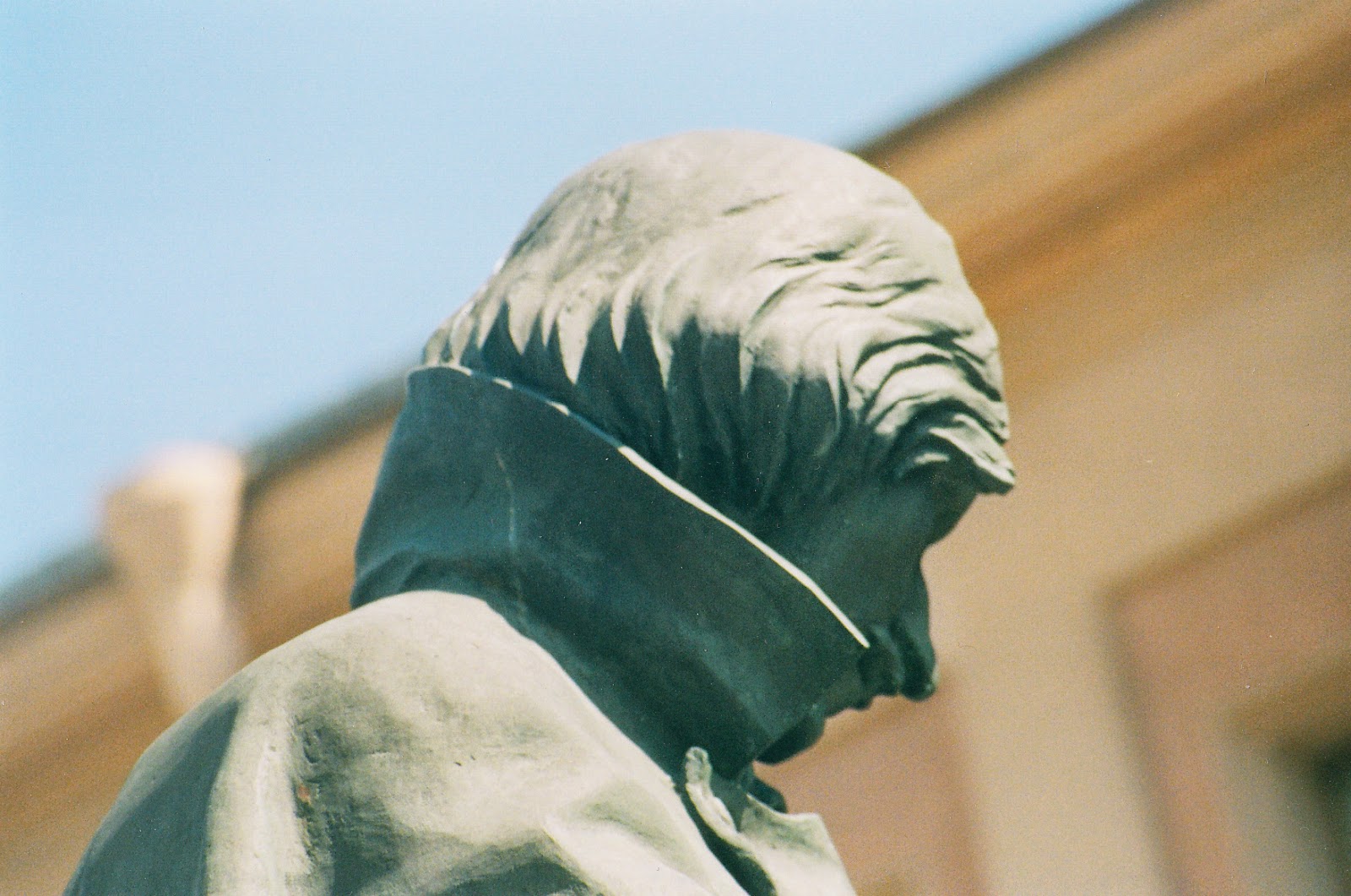
Bunin's Head Looks Askance at Life


This is a detail of the head, from the Ivan Bunin monument in Yelets, Russia, unveiled in 1995. The sculptor is Yury Grishko. In the years of his emigration Bunin once visualized such statues in his honor:

"In some city square, where, early on a summer evening, slender-legged working-class children will chase each other around that statue with idiotic shrieks, while it stands there eternally mute and unmoving" (cited in Night of Denial, p. 613).

Little did he know what ignominy is in store for the man whose image is made into a monument. The last time I was in Yelets I noticed that vandals had written unseemly things all over Bunin's head, and one leg looked to have been broken off, then reattached. You wonder how far and wide the local police had to search, before they found that plundered leg. Then again there is the monumental problem of the pigeons.

Wednesday, May 21, 2014

Gogol the "Satirist"


During the years of the Soviet Union nearly everyone was reading Gogol wrong. He was, so it was thought, the castigator of evil, the "realist" author who presented all that was bad about Russian life and forced his contemporaries to look at it.

Then again, it was not only the Soviets who interpreted Gogol as realist and satirist. During his own lifetime that was the primary interpretation of his works in Russia. Even Gogol himself, who never really understood what he was doing in his most creative fiction, accepted the view, assumed it to be true.

When I was teaching in Novgorod on a Fullbright Scholar Grant (1999-2000) the issue came up with my students, who were puzzled when I scoffed at the idea of Gogol the realist. Their teachers in high school had inculcated the old accepted view, and they fully accepted the received knowledge: Gogol is a realist and a satirist.

So it goes, and probably to this very day teachers of literature in high schools all over the country are still propagating this same old falsehood.

Gogol the realist: a man who wrote a story about a nose escaping from a government official's face; who wrote about another man who married a warm winter overcoat; whose works are populated by phantasms and pigs that are more real than anything realistic.

A satirist excoriates, fulminates in aid of some cause. The works of a satirist often drip with venom. In his greatest fictional works Gogol teaches only the lesson of highly inspired creative art. In his personal letters and his daily life, of course, he is the preacher nonpareil, promoting morality and Russian Orthodoxy to the point of fanaticism. His Selected Letters from Correspondence with Friends is written by an author who is clearly deranged. Not so his fiction. His fiction is lofty, is of the gods. In his fiction Gogol is, above all, an ironist. And a comic genius. The main hero of his best fictions is laughter, but not satirical laughter.

Who was it said it, Nabokov? "Satire is a lesson; irony is a game." And one of the greatest games played in all of human endeavor is the game of high art.

Monday, May 19, 2014

The Enigma of Gogol


Nikolai Gogol is the most enigmatic, puzzling, astonishing of all Russian writers. Of the literary figures who associated with him during his lifetime, the great majority of them (Pogodin, Zhukovsky, Pletnyov, etc.) left no written account of their association with him. Why not?

Probably because they simply did not know what to make of him. What was the man really like? Hard to say. How did this man they associated with (the finagler, manipulator, prevaricator) write the great literary works (Dead Souls, The Inspector General, "The Overcoat")? No idea.

Not so surprising, since Gogol himself, the man, had no idea where the wellspring of his talent was. He wrote astonishing literary works, then went about trying to interpret them. His ex post facto interpretations were ridiculous. The Gogol of the mind-boggling talent was a Gogol who had nothing in common with Gogol the man. Amazing.

There is probably no other writer in Russian literature whose creative, dazzlingly brilliant side is more at variance with the side that is the man walking the streets in velvet, baby blue waistcoat.