Saturday, June 4, 2022

"Growing into Grown," from Bobby Goosey's Practical Nonsense for Kids


Bobby Goosey


Growing into Grown

Are you a kid? You are? Have you got a big toe? You don’t know? Take a look at your feet; you have toes on them, and for 100% sure you have a big toe: in fact you have two. Don’t you? Yes, you do.

Have you ever thought to watch a big toe grow? Because it is growing, you know. Every minute of the day. And even in the nighttime while you sleep. It’s growing. And your ears are too. And your nose. And every little pimple on your butt. They’re all growing.

So why not sit down some time—when you have nothing else to do—and watch things grow? You can use a mirror to watch your nose. Go get a mirror.

Okay. Are you watching your nose? Are you? You are? In the mirror, right? You say you can’t see anything? You say nothing’s changing; your nose won’t grow? You tell me you don’t really believe what I’m telling you—about how your nose and toes and ears and pimples all grow?

Well, thing is they all like to grow, but they like to go/grow slow. Then again, maybe they don’t like being watched. Even you, I suspect, while you’re growing—and you are—wouldn’t want people staring at you as you grow. Now, would you?

Tell you what to do, though. Tell you how to check to make sure that your growing is going as growing should go. Before you go to bed tonight take out a ruler, a measuring stick. Measure your big toe, the one on your right foot. Or the one on your left foot, either one’s okay. Write down how many inches it is.

Now then. Do you like to suck a finger, to help you go to sleep? You do? Which one? Not the thumb? Okay, right, the index finger. So. Before you go to bed tonight—and right after you measure your big toe—measure that index finger, your sucking finger.

Then all you have to do when you wake up in the morning is: take your big toe, same one, and measure it again with the ruler. If you’re growing at the proper rate it will be a half-inch longer. Then take your sucking finger out of your mouth. Is it wet? Good. Measure it again.

Your sucking finger should be about one inch longer. It should be growing faster than your big toe. Why? It grows faster because it gets more water. Toes and fingers are like plants: they need watering. So, anyway, that’s it: that’s how to tell if your growing is going as your growing should go.

What if you discover that your big toe and your sucking finger aren’t growing that fast? Don’t worry. They’ll grow. That’s their job. If you want your big toe to grow faster dip it in water a few times a day. Or use it tonight to suck your way to sleep; give your index finger a rest.

And if none of this makes any sense to you don’t worry about it. There’s no point in worrying about growing. Or, in fact, about anything else on earth. People tend to think that things in their lives won’t work out. That’s why people worry. But the worriers have it wrong; in the end of all ends things all work out. Don’t forget that. And your growing grows all by itself. You’ll see. One day you’ll wake up all full-grown. Your nose, your ears. And your big toes too. Grown. What a relief.


Sunday, May 29, 2022

Translation of Poem by Osip Mandelstam, Осип Мандельштам, BLACK CANDLE

                                Czesława Kwoka , Polish Catholic Girl, 14; died at Auschwitz

Her dates: 15August 1928--12 March 1943


Осип Мандельштам

(1891–1938)


Твоим узким плечам под бичами краснеть,
Под бичами краснеть, на морозе гореть.

Твоим детским рукам утюги поднимать,
Утюги поднимать да веревки вязать.

Твоим нежным ногам по стеклу босиком,
По стеклу босиком да кровавым песком…

Ну, а мне за тебя черной свечкой гореть,
Черной свечкой гореть да молиться не сметь.

1934


d

Literal Translation

Your narrow shoulders are to grow red beneath the lashes,

Red beneath the lashes and to burn in the frost.


Your childish hands are to raise irons up,

Raise irons up and tie rope together.


Your tender feet are to walk on glass barefoot,

Walk on glass barefoot and on bloody sand . . .


As for me, I’m to follow behind you as a black candle burning,

As a black candle burning, and not daring to pray.


d


Literary Translation/Adaptation by U.R. Bowie


Black Candle


The whippings will redden your shoulders pathetic,

You’ll live with red shoulders and chilblains splenetic.


Your childlike thin hands will do laundry and ironing,

You’ll iron and launder, enduring fault-finding.


Your soft gentle feet will walk barefoot on glass,

Barefoot on glass and by bloodied sands pass . . .


And I’ll follow behind you, through bogs of dismay,   

With black candle burning, not daring to pray.


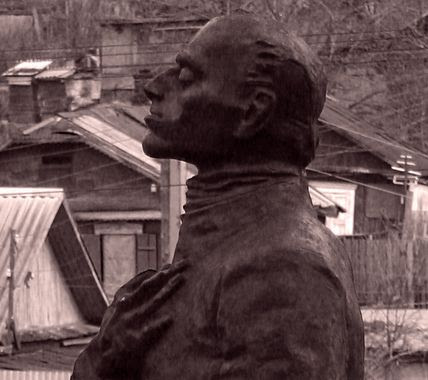
                                                       Monument to Mandelstam in Vladivostok


Wednesday, May 25, 2022

"The Sad Demise of My Pet Volcano," from Bobby Goosey’s Compendium of Perfectly Sensible Nonsense

                                                              White Island, New Zealand


Bobby Goosey


The Sad Demise of My Pet Volcano

I had a pet volcano but I let him go out. He was such a warm friend. He burned and sissed and fumed and belched up gases, and he kept my room warm in the winter. But one night, when he was burning bright, I let him go out.

He woke me up scratching at the door. He said he had to go outside and urp up some lava. Nature was calling, he said. What could I do? Who am I to gainsay Mother Nature? I should never have let him go out, but I let him go out. Now he’s extinct.

He doesn’t siss and fume and warm my room. He just sits there unsissingly. I don’t think you could even call him a pet volcano anymore. Now he’s more like a pet rock. Sad. But that’s what you get when you let your volcano go out.

[From Bobby Goosey’s Compendium of Perfectly Sensible Nonsense]

                                                              Volcano Craters, Hawaii


Monday, May 23, 2022

Translation of Poem by Osip Mandelstam, Осип Мандельштам, "Когда Психея-жизнь спускается к теням," "When Psyche, Soul of Life"

                                                         Mesquite Flat Dunes, Death Valley

Осип Мандельштам

(1891-1938)

Когда Психея-жизнь спускается к теням
В полупрозрачный лес, вослед за Персефоной,
Слепая ласточка бросается к ногам
С стигийской нежностью и веткою зеленой.


Навстречу беженке спешит толпа теней,
Товарку новую встречая причитаньем,
И руки слабые ломают перед ней
С недоумением и робким упованьем.


Кто держит зеркальце, кто баночку духов,--
Душа ведь женщина, ей нравятся безделки,
И лес безлиственный прозрачных голосов
Сухие жалобы кропят, как дождик мелкий.


И в нежной сутолке не зная, что начать,
Душа не узнает прозрачные дубравы,
Дохнет на зеркало и медлит передать
Лепешку медную с туманной переправы.


November, 1920


d

Literal Translation

When Psyche-Life descends toward the shades,

Into the translucent forest, following behind Persephone,

A blind swallow throws herself at her feet

With Stygian tenderness and a green branch.


A mob of shades rushes to greet the refugee,

Welcoming their new companion with keening,

And they wring their weak hands in front of her

In bewilderment and timid hope.


One holds a small mirror, another a bottle of perfume;

After all, the Soul is a woman and loves trinkets,

And the leafless forest of transparent voices

Sprinkles dry entreaties, like a soft rainfall.


And in the tender bustle not knowing where to begin,

The Soul does not recognize the transparent oak groves;

It breathes on the mirror and is slow to hand over

The little copper wafer from the foggy ferry crossing.


d


Literary Translation/Adaptation by U.R. Bowie (Un-rhymed, un-metered)


When Psyche, Soul of Life, a.k.a. Anima,

Descends toward the shades of Netherworld,

Into the wood translucent,

Following the pathway of Persephone,

A blind swallow swoops down before her,

At her feet genuflects,

With tenderness Stygian and

A twig spring-green in beak.


Rushing toward the refugee,

A throng of netherland shades

Wails threnodies and lamentations keens,

By way of saying Hi to their new cohort;

Bewildered, placing timid hope in her,

They cringe and wring their enervated hands.

One holds a compact mirror,

Another a flacon of fragrance;

For Psyche-Anima, you see, is a woman,

One who dearly loves her baubles and bric-a-brac;

Meanwhile, the leafless forest  

With the voices transparent

Drizzles down grievances dry,

Like a soft rainfall spitting mist.


In all this commotion and bustle of tenderness,

Not knowing where to begin,

Psyche-Soul feels estranged, disaffected

In the midst of the transparent oak groves;


She breathes on the compact,

Mists up the mirror,

Neglects to hand over

The small copper token

From the fog-hued ferry crossing

Over darkened Stygian waters

Safely landed.


Saturday, May 14, 2022

Illegal Dreams


In Dostoevsky’s novella, The Village of Stepanchikovo, the petty tyrant Foma Fomich informs a servant that he is not allowed to dream of a white bear. Every morning he questions him: “All right, what did you see in your dreams?” And every morning the poor wretch owns up, sobbing: “Forgive me, Foma Fomich, but last night I dreamed again of a white bear.”

 We old-timer Southerners in The Age of the Covid, whom do we see in our dreams? The illegal Robert E. Lee. When we were children, sweating our way through the segregated schools of the Old South, in the age before air conditioning, we were taught one firm irrefutable truth: Robert E. Lee is the greatest man who ever lived.


--You’re not allowed to dream of Robert E. Lee anymore. He’s officially illegal; we’re tearing all his statues down.

                --Fine. If you say so.

                (Two days pass)

                --Okay, dammit, tell me who you dreamed of last night.

                --Urghh. Sorry. Robert E. Lee.


Our Stone-Age Ancestors Were Smart

“There are Neolithic skulls dating from 6500 B.C. with holes that testify to trepanation, a treatment that involved drilling through the cranium, presumably to let out malign spirits.”

New Yorker, April 20, 2020

 Drill a hole in my head, let the bad vibes out. And release the illegals who still take up space in my brain: Robert E. Lee, Stonewall Jackson, Christopher Columbus.

 (sings) Oh I wish I was in the Land of Cotton, old times there are not forgotten, look away . . . urghh, sorry, I forgot that song is illegal.

[excerpted from the book by U.R. Bowie, HERE WE BE. WHERE BE WE?]


Friday, May 13, 2022

Translation of Poem by Osip Mandelstam, Осип Мандельштам, "Ласточка," BLIND SWALLOWS

                                                  Sophocles, "Antigone," Polish Theater Poster


Осип Мандельштам

(1891-1938)
                                          

Ласточка

Я слово позабыл, что я хотел сказать.
Слепая ласточка в чертог теней вернётся,
На крыльях срезанных, с прозрачными играть.
B беспамятстве ночная песнь поётся.

Не слышно птиц. Бессмертник не цветёт.
Прозрачны гривы табуна ночного.
B сухой реке пустой челнок плывёт.
Среди кузнечиков беспамятствует слово.

И медленно растёт, как бы шатёр иль храм,
То вдруг прикинется безумной Антигоной,
То мёртвой ласточкой бросается к ногам,
С стигийской нежностью и веткою зелёной.

О, если бы вернуть и зрячих пальцев стыд,
И выпуклую радость узнаванья.
Я так боюсь рыданья Аонид,
Тумана, звона и зиянья!

А смертным власть дана любить и узнавать,
Для них и звук в персты прольётся,
Но я забыл, что я хочу сказать,
И мысль бесплотная в чертог теней вернётся.

Bсё не о том прозрачная твердит,
Всё ласточка, подружка, Антигона...
И на губах, как чёрный лёд, горит
Стигийского воспоминанье звона.

1920

d

Literal Translation

The Swallow


I’ve forgotten the word that I was trying to say.

The blind swallow will return to the palace of shades,

On clipped wings, will play with transparencies.

The night song in oblivion is sung.


The birds cannot be heard. The immortelle does not bloom.

Transparent are the manes of the night herd.

In a dry river an empty bark floats.

Amidst the grasshoppers the word loses consciousness.


And slowly it grows, as if some tent or temple,

First suddenly pretending to be a mad Antigone,

Then a dead swallow that throws itself at your feet,

With Stygian tenderness and a green branch.


O, if only to return the shame even of sighted fingers,

And the bulging joy of recognition.

I so fear the sobs of the Aonides, [Muses]

And the fog, peals, gapings!


But to mortals is given the power to love and to recognize,

For them even sound will flow through fingers,

But I have forgotten what I’m trying to say,

And incorporeal thought will return to the palace of shades.


All the time the transparency repeats the wrong thing,

All the time it’s swallow, girlfriend, Antigone . . .

And on the lips, like black ice, there burns

The remembrance of the Stygian peal.


d


Literary Translation/Adaptation by U.R. Bowie (un-rhymed, un-metered)


Blind Swallows


On tip of brain-tongue had the—damn—forgot the word I had.

So flits the blind swallow back into the old manse of shades,

On wings now clipped, her swoops maligned,

To play with things transparent.

While the song of night, mind dim, benumbed, goes on trilling its ditty.


Can’t hear the birds sing anymore; the immortelle won’t bloom.

Transparent are the manes on the steeds of galloping night. 

An empty bark afloat on a river gone dry.

While word amidst the grasshoppers

Falls helplessly in swoon.  


Then slowly something grows—feel it?—like a tent going up, or a temple;

Takes turns pretending: I’m Antigone crazed, or no—

I’m a dead swallow who throws herself at your feet,

With Stygian tenderness

And a green twig in her beak.


O, if only to bring back the shame of the sighted fingers that see,

To grasp once more the bulging, tumescent joy of cognition.

I do so fear the sobs of the Aonides, my Muses,

And the haze,

And the peals, and the gapes!


But unto mortals is given the power to love and to be cognizant,

For them pure sound will flow its way through fingers,

But yea, woe, damn; I’ve forgotten what I wanted to say!

And now fleshless thought must slink its way back,

Into the old manse of shades. 


Transparency, you see, goes on and on with not getting it right,

On and on with its bleating: swallow, girlfriend, Antigone . . .

While on my lips, on the tip of the tongue

Of my black-iced brain, burns

The remembrance of that primordial

Peal of the Stygian bells.


d


Translator’s Note


Сommentary on this poem by Irina Surat, from her article in Russian about various Russian poems featuring swallows (in the journal Novy Mir, “Tri veka russkoj poezii”), available online:


http://www.nm1925.ru/Archive/Journal6_2007_4/Content/Publication6_1981/Default.aspx


Among her most interesting points: this is a poem about trying to write poetry, about the thing of words on the tip of the tongue of your mind that keep slipping away. The poet never does recapture the exact words he wanted, but, paradoxically, he writes a lovely poem, with all the right words, about how blind swallows cannot get their swoops right in his mind.


Sunday, May 8, 2022

Translation of Poem by VLADIMIR NABOKOV, "The Swallow (The Swift)" "Ласточка"


Владимир Набоков

(1899-1977)


Ласточка

Однажды мы под вечер оба
стояли на старом мосту.
Скажи мне, спросил я, до гроба
запомнишь вон ласточку ту?
И ты отвечала: еще бы!

И как мы заплакали оба,
как вскрикнула жизнь на лету…
До завтра, навеки, до гроба —
однажды, на старом мосту…


Literal Translation


The Swallow


Once toward evening the two of us

Were standing on an old bridge.

Tell me, I asked, to the grave

Will you remember that swallow there?

And you answered: Of course!


And how the two of us wept,

How life on the fly cried out . . .

Until tomorrow, for ages, to the grave—

Once on an old bridge . . .


d


Literary Translation/Adaptation by U.R. Bowie


The Swallow


One day close to gloaming’s first sigh, 

You and I on a bridge near the shore.

See that swallow, I said, that swooped by;  

In your mind till we die will she soar?

And you answered, She will; I swear!


With what fervor the both of us wept,

How the life-bird cried out on the fly!

Till we die and for eons windswept, 

On an old bridge at gloaming’s first sigh. 

d


Translation by Vladimir Nabokov

(with new bird in title role)


The Swift

One night between sunset and river

On an old bridge we stood, you and I.

Will you ever forget it, I queried,

That particular swift that went by?

And you answered, so earnestly: Never!


And what sobs made us suddenly shiver,

What a cry life emitted in flight!

Till we die, till tomorrow, for ever,

You and I on the old bridge one night.


 Nabokov reads the poem in Russian and English:

 https://www.youtube.com/watch?v=Tdn5SxFAMEg&ab_channel=JiffySpook