Showing posts with label fiction based on Russian literature. Show all posts

Tuesday, July 11, 2017

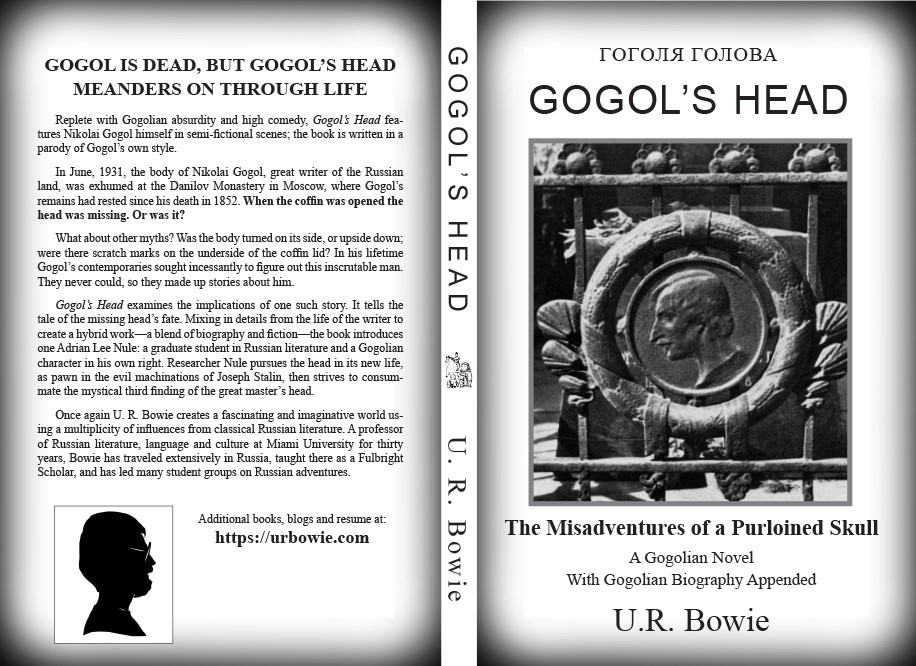
Cover art and front matter for new novel, "GOGOL'S HEAD," by U.R. Bowie


FRONT MATTER OF THE BOOK:


ГОГОЛЯ ГОЛОВА

GOGOL’S HEAD
Or
Skullduggery
Or
The Misadventures of a Purloined Skull


A Gogolian Novel
(With Gogolian Biography Appended)

U.R. Bowie
Series: The Collected Works of U.R. Bowie, Volume Eleven
Ogee Zakamora Publications, 2017


Copyright © 2017 by Robert Lee Bowie
All Rights Reserved
ISBN-13: 978-1548244149
ISBN-10: 1548244147

Front Cover Illustration:
N.A. Andreev, Medallion on Enclosure
of Nikolai Gogol’s Grave
(Danilov Monastery, Moscow, 1909)


Cover Design by Daniel Hime


                              ACKNOWLEDGEMENTS
Parts of this book have been workshopped through Gainesville Poets and Writers. Special thanks to my publicist Daniel Hime, who created the beautiful cover design. Also I am grateful to my copy editor D. C. Williams, and to my editor and publisher O.G. Zakamora. Once again Sergei Stadnik has helped me with proofreading the Cyrillic passages and refining my style in Russian. Благодарю!


                      NOTE ON CALENDARS
During the lifetime of Nikolai Gogol, Russia still operated according to the old Julian calendar, which, in the nineteenth century was twelve days behind the Gregorian calendar, then widely adopted in the countries of Western Europe. The differences can make for confusion. For example, Gogol’s friend, the poet Nikolai Yazykov, died in two different years: in December of 1846 by the Julian calendar, but in January, 1847 by the Gregorian. At the time of Lenin’s Socialist Revolution in 1917 Russia still ran on Julian dates, and, as a result, what the Soviets always referred to as “The Great October Revolution” took place in November.
Gogol, of course, spent much of his later life abroad, living by the Gregorian calendar. In the text of this book dates are given mostly by  Gregorian. In instances when the Julian calendar date is used, the initials OS (for Old Style) appear in parentheses.


For


THE READERS 
OF GOGOL


CONTENTS

In Lieu of an Introduction                                                                                                                                            
Biographical One: Freak Shows (Ukraine, 1822)                                                                  
Chapter One: The Exhumation                                                                                                                  
Biographical Two: Off to Meet Pushkin (St. Petersburg, Winter, 1829)          
Biographical Three: The Hans Fiasco, First Flight (May, 1829)                       
Chapter Two: Meet Adrian Nule                                                                                                               
Biographical Four: The Scrivener/Writer (St. Petersburg, 1829-1831) 
Chapter Three: Shoes Run Amuck                                                                                                                              
Biographical Five: Good Times (St. Petersburg, Moscow,1831-1834)  
Chapter Four: How It Began with Nule                                                                                                  Biographical Six: Performing (1835-1836)                                                                                            Chapter Five: More Skullduggery                                                                                                                               
Biographical Seven: Wandering, Borrowing Money (1836-1839)   
Chapter Six: Akaky Goes Out Partying                                                                                                      
Biographical Eight: In Search of A Living Soul (1839-1842)                                               
The Three-Handed (Moscow, February, 1842)                                                                    
Buttons (Bad Gastein, Austria, early October, 1842)                                                           
Chapter Seven: The Politburo and the Skull                                                                                          
Biographical Nine: Floundering on, Petering out (1842-1845)                         
Chapter Eight: Nule’s Head Maunders On                                                                                            
Biographical Ten: Final Flight of the Buffleheaded Goo-Goo Bird 
(1846-1852)
Dear Eyes Gone (Moscow, February, 1852)                                                                                         
Chapter Nine: An Eye for an Eye at the Hands of the Head                                             
In Lieu of a Conclusion: Masafuera                                                                                                            


If mere creative force is to be the standard of valuation, Gogol is the greatest of Russian writers. In this respect he need hardly fear comparison with Shakespeare, and can boldly stand by the side of Rabelais. Neither Pushkin nor Tolstoy possessed anything like that volcano of imaginative creativeness.
                                                               … D.S. Mirsky

Nobody can ever imagine what Gogol was really like. From beginning to end everything about him is incomprehensible. The individual features are blurred, inchoate—they refuse to add up to anything.
                                                                … Anna Akhmatova

What are you like? As a person you are secretive, egotistical, arrogant, and mistrustful, a man who sacrifices everything for fame. As a friend what are you like? But then, do you really have any friends?
                                       … Pletnyov letter to Gogol, October, 1844

Дорога, дорогадорогая дорогадорога мне дороже всего (The road, the road—the dear road—dearest of all to me is the road).
                                      … Gogol letter to Pogodin, October, 1840

The diver, the seeker for pearls, the man who prefers the monsters of the deep to the sunshades on the beach, will find in “The Overcoat” shadows linking our state of existence to those other states and modes that we dimly apprehend in our rare moments of irrational perception.

                                                           … Vladimir Nabokov


Вместо Предисловия
In Lieu of an Introduction

This is the story of a head, and the story of the man who lost his head, and the story of what happened to the lost head. We begin with background on the man. In the process of telling the story of the purloined head, we tell—in lieu of a biography—a truncated version of the life of the man. We cut through all the lies and establish the truth.
                                                                        Adrian Lee Nule, ABD
                                                                        Madison, Wisconsin,
                                                                        March 20, 2015
                                   
d


Wednesday, July 6, 2016

"GOOGLEGOGOL" 'product descripton' on Amazon


U.R. Bowie. Collection of short stories. Googlegogol: Stories from the Database of Russian Literature, Inc. [published July, 2016]

Available for purchase on Amazon:


U.R. Bowie writes in the grand tradition of Russian literature. "Googlegogol" consists of thirteen short stories, based (thematically, biographically, or stylistically) on Bulgakov, Bunin, Chekhov, Gogol, Dostoevsky, Nabokov, Tolstoy, and others. The entire production is refracted through the consciousness of that quintessential deranged master of Russian prose: Nikolai Gogol.

Some of the stories are set in Russia, others in the U.S. Some are written in purely realistic style, but the collection as a whole owes much to Russian modernism. An example of the realism is “The Death of Ivan Lvovich,” which tells the tale of the brief life of Tolstoy’s last and most beloved son, Ivan, as narrated by Ivan Bunin—winner of the Nobel Prize for literature in 1933. Bunin, who is eking out a poverty-stricken life in the south of France, while Hitler’s forces are invading Russia, looks back on the year 1895—when, as a young writer, he visited Lev Tolstoy in Moscow and found him grieving over his dead son. “Running Thoughts” is a stream-of-consciousness tale that takes the reader into the mind of Tolstoy, on the evening in 1910 when he made his decision to flee his Yasnaja Polyana estate and his intolerable life—and ended up running into the arms of Death.

Several stories describe events in the life of Fyodor Dostoevsky.  “Man Beating Man Beating Horse” relates an episode that occurred in 1837, when Dostoevsky, his father and brother were on their way to St. Petersburg, where he would enroll in the Academy for Military Engineers. “Something in the Way of a Parricide” tries to get a handle on the story of the “murder” of Dostoevsky’s father in 1839, while “Executed (Almost)” relates how Dostoevsky was put through the ordeal of a fake execution in St. Petersburg (1849).

Other stories range far from the style of traditional Russian realism.  Owing much in its themes and style to Gogol and Bulgakov, “Shoes Run Amuck” describes the misadventures of a man who—much to his subsequent chagrin—robbed the grave of Nikolai Gogol in 1931, on the day when Gogol’s body was disinterred for reburial at Novodevichy Cemetery in Moscow. “Hobnob” uses Nabokovian tropes to recreate a pale version of the great Nabacocoa and describe his proctoring of an exam in Ohio, 1952— and his interactions with the mind of one of the students taking that exam.

Several stories are written in a Chekhovian vein. “The Lady from Berdichev” is the tale of an old lady living out her life in Brighton Beach, while ever yearning back toward her birthplace of Berdichev, as Chekhov’s three sisters yearn for Moscow. In “Divertimento for Strings and Structure,” a story into which Raymond Carver pokes his nose briefly, Chekhov makes a personal appearance in the flesh (or at least in the mind of the hapless protagonist).

Other stories feature highly unusual characters or narrators. “Anteayer” is a modern tale of schizophrenia, a story of a young woman who leaves Russia for the American Dream, only to find that the only dreams she knows how to dream are Russian dreams. The lead story, “Recruiting,” describes obliquely  how Russian Literature goes about gathering its personages and images, while its companion story, “Chimeras,”—the last in the collection—is a tale of Russian nesting dolls; open one up, and whoops, there’s a new narrator or author inside, and then open that one up and whoops, there’s still someone else. “The Riddle of the Duck” is, primarily, about Russian mentalities, the way Russians can hold simultaneous contradictory notions in their minds. It features a man who may or may not be Lee Harvey Oswald, still alive on the fiftieth anniversary of Kennedy’s assassination.


A brief word about the cover art. The front cover depicts a scene from the famous fabulist Ivan Krylov, his tale (“Quartet”) of how a nasty and uppity monkey decided to organize a string quartet. The monkey recruited an ass, a goat and a bear, and they all set about sawing away on their instruments; only to discover that none of them had ever learned to play an instrument. The back cover shows three of Russia’s finest writers—Lermontov, Pushkin, and Gogol—mulling over life in general, while cogitating over the back cover copy beneath them and the way Russian literature is presented in Googlegogol.

Monday, July 4, 2016

"GOOGLEGOGOL (ГУГОЛЬГОГОЛЬ): Stories from the Data Base of Russian Literature, Inc." NEW BOOK BY U.R.BOWIE


https://www.amazon.com/Googlegogol-Stories-Database-Literature-Collected/dp/1534676961/ref=sr_1_fkmr0_1?s=books&ie=UTF8&qid=1467651672&sr=1-1-fkmr0&keywords=U.R.+Bowie%2C+%22Googlgogol%22

Series: The Collected Works of U.R. Bowie, Volume Nine
Ogee Zakamora Publications, 2016


Copyright © 2016 by Robert Lee Bowie
            All Rights Reserved

ISBN-13: 978-1534676961
ISBN-10: 1534676961


Cover image: Detail from base of statue, monument to Ivan Krylov, St. Petersburg, Russia, photograph by Alexsey Sergeev

Проказница-Мартышка,
Осел,
Козел,
Да косолапый Мишка
Затеяли сыграть квартет.


Cover design by Christy Sanford


AUTHOR’S NOTE

All the stories in this collection come, in one degree or another, out of the grand tradition of Russian literature. Some have direct connections (stylistically, thematically, or biographically) with certain prose writers: (1) “The Death of Ivan Lvovich, ” Lev Tolstoy and Ivan Bunin; (2) “Running Thoughts,” Tolstoy; (3) “Shoes Run Amuck,” Nikolai Gogol and Mikhail Bulgakov; (4) “The Lady from Berdichev” and “Divertimento for Strings and Structure,” Anton Chekhov; (5) “Hobnob,” Vladimir Nabokov; (6) “Man Beating Man Beating Horse,” “Something in the Way of a Parricide,” and “Executed (Almost),” Fyodor Dostoevsky.

As the title suggests, the entire collection has been refracted through the head of that quintessential deranged genius of Russian literature—the man about whom the critic D.S. Mirsky once wrote the following:
            “If mere creative force is to be the standard of valuation, Gogol is the greatest of Russian writers. In this respect he need hardly fear comparison with Shakespeare, and can boldly stand by the side of Rabelais. Neither Pushkin nor Tolstoy possessed anything like that volcano of imaginative creativeness.”
TABLE OF CONTENTS


Recruiting (Набор)                                                                  
           The Death of Ivan Lvovich (Смерти нету)                              
           Man Beating Man Beating Horse (Бьет Россия, бьет)
           The Lady from Berdichev (Дама из Бердичева)                  
Running Thoughts (Бегство)                                                    
           Something in the Way of a Parricide (Отцеубийство?)       
The Riddle of the Duck (Уткина загадка)                               
Shoes Run Amuck (Башмаки вдребезги)                               
Divertimento for Strings and Structure (Дивертисмент)          
           Hobnob (Междусобойчик)                                                   
           Executed (Almost) (Приглашение на почти)                        
           Anteayer (Позавчера)                                                
           Chimeras (Химеры)