Saturday, January 16, 2021

Notes on WAR AND PEACE Petya's Demise


Notes on War and Peace: Petya’s Demise

Sixteen years old, Petya Rostov is a young officer, eager for baptism in battle. “Petya, having left his family on their departure from Moscow, had joined his regiment, and soon after that he was attached as an orderly to a general in command of a large detachment. Since the time of his promotion to officer, and especially since going on active duty, where he had taken part in the Battle of Vyazma, Petya had constantly been in a state of happily excited joy that he was grown up, and in constantly rapturous haste not to miss any occasion for real heroism. He was happy with what he had seen and experienced in the army, but at the same time it seemed to him all the time that he was not present where the most real and heroic things were happening. And he hurried to get where he was not."

 A telling sentence, that last one, which in the Russian reads, “И он торопился поспеть туда, где его не было.” Literally, “And he was in a hurry to arrive on time at the place where he was not” (Vol. 4, Part 3, Ch. 7). The following chapters (Ch. 7-11) describe Petya’s path toward arriving where he would be not— i.e., in the condition of the Big Not. While sitting with the other officers at the table eating, he is described as being “in a rapturous, childlike state of tender love for all people, and consequently of certainty that other people had the same love for him.” He expresses this love in his kind treatment of a French prisoner, a drummer boy roughly the same age as him.

 Later he volunteers to go with the reckless Dolokhov on an unnecessary mission to reconnoiter the French forces. They dress in French uniforms and ride directly into the French camp, where Dolokhov converses with the French soldiers. Keep in mind that the Russian upper classes spoke French as well as they did Russian. Luckily, they escape from this episode unscathed, but the very presence of Dolokhov—who has proven no friend of the Rostov family in the past—suggests more bad vibrations for the action ahead.

 Back in the Russian camp with the attachment of Denisov, Petya cannot sleep. He has begged Denisov to let him take part in the next day’s battle, and Denisov has reluctantly agreed, after forcing Petya to promise he won’t do anything rash. That evening Petya drifts off to the accompaniment of his sword being sharpened by a Cossack. At this point Tolstoy provides Petya with a kind of threnody in a dream, set to a background of sword-sharpening.

 “Petya began to close his eyes and rock.

 Drops dripped. Quiet talk went on. Horses neighed and scuffled. Someone snored.

Ozhik, zhik, ozhik, zhik, whistled the saber being sharpened. And suddenly Petya heard a harmonious chorus of music, playing some unknown, solemnly sweet hymn. Petya was musical, like Natasha, and more so than Nikolai, but he had never studied music or thought about music, and therefore the melodies that abruptly entered his head were especially new and attractive to him. The music played more and more audibly. The melody grew, passing from one instrument to another. What is known as a fugue was going on, though Petya had not the slightest idea of what a fugue was. Each instrument, now resembling a violin, now trumpets—each instrument played its own part and, before finishing its motif, merged with another, starting out almost the same, and with a third, and with a fourth, and they all merged into one and scattered again, and merged again, now solemn and churchly, now brightly coruscating and victorious.

 ‘Ah, yes, it’s just me dreaming,’ Petya said to himself, rocking forward. ‘It’s in my ears. And maybe it’s my music. Well, play again. Go on, my music! Go to it!’ . . .

 He closed his eyes. And on all sides, as if from afar, sounds trembled, began to harmonize, scattered, merged, and again all were joined in the same sweet and solemn hymn. ‘Ah, how lovely that is! As much as I like and however I like it,’ Petya said to himself. He attempted to conduct this huge chorus of instruments.

 ‘Softer, softer now, fade away,’ And the sounds obeyed him. ‘Fuller now, merrier. More, still more joyful.’ And swelling, solemn sounds rose from an unknown depth. ‘Now, voices, join in!’ Petya ordered. And voices, first men’s, then women’s, came from far away. The voices grew, grew in a measured, solemn effort. Petya felt frightened and joyful as he hearkened to their uncommon beauty.

 The song merged with the solemn, victorious march, and drops dripped, and bzhik, zhik, zhik . . . whistled the saber, and again the horses scuffled and neighed, not disrupting the chorus, but entering into it.”


So it is that Petya conducts the music that is something like his own imminent funeral march, for on the following day he rides recklessly into battle, forgetting his promises to Denisov, and is struck by a stray bullet.

 “‘Hurrah,’ shouted Petya, and, not losing a moment, he galloped toward the place from which the shots were coming and where the powder smoke was thickest. A volley of shots rang out, stray bullets whined and splatted into something. The Cossacks and Dolokhov galloped after Petya through the gates of the house. In the dense, undulating smoke some of the French dropped their weapons and ran out of the bushes towards the Cossacks, other ran down the hill to the pond. Petya galloped on his horse across the manor courtyard, and, instead of holding the reins, waved both arms somehow strangely and quickly, and kept slipping further and further to one side in his saddle. Running up onto the campfire smoldering in the morning light, the horse balked, and Petya fell heavily onto the wet ground. The Cossacks saw how his arms and legs jerked rapidly, though his head did not move. His head had been pierced by a bullet” (Vol. 4, Part 3, Ch. 7-11).


Saturday, January 9, 2021

Translation of Poem by A.K. Tolstoy, "Баллада о камергере Деларю," "The Ballad of Chamberlain Delarue"

Painting of A.K. Tolstoy, by Ilya Repin


Aleksei Konstantinovich Tolstoy

(1817-1875)


Баллада о камергере Деларю

Вонзил кинжал убийца нечестивый

                В грудь Деларю.

Тот шляпу сняв, сказал ему учтиво:

                «Благодарю».


Тут в левый бок ему кинжал ужасный

                Злодей вогнал,

А Деларю сказал: «Какой прекрасный

                У вас кинжал!»


Тогда злодей, к нему зашедши справа,

                Его пронзил,

А Деларю с улыбкой лукавой

                Лишь погрозил.


Истыкал тут злодей ему, пронзая,

                Все телеса,

А Деларю: «Прошу на чашку чая

                К нам в три часа».


Злодей пал ниц, слез проливши много,

                Дрожал как лист,

А Деларю: «Ах, встаньте ради Бога!

                Здесь пол нечист».


Но все у ног его в сердечной муке

                Злодей рыдал,

А Деларю сказал, расставя руки:

                «Не ожидал!


Возможно-ль? Как? Рыдать с такою силой?

                По пустякам?

Я вам аренду выхлопочу, милый,

Аренду вам!


Через плечо дадут вам Станислава

                Другим в пример.

Я дать совет властям имею право:

                Я камергер.

Хотите дочь мою просватать, Дуню?

                А я за то

Кредитными билетами отслюню

                Вам тысяч сто;


А вот пока вам мой портрет на память,

                Приязни в знак.

Я не успел его еще обрамить,

                Примите так!»


Тут едок стал и даже горче перца

                Злодея вид.

Добра на зло испорченное сердце –

                Ах! – не простит.


Высокий дух посредственность тревожит,

                Тьме страшен свет.

Портрет еще простить убийца может,

                Аренду-ж – нет.


Зажглась в злодее зависти отрава

                Так горячо,

Что, лишь надел мерзавец Станислава

                Через плечо, 


Он окунул со злобою безбожной

                Кинжал свой в яд

И, к Деларю подкравшишь осторожно,

                Хвать друга в зад!


Тот на пол лег, не в силах в страшных болях

                На кресло сесть.

Меж тем злодей, отняв на антресолях

                У Дуни честь,


Бежал в Тамбов, гле был, как губернатор,

                Весьма любим.

Потом в Москве, как ревностный сенатор,

                Был всеми чтим.


Потом он членом сделался совета

                В короткий срок . . .

Какой пример для нас являет это,

                Какой урок!


d


Literal Translation


The Ballad of Chamberlain Delarue


The impious murderer plunged his dagger

                Into the chest of Delarue.

Doffing his hat, the latter said to him politely,

                “Thank you.”


At this the villain thrust his horrible dagger

                Into his left side,

But Delarue said, “What a fine

                Dagger you have there!”


Then the villain, coming at him from the right,

                Pierced him through,

But Delarue, with a sly grin,

                Just wagged a finger at him.


At this the villain stabbed him here and there,

                All over his body,

And Delarue said: “You’re invited to

                A cup of tea with us at three.”


The rogue fell prostrate, shedding many tears,

                He trembled like a leaf.

Said Delarue: “Oh, do get up, for heaven’s sake!

                The floor is dirty here.”


But still the villain sobbed in anguish

                At his feet,

And, spreading wide his hands, Delarue exclaimed,

                “This I did not expect of you!


“What! Is it possible? To weep with such force

                Over mere trifles?”

I’ll get you a raise in salary, dear boy,

                Arrange a raise for you!”


You’ll have the Order of St. Stanislaus hung over your shoulder,

                Setting an example for others.

I have the right to give advice to the authorities,

                For I’m a chamberlain.


Would you like to seek the hand of my daughter, Dunya, in marriage?

                If you should so wish,

I’ll fix you up with the cash you’ll need,

                Say, a hundred thousand in banknotes;


Meanwhile, please accept my portrait in memory of me,

                A token of our friendship.

I’ve not yet found time to frame it;

                Please take it as it is!”


With this the bad guy got up, and the look

                On his face was more bitter than pepper.

A heart depraved—alas!—cannot forgive

                Good in return for evil.


Mediocrity is troubled by loftiness of spirit,

                Darkness fears the light.

The killer, perhaps, might forgive the proffered portrait,

                But the offer of a raise, no way.


The venom of envy flared up in the villain

                With such heat,

That, no sooner had he hung the Order of St. Stanislaus

Over his shoulder,


Than he dipped with impious rancor

                His dagger in poison,

And, sneaking up to Delarue,

                Stabbed him in the backside!


In terrible pain, the latter lay down on the floor,

                Unable to sit in his armchair.

Meanwhile, the villain violated Dunya’s chastity

                On the entresol,


And fled to Tambov, where, serving as governor,

                He was greatly loved.

Later, in Moscow, as a diligent senator,

                He was esteemed by all.


After which, in short order, he became

                A member of the State Council . . .

What an example he set for all of us,

                What a lesson!


d


Literary Translation/Adaptation by U.R. Bowie


The Ballad of Chamberlain Delarue


The cutthroat plunged his dagger dire

                Deep in the breast of Delarue.

The latter doffed his hat, said, “Sire,

                Most humbly do I thank you.”


At this the villain drove the dagger

                Into his frail left side.

Calm Delarue declared with swagger,

                “Your blade’s honed sharp, I must confide.”


Then, coming at him from the right,

                The rogue sliced into a rib.

Sly Delarue just smiled at the sight,

Remained urbane and glib.


The ne’er-do-well began to stab

                At bodily flesh with a one-two-three.

Delarue said, “Have tea with us, and a cake of crab?

Come round at three for a cup of tea.”


Awash in tears, the rogue fell flat,

He quailed with rancor and spleen.  

Quoth Delarue,“For mercy’s sake, please do get up;

                The floor is none too clean”


But still sobbed on the cad in his rue,

                Lay prostrate on the floor.

 Spread wide his hands kind Delarue,

“Such behavior I’m prone to deplore!


“How can this be, these heartfelt sobs,

                And all over matters so trivial?

Cheer up, my boy, I’ll help you find jobs,

                I’ll get you a raise most convivial.


We’ll give you the Order of St. Stanislaus,  

                No, don’t even think to disdain it.

You’ll wear it most proudly, its merits espouse,

                I have pull in court; I’ll arrange it.


My daughter named Dunya is eager to wed;

                Why not seek her hand? She’s a prize.

If you’re short of cash for the nuptials and bed,

                I’ll stake you the moolah; the limit’s the skies.


For now, please accept this fond likeness of me,

                I’ve not found the time yet to frame it;

In token of our bond, which links you and me,

                Need anything else? Well just name it.”


The ne’er-do-well got back up on his feet,

                And the look on his face was ferocious.

For a heart full of spite must make mushy mincemeat

Of good rendered in turn for atrocious.


The lofty in spirit makes commonplace quake,

                For darkness and foul fears the light;

Our cad forgave him the portrait, the crab cake,

                But the job offer—no way, right?


Infused was the villain with envy and spite,

                Which flared up in his breast.

He paused to put right, on his shoulder bedight,

The Stanislaus order, with heraldic crest,


Then, beaming with malice and impious air,

                His dagger envenomed with hebenon vile,

He tiptoed, sneaked up on our Rue’s savoir faire,

                And zapped him in heinie and piles! 


In hideous pain on the floor writhed poor Rue,

                Unable the ache to allay.

The villain, meantime, on the couch, out of view,

                With Dunya the chaste had his way,


And fled for far-distant Tambov in a trice,

                Where he became mayor, beloved of all,

Then later, in Moscow, quintessence of nice,

                He served in the Senate, there all did enthrall.


Guess what happened next? Right. He soon

                In State Council did honors accrue . . .

He set a high bar, did this erstwhile poltroon;

                Let his life be a lesson for you!


                                       A Note on How I Translate Russian Poetry

This method applies not only to the poem by A.K. Tolstoy, translated above, but also to all the other Russian poetry that I have translated on this blog. 

The first translation above is literal, a pony, which makes no attempt at literary effect. It tries to capture, to the extent that this is possible, the exact meaning of the original Russian words in English. Of course, totally literal translation is not possible, since words in one language often have no exact equivalents in a different language.

The second translation, which I call a "literary translation/adaptation," is an attempt to create a real poem in the target language, English, while taking some liberties with the original text in Russian. The adaptation, in a sense, is truer to the original poem than the literal translation, since it strives to keep the gist/idea of the original and strives, like the original (which is rhymed and metered), to be a real poem.

U.R. Bowie


                                     A.K. Tolstoy as a Young Man, Painting by Karl Brullov


Monday, December 28, 2020

Notes on WAR AND PEACE Eyes and Lips


Eyes and Lips in War and Peace

Tolstoy often uses descriptions of gestures or bodily features to cement his characterizations or move the plot along. When Prince Andrei Bolkonsky returns to the family estate after he and the Russian army have retreated from Smolensk—in Vol. 3, Part 1, Ch. 8—the relatives he encounters after a long absence are all described. His sister Princess Marya “was the same timid, plain, aging maiden, fearful and suffering perpetual moral crises, living out the best years of her life uselessly and joylessly.” No mention here of her “radiant, glistening eyes,” a description that often accompanies her.

 Young Prince Nikolushka is described as having grown and changed. He has dark curly hair, and “unaware of this himself, when laughing and having fun, he would raise his attractive upper lip in exactly the same way as had his late mother, the little princess.” Dead in childbirth by this point in the novel, the little princess, we recall, is almost constantly accompanied by that gesture of lip raising when she smiles.

 Later on in Volume 3 (Part 2, Ch. 13), Tolstoy needs to show the haggard Princess Marya at her best, in the scenes where Nicholas Rostov first meets her (they will later become man and wife). At this point she is in dire straits, since her father, the old prince, has just died, the French are advancing upon the Bolkonsky estate, and her own peasants are preventing her from leaving. But when Rostov walks into the room, “she cast her deep and radiant gaze upon him and began speaking in a breaking voice that quavered with emotion.” There we have it: despite her plain looks, Princess Marya’s radiant eyes, along with the helplessness of her position—which affords Nicholas Rostov the opportunity to play the role of knight/savior of the damsel in distress—carries the day, and Nicholas is won over.


Monday, December 14, 2020

Notes on WAR AND PEACE Tolstoy as Humorist


Notes on War and Peace: Tolstoy the Humorist

As Russian writers go, Tolstoy does not stand out for his humor. Not, at least, in comparison to Gogol or Bulgakov. Even Dostoevsky relies more on humor in his works than Tolstoy does—though Dostoevsky’s humor is dark and warped. But when Tolstoy wants to write funny passages he is well capable of doing so.

 Probably the best example of humor in War and Peace comes in Vol. 3, Part 3, Ch. 6-7, featuring the most dissolute character in the whole novel, Hélène, wife of Pierre Bezukhov. Here we have Hélène, still married to Pierre but conducting simultaneous affairs with an old dignitary and a young foreign prince, and mulling over which of these men to marry. She decides to turn Catholic, somehow convincing herself that by switching religions she will be able to discard an unwanted husband and acquire a new one. Here’s the beginning of Chapter Seven:

 “Hélène realized that the case was very simple and easy from the spiritual point of view, but that her spiritual handlers [the ones who had turned her to Catholicism] were creating difficulties only because they feared how the secular authorities would view this business.

 “Consequently, Hélène decided that the matter had to be prepared for in social circles. She provoked the jealously of the old dignitary, telling him the same thing she had told the first suitor [the foreign prince], that is, she made it clear that the only way of obtaining rights to her consisted in marrying her. For a moment the old grandee was just as astounded by that proposal to marry while married to a living husband as the first young suitor had been; but Hélène’s unshakable conviction that this was as simple and natural as would be the marriage of a young maiden ended up convincing him.

 “If Hélène had manifested even the faintest signs of hesitation, shame, or secretiveness, her case would have been certainly lost; but not only were there no signs of secretiveness or shame; on the contrary, with simple and good-natured naivety she informed her close friends (and that meant all of Petersburg) that both the prince and the grandee had proposed to her, and that she loved them both and feared upsetting either of them.

 “The rumor spread instantly throughout Petersburg, not that Hélène wanted to divorce her husband—had such a rumor spread, a great many people would have declared their objection to such an unlawful intention—but simply that the unfortunate, but ever interesting Hélène was in a quandary over which of two men to marry. The matter now consisted not in the degree to which this was possible, but only in which match was more advantageous and how the court would view it . . . .

 “Only Marya Dmitrievna Akhrosimova, who was in Petersburg that summer to visit one of her sons, allowed herself to express her frank opinion, which ran counter to that of society. Meeting Hélène at a ball, Marya Dmitrievna stopped her in the middle of the ballroom and, amidst a general silence, said to her in a gruff voice:

 ‘So now you’re out to get yourself married while married already to a living husband. Maybe you think you’ve come up with something novel, do you? But no, dearie, it’s been done before. Somebody came up with this a long time ago. This is what they do in any ……. [bordello].’”


Later the comedy is compounded. Hélène sends her husband Pierre a loving letter, informing him of her plans to marry. Pierre reads the letter only upon his return—disillusioned and enervated—from the battlefield at Borodino. Disjointed thoughts race through his head: “Them—the soldiers on the battery, Prince André killed . . . the old man . . . Simplicity means submission to God’s will. We must suffer . . . the meaning of it all . . . got to harness the carriage . . . my wife is getting married . . . one must forget and understand . . .” (Vol. 3, Part 3, Ch. 11).


Friday, December 4, 2020

Notes on WAR AND PEACE Air Warfare Against Napoleon

                                                            Early Hot Air Balloon Designs


Air Warfare Against Napoleon

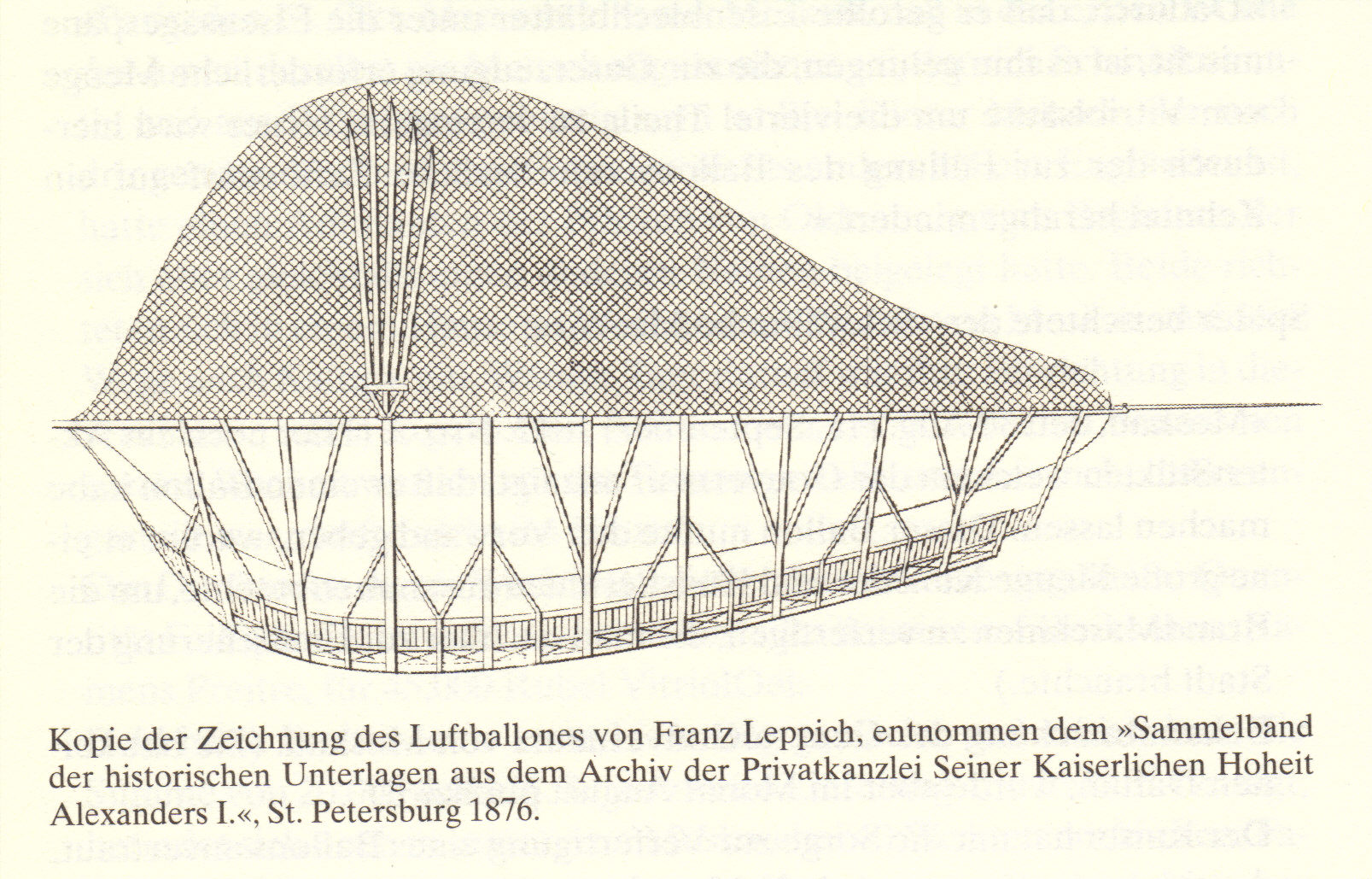
In War and Peace (Vol. 3, Part 2, Ch. 18) Pierre Bezukhov drives out of Moscow, to the village of Vorontsovo, to have a look at a novel weapon in development. This is the big hot-air balloon designed by Franz Leppich, a Dutch peasant, also known by his alias, Schmidt. Leppich had originally approached Napoleon with his project in 1811, but was rejected and exiled from France. The gondola of the balloon had a twenty-meter wooden platform with gun mounts and compartments for bombs. Locomotion for this primitive blimp was to be provided by forty rowers with giant paddles, who would row the balloon through the air (?).


Tsar Aleksandr I apparently saw great promise in the Leppich balloon. A letter in French is quoted, in which he writes as follows: “As soon as Leppich is ready, put together a cockpit crew of trustworthy and intelligent men and send a courier to General Kutuzov to inform him of this. I have told him of the project. I implore you, urge Leppich to be very careful where he lands for the first time, so as not to miscalculate and fall into the hands of the enemy. It is imperative that he coordinate his movements with the general-in-chief.”


Leppich took forever to get his balloon ready, all the time asking for more money from state coffers. In November of 1812, he declared his project complete and ready for testing, but the test failed, and the balloon never got off the ground. After making this brief appearance in the annals of history, Franz Leppich was never heard from again.


                                                            The Leppich Balloon


Friday, November 20, 2020

Notes on WAR AND PEACE Tolstoy and the Deep State


The Deep State

“A recent survey of 26,000 people in twenty-five countries asked respondents whether they believe there is ‘a single group of people who secretly control events and rule the world together.’ Thirty-seven percent of Americans replied that this is definitely or probably true. So did 45 percent of Italians, 55 percent of Spaniards, and 78 percent of Nigerians.”

Yuval Noah Harari in New York Times, November 20, 2020


“Global cabal theories suffer from the same basic flaw: they assume that history is simple. The key premise is that it is relatively easy to manipulate the world. A small group of people can understand, predict and control everything, from wars to technological revolutions to pandemics.”

Ibid


One of our distinguishing traits as Americans (or as people?) is that we don’t like to think—we’re too lazy and ignorant—and we distrust thinkers. That’s why we go for simplistic ideas. What’s this new 5G technology everybody’s talking about? I don’t know; I’m too dumb. No doubt, though, it has something to do with the nefarious plot of the Global Cabal, those Jews and Masons and such who run the world and all its institutions.


What about the Covid pandemic? Easy. More plotting on the part of the Global Cabal. They cooked up the virus, with the help of China; then they spread it all over the world.


Why is Bozo the Clown such a great President? Because—even though he’s an idiot and an unhinged narcissist—he has fought tooth and nail to save us from the Global Cabal. And I like him because he never reads books; he’s a dumbass, just like me. But we both, me and him, despite our ignorance, know a whole lot more about how the Deep State works—the REAL facts about world politics—than the la-tee-dah profs do. Them guys with bald heads and ponytails caint even park their bicycles straight.


How did Bozo lose the election? He didn’t really; he won. But the nefarious, scheming fat cats in the Global Cabal—or the Deep State; call it what you will—stole it away from him.


Tolstoy and the Deep State: War and Peace

Throughout his long novel Tolstoy repeats the same message about world history over and over; it is the message of Yuval Noah Harari in his recent article: history is vastly complex. No one great man (Napoleon), or no secret cabal of Jews and Masons, can control the inchoate forces of history. Why did Napoleon invade Russia in 1812? Nobody knows, least of all Napoleon or some Global Cabal. How did he get himself bogged down in Russia and end up losing most of the French army? Because the Russian generals were such great strategists? Ha. Because Tsar Aleksandr I had a wonderful plan? Ha. Because Napoleon’s own strategic gifts finally failed him? No. Because just because. The concatenation of circumstances and events is too complicated for anyone ever to grasp.


Tuesday, November 10, 2020

Notes on WAR AND PEACE Napoleon, Bathed in Self-Love, Pulling on Ears


Napoleon, Ever Bathed in Self-Love, Pulling on Ears

Napoleon Bonaparte, who makes several appearances in War and Peace, is always portrayed negatively and ironically. Emphasis is placed on his short stature, his plump hands and little jutting belly. Above all, he is shown as lost in delusionary admiration of self. Here he is, in 1812—about to launch the move that will destroy him, an invasion of Russia—putting on a performance for General Balashev, who has delivered a message to him from the Russian emperor Aleksandr I.

 “‘What I can’t understand,’ he said, ‘is that the emperor Alexander made all these personal enemies of mine his intimates. That I don’t . . . understand. Didn’t he reflect that I might do the same?’ He turned to Balashev with this question, and the recollection evidently pushed him back onto the track of his morning’s wrath, which was still fresh in him.

    ‘And let him know that I will do it,’ said Napoleon, getting up and shoving his cup away with his hand. ‘I’ll kick all his relatives out of Germany, all these Württembergs, Badens, Weimars . . . Yes, I’ll kick them out. Let him prepare a refuge for them in Russia!’    

    Balashev inclined his head, showing by his look that he would have liked to bow out, and was listening only because he could not help listening to what was said to him. Napoleon did not notice that expression; he addressed Balashev not as his enemy’s envoy, but as a man who was now entirely devoted to him, and was supposed to take joy in his former master’s humiliation.    

    ‘And why has the emperor Alexander taken charge of the army? What for? War is my trade, and his business is to rule, not to command troops. Why has he taken such responsibility upon himself?’

    Napoleon took out his snuffbox again, silently paced the room several times, and suddenly went up to Balashev unexpectedly, and with a slight smile, as confidently, quickly, and simply as if he were doing something not only important but pleasant to Balashev, raised his hand to the face of the forty-year-old Russian general and, taking him by the ear, tugged at it slightly, smiling with his lips only.

    Avoir l’oreille tirée par l’Empereur [to have your ear pulled by the Emperor] was considered the greatest honor and favor at the French court.    

    Eh bien, vous ne dites rien, admirateur et courtisan de l’Empereur Alexandre?’ [So then, you have nothing to say, admirer and courtier of the Emperor Alexander?] he said, as if it was ridiculous in his presence to be anyone else’s courtisan and admirateur than his, Napoleon’s.”

Vol. Three, Part One, Ch. Seven