Showing posts with label Осип Мандельштам. Show all posts

Saturday, July 27, 2024

Translation of Poem by Osip Mandelstam, Осип Мандельштам, "Пусть в душной комнате," SICK ROOM


Осип Мандельштам
(1891-1938)
 
Пусть в душной комнате, где клочья серой ваты
И склянки с кислотой, часы хрипят и бьют, —
Гигантские шаги, с которых петли сняты, —
В туманной памяти виденья оживут.
 
И лихорадочный больной, тоской распятый,
Худыми пальцами свивая тонкий жгут,
Сжимает свой платок, как талисман крылатый,
И с отвращением глядит на круг минут...
 
То было в сентябре, вертелись флюгера,
И ставни хлопали, — но буйная игра
Гигантов и детей пророческой казалась,
И тело нежное то плавно подымалось,
То грузно падало: средь пестрого двора
Живая карусель, без музыки, вращалась...
 
1912 or 1913
 
d
 
Literary Translation/Adaptation by U.R. Bowie
 
                   Sick Room
 
Let’s say we’re in a stuffy room,
with dust-clumps cotton-wadding gray
and medicinal phials acidily reeking,   
where wall clocks wheeze before they strike—
 
take giant time-steps, with hitches
in the stride removed—
and visions in the haze alight
on memories flare-bright.
 
And crucified by yearning, burning,
in fever dreams some someone bedfast,
with fingers slender, time-worn, leathered,
twists fabric into tight-taut plait;
 
she clutches at her handkerchief
as if it were a talisman soft-feathered, 
while peering at time’s circling path
of muscae volitantes, aghast.
 
September it was when this was, 
the weathercocks were spinning, crowing,
shutters flapped and banged;
but the perfervid game
 
of the children and giants
prophetic somehow seemed,
and her soft and tender body’s breath
would heave a bit, then fall again:
 
Amidst the courtyard motley-hued
a carousel, real merry-go-round,
was spinning, revolving, whirling around
its prancing steeds and silent sound.


Friday, June 7, 2024

Translation of Poem by Osip Mandelstam, Осип Мандельштам, THE STALIN EPIGRAM

                                                                 Stalin Mugshot, 1911


Father of the Soviet People, 1936

Осип Мандельштам
(1891-1938)


Мы живем, под собою не чуя страны,
Наши речи за
 десять шагов не слышны,
А
 где хватит на полразговорца,
Там припомнят кремлёвского горца.

Его толстые пальцы, как черви, жирны,
А
 слова, как пудовые гири, верны,
Тараканьи смеются усища,
И
 сияют его голенища.


А вокруг него сброд тонкошеих вождей,
Он
 играет услугами полулюдей.
Кто свистит, кто мяучит, кто хнычет,
Он
 один лишь бабачит и тычет,


Как подкову, кует за указом указ —
Кому в
 пах, кому в лоб, кому в бровь, кому в глаз.
Что ни
 казнь у него — то малина
И
 широкая грудь осетина.

 1933 г.


d

Literary Translation/Adaptation by U.R. Bowie


Soso


Underfoot all’s a-tremble, for our country’s gone blurred, 

Ten steps from us none of our words can be heard;

When we find enough speech to converse, a half schmeer,

We mention the Kremlin’s renowned mountaineer.


His fingers are fat, and like worms, squirmy-greasy,

And his words are like true-blue barbells from Tbilisi;

His handlebar cockroach-style moustaches laughing,

And his boot tops are gleaming and ever so dashing.


Around him swirl bureaucrats, vermin thin-necked,

He plays with this half-human sycophant sect.

One whistles, one meows, one whimpers, one kids,

He alone clonks on noggins and jabs hard at ribs.


One decree, then another, he forges like horseshoes—

A groin-kick, eye-poke for you, yours and youse—

Lopping off heads is just part of the deal

For this broad-chested guy made of Ossetian steel.  


d


Translator’s Note

 The “Stalin Epigram,” one of the most famous/notorious poems of twentieth-century Russian literature, was written in November of 1933. The poem of course could not be published, but Mandelstam read it to some twelve persons—at least one of whom denounced him to the authorities. When he read it to Boris Pasternak, his fellow poet responded as follows: “То, что вы мне прочли, не имеет никакого отношения к литературе, поэзии. Это не литературный факт, но акт самоубийства, который я не одобряю и в котором не хочу принимать участия. Вы мне ничего не читали, я ничего не слышал, и прошу вас не читать их никому другому. Translation: What you’ve just read to me has nothing to do with literature or poetry. This is not a literary artifact, but an act of suicide, which I do not approve of and do not want to participate in. You read me nothing, I heard nothing, and I beg you not to read it to anyone else.”

The only surprising thing is that Mandelstam was not arrested and executed as soon as the poem came to light. But Stalin himself—who had a dark sense of humor—was rumored to have liked it. He allowed the poet to go on living, in various places of exile, until 1938, when he was arrested and died in a transit camp in Vladivostok, on his way to the Gulag.


Words Used and What They Allude To (most info here is from Wikipedia)

Soso: the poem is not titled in the original; I have given it this title in my translation. Soso was Stalin’s nickname in his Georgian childhood. He originally was Ioseb [Joseph] (“Soso”) Jughashvilli (sometimes spelled Dzhugashvilli). Stalin (“Man of Steel”) is a nom de guerre, like Lenin, a revolutionary name.

First stanza: The mountaineer (горец) alludes to Stalin’s origins in Georgia and the Caucasus Mountains.

Second stanza: “His fingers are fat . . .” In her reminiscences Nadezhda Mandelstam describes how the poet Demyan Bednyj “was careless enough to write in his diary that he did not like lending books to Stalin, because the latter left on the white pages smudges from his greasy fingers.”

Tbilisi: capital of Georgia, Stalin’s homeland, now the independent Georgian Republic. The word is not in the original, but presented itself as the perfect rhyme for greasy in my translation.

Third stanza: “clonks on noggins . . .” Reminiscences of Stalin emphasize how he liked to play around with his confederates, leaders of the Politburo. In meetings at his dacha he made them dance with one another. He enjoyed humiliating them, bonking them on the head, pulling them by an ear, or poking them in the ribs.

Fourth stanza: in this poem the word raspberries (малина) has nothing to do with raspberries. I’ve looked at the some dozen translations of this poem into English on the website ruverses.com, and it appears that not a single translator figured this out. Most of them just ignore the word, not knowing what the hell it’s doing there; a few make lame attempts to get some raspberries into the translation.

Малина in the jargon of the criminal underworld means a scheme or endeavor (“the job”—a caper, theft, robbery, or other criminal plan or act). E.g., “Он испортил всю малину” (literally, “He spoiled all the raspberries”) means “He put the quietus on the whole deal.” See Kratkij slovar’ sovremennogo russkogo zhargona (A Brief Lexicon of Modern Russian Jargon), compiled by M.M. and B.P. Krestinsky (Posev: 1965), p. 16. The next to last line in the poem means roughly that executions are part and parcel of Stalin’s criminal machinations. Using a slang word current among criminals could be an allusion to his revolutionary youth when he was known as Koba. Among other felonious activities, he participated in kidnappings for ransom, protection rackets, and robbing banks.

More on malina--note in a e-mail from Andrei Filippov, which I add below, with thanks to him: 

Только что прочитал ваш перевод стихотворения О. Мандельштама с примечаниями. Позвольте небольшое уточнение. На фене, русском блатном жаргоне, слово "малина", насколько мне известно, означает место проживания или сбора группы, место хранения добычи и место проведения свободного времени. Это может быть дом, квартира, ресторан и т. д. То есть это географическая точка, а не сама группа. Я могу ошибаться, но за свои 60 с лишним лет я не встречал другого определения.

The gist in English: "as far as I know the word "malina" signifies the place where a criminal gang, lives, hangs out or keeps its booty. That can be a house, apartment, restaurant, etc. In other words, it's a geographical place, and the word does not refer to the gang itself. I may be mistaken, but . . . I've never heard another definition of the word.

Ossetian: Stalin was a Georgian, not an Ossetian, but his hometown of Gori was located near Southern Ossetia.

d

In the original variant of the poem the first stanza went like this:

Мы живём, под собою не чуя страны,
Наши речи за десять шагов не слышны,
Только слышно кремлёвского горца —
Душегубца и мужикоборца.

Literal translation:

We live, not sensing the country beneath us,

What we say is not heard ten steps away from us,

Only audible [are the words of] the Kremlin mountaineer:

A murderer and oppressor of peasants.


Sunday, May 29, 2022

Translation of Poem by Osip Mandelstam, Осип Мандельштам, BLACK CANDLE

                                Czesława Kwoka , Polish Catholic Girl, 14; died at Auschwitz

Her dates: 15August 1928--12 March 1943


Осип Мандельштам

(1891–1938)


Твоим узким плечам под бичами краснеть,
Под бичами краснеть, на морозе гореть.

Твоим детским рукам утюги поднимать,
Утюги поднимать да веревки вязать.

Твоим нежным ногам по стеклу босиком,
По стеклу босиком да кровавым песком…

Ну, а мне за тебя черной свечкой гореть,
Черной свечкой гореть да молиться не сметь.

1934


d

Literal Translation

Your narrow shoulders are to grow red beneath the lashes,

Red beneath the lashes and to burn in the frost.


Your childish hands are to raise irons up,

Raise irons up and tie rope together.


Your tender feet are to walk on glass barefoot,

Walk on glass barefoot and on bloody sand . . .


As for me, I’m to follow behind you as a black candle burning,

As a black candle burning, and not daring to pray.


d


Literary Translation/Adaptation by U.R. Bowie


Black Candle


The whippings will redden your shoulders pathetic,

You’ll live with red shoulders and chilblains splenetic.


Your childlike thin hands will do laundry and ironing,

You’ll iron and launder, enduring fault-finding.


Your soft gentle feet will walk barefoot on glass,

Barefoot on glass and by bloodied sands pass . . .


And I’ll follow behind you, through bogs of dismay,   

With black candle burning, not daring to pray.


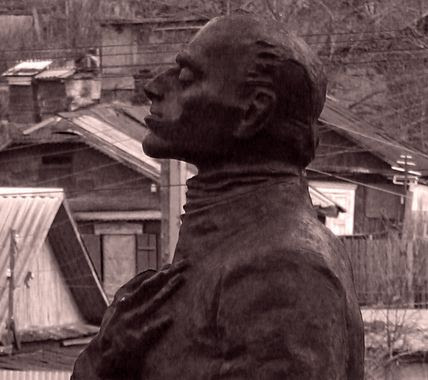
                                                       Monument to Mandelstam in Vladivostok


Monday, May 23, 2022

Translation of Poem by Osip Mandelstam, Осип Мандельштам, "Когда Психея-жизнь спускается к теням," "When Psyche, Soul of Life"

                                                         Mesquite Flat Dunes, Death Valley

Осип Мандельштам

(1891-1938)

Когда Психея-жизнь спускается к теням
В полупрозрачный лес, вослед за Персефоной,
Слепая ласточка бросается к ногам
С стигийской нежностью и веткою зеленой.


Навстречу беженке спешит толпа теней,
Товарку новую встречая причитаньем,
И руки слабые ломают перед ней
С недоумением и робким упованьем.


Кто держит зеркальце, кто баночку духов,--
Душа ведь женщина, ей нравятся безделки,
И лес безлиственный прозрачных голосов
Сухие жалобы кропят, как дождик мелкий.


И в нежной сутолке не зная, что начать,
Душа не узнает прозрачные дубравы,
Дохнет на зеркало и медлит передать
Лепешку медную с туманной переправы.


November, 1920


d

Literal Translation

When Psyche-Life descends toward the shades,

Into the translucent forest, following behind Persephone,

A blind swallow throws herself at her feet

With Stygian tenderness and a green branch.


A mob of shades rushes to greet the refugee,

Welcoming their new companion with keening,

And they wring their weak hands in front of her

In bewilderment and timid hope.


One holds a small mirror, another a bottle of perfume;

After all, the Soul is a woman and loves trinkets,

And the leafless forest of transparent voices

Sprinkles dry entreaties, like a soft rainfall.


And in the tender bustle not knowing where to begin,

The Soul does not recognize the transparent oak groves;

It breathes on the mirror and is slow to hand over

The little copper wafer from the foggy ferry crossing.


d


Literary Translation/Adaptation by U.R. Bowie (Un-rhymed, un-metered)


When Psyche, Soul of Life, a.k.a. Anima,

Descends toward the shades of Netherworld,

Into the wood translucent,

Following the pathway of Persephone,

A blind swallow swoops down before her,

At her feet genuflects,

With tenderness Stygian and

A twig spring-green in beak.


Rushing toward the refugee,

A throng of netherland shades

Wails threnodies and lamentations keens,

By way of saying Hi to their new cohort;

Bewildered, placing timid hope in her,

They cringe and wring their enervated hands.

One holds a compact mirror,

Another a flacon of fragrance;

For Psyche-Anima, you see, is a woman,

One who dearly loves her baubles and bric-a-brac;

Meanwhile, the leafless forest  

With the voices transparent

Drizzles down grievances dry,

Like a soft rainfall spitting mist.


In all this commotion and bustle of tenderness,

Not knowing where to begin,

Psyche-Soul feels estranged, disaffected

In the midst of the transparent oak groves;


She breathes on the compact,

Mists up the mirror,

Neglects to hand over

The small copper token

From the fog-hued ferry crossing

Over darkened Stygian waters

Safely landed.


Friday, May 13, 2022

Translation of Poem by Osip Mandelstam, Осип Мандельштам, "Ласточка," BLIND SWALLOWS

                                                  Sophocles, "Antigone," Polish Theater Poster


Осип Мандельштам

(1891-1938)
                                          

Ласточка

Я слово позабыл, что я хотел сказать.
Слепая ласточка в чертог теней вернётся,
На крыльях срезанных, с прозрачными играть.
B беспамятстве ночная песнь поётся.

Не слышно птиц. Бессмертник не цветёт.
Прозрачны гривы табуна ночного.
B сухой реке пустой челнок плывёт.
Среди кузнечиков беспамятствует слово.

И медленно растёт, как бы шатёр иль храм,
То вдруг прикинется безумной Антигоной,
То мёртвой ласточкой бросается к ногам,
С стигийской нежностью и веткою зелёной.

О, если бы вернуть и зрячих пальцев стыд,
И выпуклую радость узнаванья.
Я так боюсь рыданья Аонид,
Тумана, звона и зиянья!

А смертным власть дана любить и узнавать,
Для них и звук в персты прольётся,
Но я забыл, что я хочу сказать,
И мысль бесплотная в чертог теней вернётся.

Bсё не о том прозрачная твердит,
Всё ласточка, подружка, Антигона...
И на губах, как чёрный лёд, горит
Стигийского воспоминанье звона.

1920

d

Literal Translation

The Swallow


I’ve forgotten the word that I was trying to say.

The blind swallow will return to the palace of shades,

On clipped wings, will play with transparencies.

The night song in oblivion is sung.


The birds cannot be heard. The immortelle does not bloom.

Transparent are the manes of the night herd.

In a dry river an empty bark floats.

Amidst the grasshoppers the word loses consciousness.


And slowly it grows, as if some tent or temple,

First suddenly pretending to be a mad Antigone,

Then a dead swallow that throws itself at your feet,

With Stygian tenderness and a green branch.


O, if only to return the shame even of sighted fingers,

And the bulging joy of recognition.

I so fear the sobs of the Aonides, [Muses]

And the fog, peals, gapings!


But to mortals is given the power to love and to recognize,

For them even sound will flow through fingers,

But I have forgotten what I’m trying to say,

And incorporeal thought will return to the palace of shades.


All the time the transparency repeats the wrong thing,

All the time it’s swallow, girlfriend, Antigone . . .

And on the lips, like black ice, there burns

The remembrance of the Stygian peal.


d


Literary Translation/Adaptation by U.R. Bowie (un-rhymed, un-metered)


Blind Swallows


On tip of brain-tongue had the—damn—forgot the word I had.

So flits the blind swallow back into the old manse of shades,

On wings now clipped, her swoops maligned,

To play with things transparent.

While the song of night, mind dim, benumbed, goes on trilling its ditty.


Can’t hear the birds sing anymore; the immortelle won’t bloom.

Transparent are the manes on the steeds of galloping night. 

An empty bark afloat on a river gone dry.

While word amidst the grasshoppers

Falls helplessly in swoon.  


Then slowly something grows—feel it?—like a tent going up, or a temple;

Takes turns pretending: I’m Antigone crazed, or no—

I’m a dead swallow who throws herself at your feet,

With Stygian tenderness

And a green twig in her beak.


O, if only to bring back the shame of the sighted fingers that see,

To grasp once more the bulging, tumescent joy of cognition.

I do so fear the sobs of the Aonides, my Muses,

And the haze,

And the peals, and the gapes!


But unto mortals is given the power to love and to be cognizant,

For them pure sound will flow its way through fingers,

But yea, woe, damn; I’ve forgotten what I wanted to say!

And now fleshless thought must slink its way back,

Into the old manse of shades. 


Transparency, you see, goes on and on with not getting it right,

On and on with its bleating: swallow, girlfriend, Antigone . . .

While on my lips, on the tip of the tongue

Of my black-iced brain, burns

The remembrance of that primordial

Peal of the Stygian bells.


d


Translator’s Note


Сommentary on this poem by Irina Surat, from her article in Russian about various Russian poems featuring swallows (in the journal Novy Mir, “Tri veka russkoj poezii”), available online:


http://www.nm1925.ru/Archive/Journal6_2007_4/Content/Publication6_1981/Default.aspx


Among her most interesting points: this is a poem about trying to write poetry, about the thing of words on the tip of the tongue of your mind that keep slipping away. The poet never does recapture the exact words he wanted, but, paradoxically, he writes a lovely poem, with all the right words, about how blind swallows cannot get their swoops right in his mind.