Showing posts with label turgenev. Show all posts

Monday, June 3, 2019

On Literary Fiction: Notes on NIKOLAI GOGOL


There’s Gogol, and Then Again, There’s Gogol
Among others, Ivan Turgenev could not believe that The Inspector General, the greatest play in Russian literature and “one of the most subversive comedies ever to appear on stage,” was written by the same man who wrote the bloated and ingenuous sentences of the essays in Arabesques—and, later, the moralizing and preachy epistles, coruscating with derangement, in Selected Passages from Letters to Friends.

Of course, it was not the same man. The Gogol writing fiction was a genius, and that glorious fiction welled up from some genius of a neuron deep in his brain. The Gogol writing nonfiction was a sententious fool. As Karlinsky writes, “nonfictional Gogol is hard going: verbose, rhetorical, convoluted, and all too often beside the point.”

Gogol lived and wrote in the nineteenth century, but the most prominent theme of his fiction is a twentieth century theme: the illusory nature of all human identity. The man who wrote Gogol’s fiction is a twentieth century writer.

The writer Gogol and the painter Ivanov. Quite possibly these two rather unhinged artists—who were very close, who saw each other nearly every day during the time that Gogol lived in Rome—spoke together of things they never discussed with anyone else. Maybe homosexuality?

In an earlier variant of his famous painting, “Christ Appearing Before the People”—which variant is on exhibit today at the Russian Museum in St. Petersburg—Ivanov painted two nude figures side by side, having just been baptized and emerging from the River Jordan. One had the head of Josif Vielgorsky, the young man whom Gogol nursed on his death bed in Rome. The other was Gogol himself. In that same painting the figure of a gloomy penitent located right next to Christ is another portrait of Gogol.

“Gogol has raised a personal peculiarity, his inability to fall in love with a woman—as any imbecile can—to a state of consciousness, similar to those of the Stylites. From this he has concluded that he is a ‘chosen vessel’ and to avoid ending up in Sodom, he aims to land in the calendar of saints.”
from a historical novel by Olga Forsh, The Contemporaries (on the life of Gogol)


Gogol sometimes wrote of the bizarre state of his psyche. He once compared his condition to that of a person trapped in a lethargic dream, who watches as he is being buried alive and cannot so much as lift a finger to show that he is not dead.

Typical Grandiloquence of Gogol’s Letters
“Purer than the Alpine snows and more effulgent than the sky must be my soul, and only then will I find the strength to begin my mighty feats and grandiose endeavors in art, only then will be resolved the riddle of my very existence.”
Letter to Zhukovksy, June 26, 1842

Late in Gogol’s life the sober, ascetic, tight-assed mode was in the ascendancy. He took aim at his beautiful multicolored kites—embodiments of inspired light irony and celestial humor—he shot them out of the azure-blue skies of his life and art.


 Gogol never recovered from the success of his play, The Inspector General, a play in which he discovered accidentally the puissant power of laughter. It was as if he himself were on stage in the final dumb scene of the play, paralyzed, frightened out of his wits by what he, the author had done.

 Andrei Sinyavsky, In Gogol’s Shadow


In the best of his fictional works Gogol does not write the words; the words write Gogol. Just as in the braggart Khlestakov’s wild rodomontade (The Inspector General) the words take over from the man and create themselves. Khlestakov’s speeches make for the quintessence of the creative process. Gogol himself composed by passing the conductor’s baton to some force deep within his subconscious brain, and then that force created mighty wonders far above and beyond his puny carnal existence as a writer or man. 


Monday, July 2, 2018

Notes to CRIME AND PUNISHMENT Radical-left Doctrines in the Novel: Utopian Socialism, Utilitarianism, Nihilism


Utopian Socialism, Utilitarianism, Nihilism

Dostoevsky the journalist and fiction writer was always deeply concerned with the social and political ideas of his time. In his younger days, he himself had been caught up in the fervor of Utopian Socialism—with its lofty ideals and conviction that human life on earth could be bettered for all. But after his return from Siberian prison and exile he spent the remainder of his days fighting a variety of political notions and social ideas—all of which, so he thought, depended too much on reason, and all of which were imported to Russia from Western Europe. 

He saw Western ideas as, basically, alien and dangerous on Russian soil, capable of producing highly unfavorable social and political changes. As it turned out, he was right, since the political system of Marxism-Leninism, which fueled the establishment of the new Soviet Union, ended up being a disaster for the Russian people, and even more of a disaster for peoples in a minority position in the U.S.S. R.

The Russian social and political situation in 1863-1865 was extremely complicated. For an in depth treatment of all its ramifications, the best place for the Anglophone reader to go is to Joseph Frank’s literary biography of Dostoevsky, Vol. III: Dostoevsky: The Miraculous Years, 1865-1871. Suffice it to say here that Raskolnikov’s deranged mind is much influenced by both (1) French Utopian Socialism (2) English Utilitarianism and (3) Russian Nihilism.

The spokesman for Utopian Socialism in C and P is the fatuous Lebezyatnikov, described as “a singularly commonplace and silly person.” In his empty-headedness he resembles the caricatures of radicals who are Bazarov’s “disciples” in Turgenev’s Fathers and Sons (Kukshina and Sitnikov). Lebezyatnikov espouses views that were already somewhat old-fashioned in Russia by the mid-sixties of the nineteenth century: glorification of the common people, free love, the necessity to organize communal living, beyond the restraints of traditional marriage. 

He also mouths the theory about how the environment that people live in determines their behavior. Dostoevsky uses one of the most positive characters in the novel, the generous, intelligent and impulsive Razumikhin, to criticize the environmental theory:
“they explain everything by the ‘deleterious influence of the environment’—and that’s all! Their favorite cliché . . . from that it follows that if society is properly organized all crimes will instantly disappear. . . Nature is not taken into account, nature is banished, nature is not supposed to exist! . . . . . . They have no use for the living soul. The living soul demands life, the living soul will not submit to mechanism, the living soul must be regarded with suspicion, the living soul is reactionary!” (Part 3, Ch. 5).

Here we have Dostoevsky’s insistence that the irrational ways of life often take precedence over the rational, that an overemphasis on reason can pervert life’s natural processes. His spokesman for such a view is a character whose very name reeks with reason: Razumikhin (Russian razum=reason).

At one point the dull-minded Lebezyatnikov explains to Raskolnikov modern methods of curing the mad by using logical persuasion: “madness is, so to speak, a logical mistake, a mistake of judgment, an incorrect view of things” (Part 5, Ch. 5). Katerina Ivanovna Marmeladova, who raves and rants all the way through the narrative, could be calmed (opines Lebezyatnikov), would stop crying if only she would listen to reason:

“what I mean is this: if you convinced a man logically that he had nothing to cry for, he would stop crying. That’s clear. Or are you of the opinion that he wouldn’t stop?”
“’That would make living too easy,’ answered Raskolnikov,” (Слишком легко тогда было бы жить).

Porfiry Petrovich, the police inspector, frequently emphasizes that evidence “cuts both ways” in the investigation of a crime. The Russian expression is “a stick with two ends” (палка о двух концах). But anyone reading much of Dostoevsky’s fiction soon discovers that the formula of the stick with two ends operates consistently. Despite his denigration of what he sees as a simplistic environmental theory, Dostoevsky does not deny the influence of the environment in motivating human behavior. 

One of his most intelligent characters, Porfiry Petrovich, assures Razumikhin at one point that environment can have a good deal to do with inspiring crime. Dostoevsky clearly illustrates how the squalid conditions in which Raskolnikov lives and the stifling, poisonous atmosphere of underclass Petersburg exacerbates his morbid state of mind. Frequent reference is made to his room, a horrible, cramped little cubbyhole that is compared to a coffin [see the cover art to the Norton Critical Edition of C and P, which depicts the view out the window from that room]. Environment is indeed important, but human beings cannot get away with rationalizing all their conduct by blaming it on their surroundings.

As for the ideas of English Utilitarianism, very popular in Russia in the mid-nineteenth century among the radical intelligentsia, Lebezyatnikov also mouths a few of these. Their most vocal spokesperson in Russia was Chernyshevsky, who was convinced that utilitarian theories could solve all problems of ethics and personal conduct. As Joseph Frank has written, “This has caused a great deal of confusion because only in Russia do we find the peculiar blend of French Utopian Socialism, with its belief in the possibility of a future world of love and moral perfection, held conjointly with a view of human nature stemming from the egoistic individualism [utilitarianism] of Bentham and Mill” (Norton Critical Ed., p. 563).

His “friend” Luzhin, perhaps the most despicable character in the novel, sniggers at Lebezyatnikov’s lectures on the utilitarian: “Everything that is useful to humanity is honorable, I understand only one word, useful!” (Part 5, Ch. 1). But Luzhin preaches the same utilitarian principles, using them to justify his own utter selfishness: “by the very act of devoting my gains solely and exclusively to myself, I am at the same time benefitting the whole community” (Part 2, Ch. 5).

Russian radicalism of the mid-1860s had advanced beyond the principles of Utopian Socialism. Utilizing the ideals of Utilitarianism and a love for the scientific method (positivism), the new radicals had arrived at so-called “Nihilism.’ The first important Nihilist in Russian literature was Bazarov in Turgenev’s Fathers and Sons, a man who has no great love for the common man, or for anyone else as well. He disdains what he sees as the sentimentality of Utopian Socialism; he sneers at over-idealization of the common man. He is an elitist who worries little about whose feelings he tramps on in his single-minded effort to change the social and political system.

While brought up with a Christian view of brotherly love, Raskolnikov has long since left the Orthodox religion behind. At the moment that C and P begins he is an atheist who has already gone beyond socialism and utilitarianism to his own nihilistic theory of the amoral “great man,” who can change the world if he is willing to trample upon generally accepted human morals.

Of course, one of Raskolnikov’s motivations for the crime is strictly utilitarian. He claims that he will make good use of the money he steals upon committing murder, devoting his life to serving humanity and changing the world for the better. But the error of his thinking—this being only one of many errors in his confused mind—is apparent in his own subconscious when he tells Luzhin what Luzhin’s doctrines of utilitarian “rational egoism” will lead to ultimately: “Carry to its logical conclusion what you were preaching just now, and it emerges that you can cut people’s throats” (Part 2, Ch. 5).

Such is the confusion of radical ideas that were in the air in the middle of the Russian nineteenth century, ideas that battle for ascendancy in the deranged mind of the main protagonist of C and P. The author Dostoevsky viewed all of these ideas as alien and dangerous. His great hope was that Russia and Russians could return to their roots, embracing the Russian earth and the Russian Orthodox doctrine of love, suffering their way through to a non-rational enlightenment.


"Cuts Both Ways" Caricature of Dostoevsky Sitting on an Axe, by Eugene Ivanov


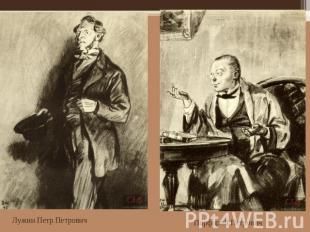
                                                        Luzhin and Porfiry Petrovich


Friday, February 2, 2018

Rosamund Bartlett on Best Russian Short Stories


See the link below for one person's take on the best Russian short stories. I put a picture of Gogol on here to remind the reader that if you're talking best short stories, no way you can leave out "The Overcoat" ("Шинель").

Then again, Rosamund Bartlett leaves out Bunin and Nabokov as well, Turgenev, plenty of others. But she, after all, limits herself to five stories, and what she has to say about the stories she chooses is worth reading. I can pretty much do without Leskov altogether, but she has picked two of my all time favorite stories: Chekhov's "Gusev," and Babel's "The Sin of Jesus."


https://fivebooks.com/best-books/rosamund-bartlett-on-russian-short-stories/


Tuesday, April 7, 2015

BEST RUSSIAN SHORT NOVELS


Theophany Convent (Богоявленский монастырь, Кострома), May, 2003


http://twitter.com/robaroundbooks

Recently Rob Burdock @RobAroundBooks retweeted from Apostrophe Books a list of 46 Best Short Novels that you can read in a day.

These include "The Great Gatsby," which probably should be savored for its prose, not read in one day.

Other greats are Marquez's "Memories of My Melancholy Whores." Probably a better choice for a short Marquez novel would be the wonderful, "Chronicle of A Death Foretold."

Then there is Kosinsky's "Being There," a rare example of a situation in which the movie (with Peter Sellers) is better than the book.


There are no Russian novellas in this list, so here are my choices for best Russian short novels (or long stories, if you want to look at it that way), listed in no particular order of merit:

Ivan Turgenev, "First Love"

Nikolai Gogol, "The Overcoat"

Lev Tolstoy, "The Death of Ivan Ilyich"

Fyodor Dostoevsky, "Notes from the Rat Hole"

Ivan Bunin, "Drydale"

Vladimir Nabokov, "The Eye"

Anton Chekhov, "The Duel"

Yury Olesha, "Envy"


                                Front Cover, Russian Translation of "The Great Gatsby"


Wednesday, July 2, 2014

Smilesburger's Russian Antecedents

American literature is full of Russian literature. I don't know if anyone has written about how much Philip Roth's Operation Shylock owes to Russian lit, in particular to Crime and Punishment. The most interesting character, Smilesburger, is a reincarnated Porfiry Petrovich, the police investigator.

Woody Allen's film "Match Point" also borrows heavily from Dostoevsky, periodically re-staging scenes from Crime and Punishment, but the movie is superficial, even negligible in comparison to the Roth novel, which is written in a kind of white heat (so typical of Dostoevsky), bordering on insanity.


All sorts of Russian themes show up in Roth's novel; prominent among them is the theme of fathers and sons. Turgenev wrote the novel (actually the title is Fathers and Children in the original), but he, of course, has no patent on the theme.

At one point (p. 245) the action is stated to be "unconvincing," and the narrator suggests that the story has been conceived as a prank, "and a nasty prank at that." See also, p.361, "the sacrosanct prank of artistic transubstantiation." Probably the greatest "prank" story in all of world literature is Nikolai Gogol's "The Nose."

But Roth, first and foremost, had Dostoevsky in mind when he wrote this book teeming with red-hot tirades. The book recalls Porfiry Petrovich's telling Raskolnikov how no fact can really be grasped, because everything "cuts both ways." In Russian the expression is "a stick with two ends."

In Dostoevsky's great novels he allows an airing to all sorts of opinions. In fact his spokesmen for the Christian point of view (ostensibly his own view) often take a back seat in the dialectic to others who make a convincing case for atheism. The same sort of dialectic is operative in Operation Shylock, in which a Jewish author goes out of his way to let characters spout anti-Israeli and even anti-Jewish messages. "Did the Six Million Really Die" (p.253-60) is the most flagrant example of this.

The critic Bakhtin famously called Dostoevsky's novels "polyphonic," meaning that competing voices rage and roil throughout the books, propagating competing messages. The struggle is never resolved in favor of one voice or another. Roth's Operation Shylock is precisely such a novel.

Tuesday, June 24, 2014

The Thing They Always and Ever Refuse to Believe


It was in February, 1852. Ivan Turgenev was attending a meeting of a charitable society in St. Petersburg. It was the usual dreary business. Not much had to be accomplished but no one could cut through the blather and get things wrapped up. Everyone in attendance deemed it imperative that he have his say. Everyone talked. On and on, to no end.
Then Turgenev noticed that I.I. Panaev, socialite, journalist, novelist of the Belinsky circle, was circulating about the room, stepping gingerly on his tiptoes, his face lit up in a strange glow of elation. With a convulsive sort of haste Panaev skipped from one person to the next, bent low to whisper something in each ear he came to. Upon which the face of the owner of the ear lit up in amazement and then fell. Taking great satisfaction, even joy, in the news that he was delivering into those ears, Panaev went tiptoeing on.
When he reached Turgenev, he bent toward the proferred ear and said: “Guess what just happened? Gogol has died in Moscow. That’s right, that’s right. Died. He burned all his papers, he took to his bed, and then he croaked.”


Nobody could believe the news. Died. They all had heard the stories about Gogol. How he was blocked and would write no more. How he still was working on the next volume of Dead Souls but could never seem to finish it. How he was deranged in the head, had thought of going into a monastery and becoming a monk. And much much more. How, for example, he had gone to Jerusalem, to pray at the tomb of the Savior, but had returned disillusioned. How he had left instructions that after his death he was not to be buried immediately, for fear of being buried alive. Much more. But still, death, somehow, despite the deaths that take place on a daily basis, all over the world, people still can’t believe it when they hear it. Death? No. For after all, the thing that people marvel at most of all on earth, the thing they always and ever refuse to believe, is death. And Gogol? He was not even ill, except in his own hypochondriac mind. Not Gogol, no, not the pride of Russian literature. He was only forty-two years old.