Dostoevsky's Morbid Characters, Representatives of "The Sick World" of FMD

The Issue of
Sensuality: Pedophiles and Perverts
Dostoevsky, to put it mildly, writes fiction about the dark
side of the human soul. Dostoevsky’s fiction is often sick, and reading too
much of it at a time can have a deleterious effect on the reader. If you read Crime and Punishment, thoroughly digest
it, take some time off before diving into another long and gut-wrenching
Dostoevsky novel.
As one critic, Geir Kjetsaa, has pointed out, “in his
[Dostoevsky’s] eyes sexuality was the fundamental condition for the
relationship between man and woman.” Kjetsaa quotes from a letter that
Dostoevsky wrote to his second wife Anna late in his life: “You think perhaps
that this is only one aspect of the matter, the coarsest one even. But there is
nothing coarse about it; everything else is dependent on it.”
Pedophilia and the sexual designs of older men on young
women are prominently featured in Dostoevsky’s fiction from the very beginning.
In his first novel, Poor People, the heroine
Varvara breaks the heart of the narrator Devushkin when she makes a marriage of
convenience with a man named Bykov. This is much the same situation as that of
Dunya and Luzhin in C and P, although
Luzhin’s designs on Dunya are foiled and the marriage does not take place.
Bykov, like Luzhin, is attracted by the idea of exerting sexual control over a
young female. The fatuous socialist Lebezyatnikov has similar proclivities.
While professing to be selflessly interested in “educating” Sonya Marmeladova
in socialist doctrines, while pretending to be interested in her as a
representative of the oppressed masses, he also has prurient designs on her.
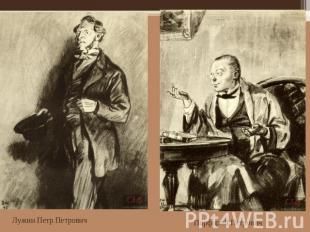
Probably the most negative character in C and P, Luzhin, a
money grubber, incipient capitalist and social climber, is perversely attracted
to the idea of possessing Dunya, a proud and attractive girl (she is eighteen).
He will pull her, along with her family, out of poverty, so he thinks, and after
their marriage she will be his love slave, totally submissive and grateful to
him.
The genuine pedophiliac in the novel is Arkady Ivanovich
Svidrigailov, who is sexually obsessed with Dunya, and, even worse, involved
with very young girls from impoverished families. His first appearance in C and P is foreshadowed by a scene in
Part 1, Ch. 4 (p. 39-43 in the Norton Critical Ed.), in which Raskolnikov sees
a young drunken girl staggering down the street. She is followed by a
plump fop with a lecherous gleam in his eye. Raskolnikov yells at him, “Hey,
Svidrigailov, what do you want here?”
Svidrigailov’s actual appearance in the novel comes much
later, at the very end of Part 3, when he almost seems to have been conjured up
out of one of Raskolnikov’s violent nightmares. Raskolnikov dreams that he is
striking the old woman—whom he has already murdered in the waking world—on the
head with repetitive blows of the axe, but she just sits there laughing at him.
He tries to run, wakes up, but “the dream seemed strangely to be continuing:
his door was wide open and on the threshold stood a complete stranger, looking
fixedly at him.”
This appearance of Svidrigailov as if out of the hero’s
dream suggests that in some weird way he may be an extension of Raskolnikov’s
personality, a part of his psyche. As has been emphasized by critics of Dostoevsky’s
works, there are frequent doublings of characters. Svidrigailov and Sonya are
both something of alter egos of Raskolnikov, she representing his good side,
and he representing his evil side.
But in terms of sensuality Svidrigailov and Raskolnikov
appear, at first glance, to have nothing in common. Svidrigailov is the supreme
sensualist, who can find nothing to believe in except the flesh. He tells Raskolnikov
at one point, “I have no confidence in anything but anatomy.” He has come to
the conclusion that spirituality, morality, religion, and everything that most
people cling to as a justification for living and behaving decently are mere
abstractions. Debauchery is, in his ironic view, of positive value, as he tells
Raskolnikov.
--Why should I give up women, if I have an inclination for
them? It’s something to do, at any rate…
--So all you hope for is a spell of debauchery?
--Well, why not? Debauchery if you will! You seem to like
the word! . . . . In ‘debauchery’ there is at least something constant, based
on nature, indeed, and not subject to fantasy, something that exists in he
blood as an eternal flame, always ready to set one on fire, and not to be
readily extinguished, for a long time to come, perhaps for many years. You will
agree that in its way it is an occupation (Part 6, Ch. 3).
As sometimes happens in a Hollywood film, a character actor steps
into the narrative and begins stealing all the scenes. Svidrigailov steps into C and P very late in the action and
almost steals all the attention from the main character Raskolnikov. Dostoevsky
here has created probably the most in-depth and complex pedophile in the
history of world literature.
Svidrigailov is aware that he is sick. “I agree that it [his
pathological sensuality] is a disease.” In his past he is apparently responsible
for the death of a deaf and dumb girl, whom Madam Resslich has procured for him,
and whom he has abused (see p. 252, 429). He mentions to Raskolnikov his
patronage of a thirteen-year-old girl and her mother, and, in the final part of
the novel, he has become engaged to a fifteen-year-old. The description of how
he visits his bride to be, then takes her up on his lap to fondle, are among
the most perversely sensual of Dostoevsky’s writings, and they certainly
provided Vladimir Nabokov with some of the material for his own treatment of
pedophilia in Lolita. Even worse is Svidrigailov’s
dream about a five-year-old girl whom he undresses, and who smiles lewdly at
him.
Then again, Svidrigailov is not entirely a negative character.
There is something even appealing about him at times. He finally has Dunya,
after whom he lusts immeasurably, in his clutches, having lured her to his room
with promises to tell her brother’s secret. But then, suppressing his own
overwhelming feelings [“In the end I couldn’t bear even to hear the rustle of
her dress. Really, I thought that I’d have a fit or something”], he lets her go.
He provides money to help the Marmeladov orphans; he helps Sonya break free
from prostitution. Then, as if realizing that there is no other way out for one
whose amorality is an oppressive burden, he shoots himself.
But why do critics consider Svidrigailov a kind of double of
Raskolnikov, who is extremely ascetic and appears almost non-sexed? You could
approach this question by considering the character of Dunya, who is shown to
be very similar to her brother. Svidrigailov tells Raskolnikov, “Avdotya
Romanovna is terribly chaste, to a positively unheard-of degree . . . . . She is
perhaps even morbidly chaste, and it will do her harm” (Part 6, Ch. 4). The
implication is that morbid chastity, the obverse of morbid sensuality,
represents another extreme condition.
Complete renunciation of
sexuality, Dostoevsky seems to suggest, is itself a kind of sexual impulse, and
there is perhaps something perversely erotic in Dunya’s noble impulse to
sacrifice herself by marrying the despicable Luzhin.
What about Raskolnikov, who is also “morbidly chaste”? In
the first place, there are indications that Raskolnikov’s suppressed sexuality
is not so dissimilar to Svidrigailov’s openly professed sexuality. This is
especially apparent in brief mention of his one-time prospective bride, a sick
and homely girl, daughter of his landlady. At one point Raskolnikov tells his mother
that he “fell in love and wanted to be married.” But the impetus for this
so-called “love” is sick and perverse, as only Dostoevsky’s characters seem
capable of being.
“She was . . . very plain. I don’t really know what
attracted me to her; I think it may have been that she was always ill… If she
had been lame as well or hump-backed, I might very likely have loved her even
more… (He smiled pensively). It was just because… Some kind of vernal delirium…”
So much for true love. There is something here fully as
perverse in Raskolnikov’s morbid “love” as in Svidrigailov’s open profession of
pathological sensuality and pedophilia. Lust is expressed in many ways, and the
bottled-up libido will find an outlet. Some critics see the murder of the two women
as a kind of rape, and act of subconscious sexual aggression on Raskolnikov’s
part.
What about the love of Raskolnikov and Sonya? Not credible.
In the first place, Sonya, the prostitute/nun in C and P is a character with little flesh on her bones. She is much
less believable as a character than the lecherous Svidrigailov. And even much less
interesting. What she is is Dostoevsky’s representative of the Christian
message in the book. But Christian love is sexless, and there is never even a
hint of sexuality between “the lovers” Raskolnikov and Sonya. They are, at some
point we assume, to be married, but what kind of marriage will this turn out to
be? Will Raskolnikov find an outlet for his own perverse sexuality by marrying,
in effect, a nun?
Maybe so. We can only assume that in the years of the
Russian Civil War Red soldiers—warriors for the cause of atheism—took great voluptuous
pleasure in raping nuns. By that time Dostoevsky was no longer alive to write
about such things, but had he still been alive he certainly would have been
capable of expressing, in fictional art, the feelings of such men. Most
important of all, he would have dared to
write about such feelings, which more timid literary artists prefer not to touch.
In another novel, The
Idiot, Dostoevsky attempted to portray the ideal man, a Christlike innocent
devoid of sensuality. But at the end of that novel the hero fails utterly in
his attempt to interact with his fellow man and woman; he degenerates into
idiocy. There is no place for a sexless man in a world dominated by passion.
Want to see a good example of Dostoevsky’s influence on
writers worldwide? Try reading Flannery O’Connor’s “Good Country People,” the
story of a bible salesman in Georgia with perverse, Dostoevskian inclinations.
"Crime and Punishment" Beating a Horse to Death and Killing an Old Woman