Thursday, July 5, 2018

Notes to CRIME AND PUNISHMENT Raskolnikov's Split Personality

Makar Devushkin, Protagonist of "Poor People"


Sonya and Raskolnikov


The Issue of Mental Instability and Raskolnikov’s Split Personality

Of all world writers Dostoevsky is probably number one for attracting the interest of psychologists or medical doctors with an interest in abnormal psychology. Dostoevsky himself was severely ill most of his life with epilepsy, and with a nervous disease apparently consequent upon the epilepsy. There is a fascinating book by James Rice, Dostoevsky and the Healing Art, which deals in depth with Dostoevsky’s lifetime struggle with his illnesses and the manifestations of emotional maladies in his works.

Perhaps no other writer in world literature has so many emotionally disturbed characters. In his very first novel, Poor People, we encounter a raft of such people, including the two main characters, Devushkin and Varvara. In C and P not only is the main hero severely deranged, but lots of others are as well. Soon after her son’s arrest, his overwrought mother Pulkheria Aleksandrovna goes out of her mind, and the consumptive Katerina Ivanovna Marmeladova goes raving mad soon after her husband’s death, raging around the streets and forcing her little children to beg.

Another example. Porfiry Petrovich, the police inspector with a keen feel for human psychology that rivals Dostoevsky’s own, has a nervous giggle, and his perpetual frantic movements suggest the sort of character whose playacting in aid of his efforts to catch criminals has led his mind a bit astray.

Raskolnikov, however, is the main character, and you cannot make much of the book without coming to some understanding of his mental state, which, from the very beginning of the action, is highly confused, even feverish. He is constantly pulled in opposite directions by opposing forces within his psyche. Time and again we see him almost intuitively doing good and then rebelling against his own altruism. As Razumikhin says, “it is as if he had two separate personalities, each taking turns dominating him.”

Early in the book (Part 1, Ch. 4), in an episode developed out of Dostoevsky’s early story, White Nights, Raskolnikov comes upon a drunk, abused girl staggering along the street. His immediate impulse is to help her and rescue her from the lecherous gentleman pursuing her. Only after he has managed to protect her, with the help of a passing policeman, do we get the switchover in his personality. “An instantaneous revulsion of feeling seemed as it were to sting Raskolnikov,” and he tells the policeman, “No, forget it. Let him [the lecher] amuse himself. It’s not our business.” After this the evil rationalizing side of him takes over for the whole next page.

It’s almost as if Raskolnikov has a switch in his head and that switch periodically flips over to one side or the other. Dostoevsky is setting up a rather simple dichotomy here in the service of his religious message: the devil and God are fighting for Raskolnikov’s soul within his psyche. We see this sort of thing again and again, and it becomes too obvious to belabor. After Raskolnikov has generously given what little money he has to the Marmeladov family, the switch clicks over: “What a stupid thing to do,” he thought. “After all, they have Sonya and I need it myself.” The sarcastic, prideful, godless side of the character clicks over to manifest itself even during his conversations with Sonya. See Part 4, Ch. 4.

Of course, deep down (we are to assume) Raskolnikov is a good person. In the epilogue we learn that he had once helped a poor consumptive student and his ailing father and had rescued two little children from a fire. But his pride remains with him to the very end, and for Dostoevsky pride in humanity is of the devil. Until Raskolnikov can humble himself as Sonya tells him, he cannot hope to be saved.

Note that as Raskolnikov is on the way to the police station to confess, he falls down and kisses the earth he has defiled. Sonya has told him that he must do this and must say, “I am a murderer.” Bystanders begin laughing when they see him on the ground: “It’s because he’s going to Jerusalem, lads [says one of them], and he’s saying good-bye to his family and his country. He’s bowing down to the whole world and kissing the famous city of St. Petersburg and the soil it stands on” (Part 6, Ch. 8).

Sonya (and Dostoevsky) would like to believe that Raskolnikov is bound eventually for Jerusalem, for expiation of his crime and salvation, but he still has a long way to go. Sonya wants him to humble himself by kissing the good earth, an ancient symbol of warmth and benevolence for Russians, but note that here he ends up kissing the soil of St. Petersburg, the city that for Dostoevsky symbolizes all the unease and malevolence that so works on his hero’s mind, and all the nefarious, rational principles imported into Russia from the West.

Is the split in Raskolnikov ever resolved? I don’t think so. Note that in the prison camp described in the epilogue he is still dominated by pride and hatred for his fellow man. Dostoevsky would have us believe that in a sudden burst of light—and of course with the help of the saintly Sonya—Raskolnikov receives God’s grace:

“How it happened he himself did not know, but suddenly he seemed to be seized and cast at her feet. He clasped her knees and wept. For a moment she was terribly frightened, and her face grew white . . . . . . But at once, at that instant, she understood . . . she no longer doubted that he loved her, loved her forever and that now at last the moment had come . . .”

Unfortunately, this passage is far from believable. Here we have a character who goes round and round—much like the Underground Man, that prisoner of rationalization in Notes from the Underground—alternating between Christian love and satanic hatred for 462 pages, and then suddenly, on p. 463, he finds salvation. This passage is what is called empty rhetoric, forced by wishful thinking. You can almost see the author prodding his reluctant protagonist here at the end of the book, forcing him over into the camp of Jesus: “Come on! Get on over there. Stop resisting! I said you’re saved.”

Of course, even Dostoevsky sensed the lack of verisimilitude in such an easy solution to the dilemma of his schizo hero, so he immediately began hedging around on the last two pages, suggesting that, no, Raskolnikov is not really quite saved yet. What happened just now is merely the first step on his path to salvation. Oddly enough, the novel ends by suggesting that before the character can find peace at least one more novel will have to be written:

“But that is the beginning of a new story, the story of the gradual renewal of a man, of his gradual regeneration, of his slow progress from one world to another, of how he learned to know a hitherto undreamed-of reality. All that might be the subject of a new tale, but our present one is ended.”

This ending with the suggestion of no ending at all is rather typical of the Russian realist novel of the nineteenth century. Gogol ended the first part of Dead Souls by promising great things in future volumes—including the redemption of his rogue hero Chichikov. He never got those future volumes written to his own satisfaction. Tolstoy finished off his heroine in Anna Karenina the best way a novelist can (with her death), but as this long novel ends we see the male hero, Levin, struggling with depression, doubting the meaning of life, contemplating suicide. His story is never concluded. Russian writers like to mention “hitherto undreamed-of realities,” but they seldom get around to treating those nebulous things in concrete terms, and writing books that are totally finished.

“Dostoevsky understood only restless, fractious, struggling people whose search is never ended. No sooner did he undertake to show us a man who has found himself and achieved tranquility than he fell into fatal banalities” (Lev Shestov cited in Norton Critical Ed. of C and P, footnote on p. 543-44).

Of course life is never finished either, not until you are dead, so perhaps it is better to leave the characters with an open-ended path ahead of them. As Grace Paley once wrote, “Everyone, real or invented, deserves the open destiny of life.”


                          The Sudden Revelation (Ending of "Crime and Punishment")


Wednesday, July 4, 2018

Notes on CRIME AND PUNISHMENT Motivations for the Murder


Motivations

Why did he do it? This is the central question of C and P, which is a murder mystery, but not what they call a “whodunnit.” This novel is a “whydunnit,” or a “I-done-it-but-I-don’t-know-why-I-dunnit.” Of course, in all of Dostoevsky’s fiction characters are ruled by subconscious impulses that they themselves are unaware of. Raskolnikov is mired in the cyclical processes of human reasoning, which Dostoevsky, the great anti-rational rationalist, treats with suspicion.

So, as one critic, Phillip Rahv, has put it, Raskolnikov is “the criminal in search of his motive” (Norton Critical Ed., p. 540-41). Why did he do it? The full complexity of the issue becomes manifest only about halfway through the book (Part 3, Ch. 5; p. 218-25 in the Norton Critical Ed.), when, for the first time we hear about the article he has published on crime. Much to the surprise of Raskolnikov, who was not even aware that his article had been printed, the police inspector, Porfiry Petrovich tells him that he has read it. The central point of the article is that human beings are divided into the ordinary and the extraordinary. The ordinary are like sheep, baaing their way passively through life, but the extraordinary have the right to overstep the boundaries of morality and law, to commit immoral acts in furtherance of their majestic goals. This overstepping provides the title of the novel, Преступление и наказание—the word for ‘crime’ in Russian, at its root meaning, suggests a “stepping across,” akin to the word “transgression” in English.

In his conversation with Sonya (Part 5, Ch. 5; p. 348-54), Raskolnikov’s confusion about his motive becomes apparent, when he goes through nearly every possible motivation for his crime, rejecting or revising each of them on the fly. Svidrigailov, who is conveniently eavesdropping on this conversation, later recapitulates the motivations to Dunya (Part 6, Ch. 5, p. 415). Here is roughly how the process goes in Raskolnikov’s feverish mind.

I did it because I was poor and I needed money to launch my career, but no, what I really wanted was to help my mother and sister and, after all, I had just received a letter from my mother describing how my sister Dunya was about to prostitute herself by marrying a despicable character, sacrificing herself to help me, but no, it wasn’t really that, what I wanted was to get money so that I could go about doing good, working toward the eradication of human evil and social inequality on earth, and I figured that by killing one contemptible old woman, who nobody on earth needed and who soon would die anyway, I could get that money and then atone for this one transgressive act by doing great good for the rest of my life, and, besides that, I was, after all, insane, or nearly insane, going nuts lying here in that cramped coffin of a room and actually physically ill as well, feverish, not even aware of what I was doing, but no, it wasn’t really that, what I wanted to be was a great man, a man who can transcend commonplace vulgar morality and become a superman, prove that he is above the ethics of the stupid baaing herd, a Napoleon, and I really could have been a Napoleon, I’ve got the stuff for it, but no, really I’m just a common louse like everyone else, but I had to know, you see, it was an experiment, I had to find out if I was a man or a louse, I had to know whether I really could overstep the bounds, whether I could do something that ordinary men are not capable of doing, and I didn’t really care about my mother and sister or the money, it was just the principle of the thing, and you know what’s the most despicable thing of all? By collapsing emotionally and physically the way I have, all I’ve really proved is that I’m a louse after all, Napoleon would have done it without even thinking about the sleaze of it, the immorality, he wouldn’t have worried for a moment about the ethics of the thing, he was beyond mere morality, a superman, but me, I’m a louse, and yet maybe I judge myself too soon and too harshly, maybe I still have great things in me, maybe I’m not a louse after all, yes I am, no, you’re not, etc., etc., etc., the round and round goes on.

In addition to the reasons Raskolnikov himself lays out, only to keep rejecting, there are several other possibilities: (1) His mental illness as the primary motivation. Certainly he would not have committed murder had he been in a balanced state of mind; (2) The idea that he is consciously seeking suffering. The “punishment” of the title operates even before he commits the crime, and he is punished in his own agonizing mind long before he is convicted and sent to Siberia. In this novel, as in so much fiction that Dostoevsky wrote, much is made of suffering as a means of purification of soul. Marmeladov says that he drinks not to relieve himself of guilt, but in order to redouble his sufferings. The peasant Mikolka, though not guilty, confesses to the crime in order to “accept his suffering” and suffer his way through to some redemption. As Porfiry Petrovich remarks, Mikolka is a “religious schismatic,” which in Russian is “iz raskol’nikov.” The very similarity of the word ‘schismatic’ with Raskolnikov’s surname suggests that this character is an alter ego of Raskolnikov. In fact, in summing up the possible reasons why Mikolka confessed (Part 6, Ch. 2, p. 383), Porfiry recapitulates Raskolnikov’s reasons for committing the crime. He ends up, once again, with suffering:
“Do you, Rodion Romanovich, know what some of these people mean by ‘suffering’? It is not suffering for somebody’s sake, but simply ‘suffering is necessary’—the acceptance of suffering . . . . . .  Mikolka desires to ‘accept suffering’ or something of the sort . . . . . What, can’t you admit that such fantastic creatures are to be found among people of this kind?”

(3) The issue of suppressed sensuality. Some psychological critics of Dostoevsky have suggested that Raskolnikov is, above all, a passionate character who has suppressed his own libido. In the text of the novel he is certainly a prude, and he reacts with revulsion to Svidrigailov’s openly expressed sensuality, his love for anatomy above all else. These same critics assert that one way Raskolnikov has of working out his repressed sexuality is murder. They comment on the sexual symbolism of the murder of two women, calling this a kind of sublimated rape.

Maurice Beebe mentions the succession of events just prior to the murder: the episode in which Raskolnikov encounters a drunken girl on the street, and saves her from a lecherous dandy pursuing her, followed by the mare dream (murder of a female horse), followed by his own acts of murder:
“The progression from seduced girl to beaten horse to murdered pawnbroker [and her sister] tells us much about the strain of aggressive sexuality that lies within Raskolnikov, a taint which he himself denies on the conscious level” (Beebe in Norton Critical Ed., p. 591).


In the epilogue of the novel Raskolnikov still struggles with motivations for his act. He is still suffering his way through to some kind of redemption, but we do not know if he will ever get there, because Sonya’s God of meekness and love still struggles in his soul with the devil of his pride. At any rate, by this late point in the novel it seems clear that the “superman motive,” his fierce pride and desire to prove himself better than other mere men, has taken precedence over the many other motivations for his crime.


Tuesday, July 3, 2018

Notes on "Crime and Punishment" COINCIDENCE AND FYODOR DOSTOEVSY AS UTILITARIAN GOD OF THE NARRATIVE


Coincidence

With his strong Christian sentiments Dostoevsky believed thoroughly in human free will and taking responsibility for one’s deeds. So how do we square that with the overriding importance of coincidence in Part One of C and P? In carrying out his plan to commit murder, Raskolnikov does everything wrong, sets himself up to fail or be caught all along the line—and, miraculously succeeds. In fact, he has committed the perfect crime, and there is little or no chance that he will ever be charged. Then he proceeds to do lots of things to guarantee that he’ll be caught.

If you consider all the coincidences that operate in Raskolnikov’s favor in Part One, it is hard to remain unconvinced that some sort of supernatural power is (1) guiding him along like a blind man toward the crime, and (2) helping him escape afterwards. Sonya would say that this is the devil at work, but there are hints in the novel that it may be the Lord God.

Let’s trace all the most significant situations in which chance operates in Part One (p. 46-74 of the Norton Critical Edition C and P). We begin with the famous mare dream and Raskolnikov’s reaction to having had a dream in which he himself plays the role of a little boy watching peasants beat a horse to death. “I won’t do it, I won’t do it! [kill the old lady as he has planned] Lord, show me the way, that I may renounce this accursed fantasy of mine!” Next, he makes for home, but instead of going home by his usual route, he is led to cross Haymarket Square.

“Why, he used to ask himself later, did such an important and fateful encounter take place in the Haymarket (through which he had no reason to go) just at this time, just when his mood and circumstances were exactly those in which the meeting could have so fateful and decisive an influence on his destiny? It was almost as if fate had laid an ambush for him (52; my italics). 

What this refers to is the way he overhears the pawnbroker’s sister Lizaveta’s conversation in the Haymarket. From this conversation he learns that Lizaveta will not be at home the next day at 7:00 p.m., and “the old woman would be at home alone” (53).

“In later years he was always inclined to see something strange and mysterious in all the happenings of that time, as if special coincidences and influences were at work” (54).

Next coincidence: he stops off at a miserable little tavern and overhears his own theory of murder propagated by a student who uses as an example precisely the same old woman whom Raskolnikov has been planning to kill. In mouthing the same utilitarian principles that motivate Raskolnikov’s behavior—“you could murder the old lady, steal from her, and use the money to do good and benefit humanity”—the student demonstrates how unoriginal Raskolnikov’s ideas are; those notions are so much blowing in the wind of the day that two people speaking casually in a bar can give voice to them.

At this point, Dostoevsky, who goes out of his way to help the reader see the main idea, adds another amazed afterthought on the part of the hero: “This always seemed to him a strange coincidence. This casual public-house conversation had an extraordinary influence on the subsequent development of the matter, as if there were indeed something fateful and foreordained about it” (57; my italics).

From this point on everything that Raskolnikov does is flawed, but Fate (or the devil, or God) so helps things along that everything works out fine. While dreaming a dream about an Egyptian oasis, he nearly sleeps through the interval when he plans to commit the crime, but then a clock strikes just in time and wakes him up (58). Now he is in a total daze, sick and feverish, and his reactions are “almost completely mechanical, as though someone had taken his hand and pulled him along irresistibly, blindly, with supernatural strength” (60; my italics)

The servant girl Nastasya ends up being in the kitchen, so that he cannot pick up the axe he needs, but almost miraculously he comes upon an axe in the porter’s room: “It was not my planning, but the devil that accomplished that! he thought” (62).

Just as Raskolnikov turns into the gateway at the old pawnbroker’s building, “as if by design” a load of hay turns as well and screens him. Nobody sees him enter the courtyard. After he commits the murder he loses his head and does everything absolutely wrong. He even leaves the door open behind him, noticing this only after he has committed his second murder, of Lizaveta, who walks in at the wrong time.

A man arrives and knocks at the door, now locked. Soon another arrives. Raskolnikov has no way to get past these men and escape down the staircase, but, luckily, the man who is to remain at the door while the other goes for help decides to leave as well. As Raskolnikov descends the stairs he hears both of them returning. He has nowhere to hide; they are bound to see him, remember him. But, again luckily, two painters have temporarily left the apartment where they are working, and Raskolnikov ducks in there and conceals himself.

He escapes. Nobody sees him anywhere. He puts the axe back in its place. No one sees him; no problem. The perfect crime. If he is caught now, Raskolnikov has only himself to blame. So then he spends the rest of the novel getting himself caught, because, wallowing in contrition, he wants to get caught. Or at least one side of his split personality wants to be caught.

So was it really the devil helping him out continuously and guiding him inevitably toward the crime? And protecting him after the crime? Was it predestination? But Dostoevsky does not believe in predestination. For the rest of the novel Sonya’s God, or Jesus Christ seems to be guiding Raskolnikov though expiation of he crime and toward redemption.

Much is made of the spiritual benefits of suffering, not only in C and P, but also in much that Dostoevsky has written. There are implications that Raskolnikov may have a great future ahead of him, and that perhaps he has to suffer his way through to spiritual enlightenment before that future can be realized. The rather strange police inspector, Porfiry Petrovich, who sometimes acts almost as much as a father confessor to Raskolnikov as an investigator trying to solve a crime, suggests as much late in the novel.

Before the journey of suffering can begin, before the sufferer can work his way through to salvation, he must commit a horrible act. Following this logic—which is certainly hinted at in the narrative—the murder must be committed. So is it the Lord God setting up all the coincidences that lead Raskolnikov through the murder and escape? If so, the Lord God certainly works in mysterious ways. In fact, you could almost see the Lord as a kind of believer in the principles of Utilitarianism here. “Let’s kill off one old woman for the greater usefulness and good of our hero.”

A different and better way of looking at this issue is to assume that the god of the fiction here, Fyodor Dostoevsky himself, sets things up so as to make his narrative move along the way he wishes. Raskolnikov must commit the crime and must get away with it. If not, where would the book go as a whole, and how could the rest of it be written?


Notes to "Crime and Punishment" DOSTOEVSKY THE NEUROSCIENTIST (Dunya and Svidrigailov)


D. Shmarinov, Illustrations to C and P: Dunya


Dostoevsky the Neuroscientist
(Dunya and Svidrigailov)

Dostoevsky’s métier as a writer of fiction is his deep understanding of human psychology. In fact, his insights are so acute that already in the nineteenth century he anticipated the findings of neuroscience in the twenty-first century. In the past twenty years brain scientists have learned, among many other discoveries, that we humans are often not in control of our actions, even unaware, on a conscious level, of why we do certain things. In control, rather, are neurons deep in our brain, working sometimes at cross purposes even with our own ethical principles.

Examples of such a situation are rife throughout Dostoevsky’s works of fiction. A good example in C and P is Dunya Raskolnikov’s relationship with the perverse Svidrigailov. We learn that while she worked as a governess on his estate he constantly pursued her, in an attempt to seduce her. During that past time in the narrative she resisted him, as she does in present time narrative. Of the many melodramatic scenes in subplots of the novel, the encounter of Dunya and Svidrigailov in his lodgings, their last meeting, stands out (Part 6, Ch. 5).

Svidrigailov has lured her to a one-on-one meeting with his promise to tell her about her brother’s secret—his having committed murder—which Svidrigailov has discovered by eavesdropping on a conversation between Raskolnikov and Sonya. The confrontation scene is quite well motivated until Dunya draws a revolver; at which point we are into pulp fiction, and the scene ends up like something out of a Saturday afternoon serial at the local cinema. 

Svidrigailov has offered to save Raskolnikov, to help him escape to America. And given Dunya’s character, we expect more logically that she would yield to Svidrigailov in order to save her brother. But she shoots at him, grazing his scalp.

This confrontation scene does a good deal to advance the action of the main plot. For example, Svidrigailov recapitulates for Dunya the multiple motivations for Raskolnikov’s crime. Much is also said about how Dunya related to Svidrigailov back when she worked on his estate. While resisting his advances, she was constantly trying to reform him, to cure him of his “broadmindedness,” which he brings up again at this meeting.

“Ah, Avdotya Romanovna [Dunya], everything is mixed up now, though that is not to say that it was ever particularly straightforward. The minds of the Russian people in general are broad, Avdotya Romanovna, like their country, and extraordinarily inclined to the fantastic and chaotic (Русские люди вообще широкие люди, Авдотья Романовна, широкие, как их земля, и чрезвычайно склонны к фантастическому, к беспорядочному); but it is disastrous to have a broad mind without special genius. Do you remember how often we two discussed this theme . . . . sitting on the terrace in the garden, in the evening after supper? You were always reproaching me with that breadth of mind.”

Given what we learn in this confrontation scene, plus what information we have about Dunya and Svidrigailov previously, it is clear now that Dunya is both attracted to him and repulsed simultaneously. There is good reason for asserting that, against her own will, she may be even a bit in love with him. She is morally horrified by that deep neuron in her brain that wants Svidrigailov, she refuses to admit the attraction and openly expresses the revulsion. 

Svidrigailov, who like the police inspector Porfiry Petrovich, is one of the keen psychologists of the novel, earlier has explained to Raskolnikov how he set up Dunya for her fall.
“In spite of Avdotya Romanovna’s real aversion for me, and my persistently gloomy and forbidding aspect, she grew sorry for me at last, sorry for a lost soul. And when a girl’s heart begins to feel pity for a man, then of course she is in the greatest danger. She begins to want to ‘save’ him, and make him see reason, and raise him up and put before him nobler aims . . . . . I realized at once that the bird had flown into the net of its own accord, and I began to make preparations in my turn” (Part 6, Ch. 4).


So exactly how does Dunya feel about Svidrigailov? It depends on which neuron deep in her brain that you ask. Nothing is ever black or white in the complicated psychology of Dostoevsky’s characters. Dostoevsky often emphasizes that she resembles her brother, and is fully as complex a person as is he. Dunya is a secondary character, so there is not room in C and P to develop her to the full. At the end of the book Dostoevsky has conveniently married her off to the generous and good-hearted Razumikhin, but, given her tempestuous and complex nature, we wonder how successful that marriage will be.


Monday, July 2, 2018

ALEKSANDR BLOK, "Девушка пела в церковном хоре" Translation into English, "In The Choir of a Church a Young Girl Was Singing"


Aleksandr Blok
(1880-1921)

Девушка пела в церковном хоре
О всех усталых в чужом краю,
О всех кораблях, ушедших в море,
О всех, забывших радость свою.

Так пел ее голос, летящий в купол,
И луч сиял на белом плече,
И каждый из мрака смотрел и слушал,
Как белое платье пело в луче.

И всем казалось, что радость будет,
Что в тихой заводи все корабли,
Что на чужбине усталые люди
Светлую жизнь себе обрели.

И голос был сладок, и луч был тонок,
И только высоко, у Царских Врат,
Причастный Тайнам,- плакал ребенок
О том, что никто не придет назад.
                                                               August, 1905


Literal Translation

A girl in a church choir sang
About all those who were weary in a foreign land,
About all the ships that had gone to sea,
About all those who had forgotten their joy.

So sang out her voice, flying up to the cupola,
And a ray of light shone on her white shoulder,
And all those in darkness watched and listened,
As the white dress sang in the ray.

And it seemed to them all that joy would come,
That all the ships were in a quiet backwater,
That weary people in a foreign land
Had found a bright life for themselves.

And the voice was sweet, and the ray was slender (thin),
And only up high, by the Royal Gates [entrance to the altar in an Orthodox church],
Privy to the Secrets, a child was crying
Over the fact that no one would ever come back.


Rhymed and Metered Translation


In the choir of a church a young girl was singing,
Of languishing folk in an alien demesne,
Of ships out at sea lashed by gales harsh and stinging,
Of all those whose joys had been tempered by pain.  

Her voice rang on high, soaring up to the dome,
And a ray of white gleamed on her arm’s shadow play,
And those swathed in darkness beheld that pure tone,
As the white of her dress sang its song in the ray.

And each of them felt as if joy were at hand,
As if all harried ships would soon find a safe niche,
As if worn, wearied people in a far distant land
Were bathed in a song with a perfect light pitch.

And the voice was pure sweetness, the ray shone undying,
But perched way up high, on the wall’s narrow berm,
Aware of all Secrets, a child was crying,
For the teeming lost dead who would never return.
                                                                                           Translated by U.R. Bowie, June, 2018


Translator’s Note

Literary critics have noted the preponderance of maritime imagery in Blok’s poetry written in the summer of 1905. Much on all Russians’ minds at the time was the Russo-Japanese War and the devastating defeat in the maritime Battle of Tsushima. Attempting to relieve the Japanese siege of Port Arthur, in an amazing logistical feat, the Russian Baltic fleet had sailed all around the world.

By the time the fleet reached the Sea of Japan, in May of 1905, Port Arthur had fallen, and the Russian armada changed course, making for the port of Vladivostok. Engaging the Russians in the Tsushima Straits on 27-28 May, 1905, the Japanese annihilated the whole fleet. The Russians lost eight battleships, numerous smaller vessels, and more than 5000 men. Only three Russian ships made it safely to Vladivostok.

Some critics have noted that what the girl sings is a kind of prayer, for the repose of the dead sailors of the Russian fleet, or for those adrift in foreign lands. In the Russian Orthodox church there is also a prayer of intercession intoned by the priest (called евтения), for wayfarers at sea, travelers, and all those who are ill or suffering, during which the choir sings repetitively the Kyrie eleison (Господи помилуй).

The prayer of the girl, or of the priest and the choir, alas, is of no avail, since, as the final line tells us, no one ever gets back alive. Once again, this could be an oblique reference to the dead sailors, or, to take it more broadly, it may allude to the vast dead of the historical universe.
Some have suggested that the child crying at the Royal Gates is a depiction of a cherub, or of the Christ child.


Blok's poem declaimed by Olga Bunina:

https://www.youtube.com/watch?v=1a2dRw-MLxM


Notes to CRIME AND PUNISHMENT Radical-left Doctrines in the Novel: Utopian Socialism, Utilitarianism, Nihilism


Utopian Socialism, Utilitarianism, Nihilism

Dostoevsky the journalist and fiction writer was always deeply concerned with the social and political ideas of his time. In his younger days, he himself had been caught up in the fervor of Utopian Socialism—with its lofty ideals and conviction that human life on earth could be bettered for all. But after his return from Siberian prison and exile he spent the remainder of his days fighting a variety of political notions and social ideas—all of which, so he thought, depended too much on reason, and all of which were imported to Russia from Western Europe. 

He saw Western ideas as, basically, alien and dangerous on Russian soil, capable of producing highly unfavorable social and political changes. As it turned out, he was right, since the political system of Marxism-Leninism, which fueled the establishment of the new Soviet Union, ended up being a disaster for the Russian people, and even more of a disaster for peoples in a minority position in the U.S.S. R.

The Russian social and political situation in 1863-1865 was extremely complicated. For an in depth treatment of all its ramifications, the best place for the Anglophone reader to go is to Joseph Frank’s literary biography of Dostoevsky, Vol. III: Dostoevsky: The Miraculous Years, 1865-1871. Suffice it to say here that Raskolnikov’s deranged mind is much influenced by both (1) French Utopian Socialism (2) English Utilitarianism and (3) Russian Nihilism.

The spokesman for Utopian Socialism in C and P is the fatuous Lebezyatnikov, described as “a singularly commonplace and silly person.” In his empty-headedness he resembles the caricatures of radicals who are Bazarov’s “disciples” in Turgenev’s Fathers and Sons (Kukshina and Sitnikov). Lebezyatnikov espouses views that were already somewhat old-fashioned in Russia by the mid-sixties of the nineteenth century: glorification of the common people, free love, the necessity to organize communal living, beyond the restraints of traditional marriage. 

He also mouths the theory about how the environment that people live in determines their behavior. Dostoevsky uses one of the most positive characters in the novel, the generous, intelligent and impulsive Razumikhin, to criticize the environmental theory:
“they explain everything by the ‘deleterious influence of the environment’—and that’s all! Their favorite cliché . . . from that it follows that if society is properly organized all crimes will instantly disappear. . . Nature is not taken into account, nature is banished, nature is not supposed to exist! . . . . . . They have no use for the living soul. The living soul demands life, the living soul will not submit to mechanism, the living soul must be regarded with suspicion, the living soul is reactionary!” (Part 3, Ch. 5).

Here we have Dostoevsky’s insistence that the irrational ways of life often take precedence over the rational, that an overemphasis on reason can pervert life’s natural processes. His spokesman for such a view is a character whose very name reeks with reason: Razumikhin (Russian razum=reason).

At one point the dull-minded Lebezyatnikov explains to Raskolnikov modern methods of curing the mad by using logical persuasion: “madness is, so to speak, a logical mistake, a mistake of judgment, an incorrect view of things” (Part 5, Ch. 5). Katerina Ivanovna Marmeladova, who raves and rants all the way through the narrative, could be calmed (opines Lebezyatnikov), would stop crying if only she would listen to reason:

“what I mean is this: if you convinced a man logically that he had nothing to cry for, he would stop crying. That’s clear. Or are you of the opinion that he wouldn’t stop?”
“’That would make living too easy,’ answered Raskolnikov,” (Слишком легко тогда было бы жить).

Porfiry Petrovich, the police inspector, frequently emphasizes that evidence “cuts both ways” in the investigation of a crime. The Russian expression is “a stick with two ends” (палка о двух концах). But anyone reading much of Dostoevsky’s fiction soon discovers that the formula of the stick with two ends operates consistently. Despite his denigration of what he sees as a simplistic environmental theory, Dostoevsky does not deny the influence of the environment in motivating human behavior. 

One of his most intelligent characters, Porfiry Petrovich, assures Razumikhin at one point that environment can have a good deal to do with inspiring crime. Dostoevsky clearly illustrates how the squalid conditions in which Raskolnikov lives and the stifling, poisonous atmosphere of underclass Petersburg exacerbates his morbid state of mind. Frequent reference is made to his room, a horrible, cramped little cubbyhole that is compared to a coffin [see the cover art to the Norton Critical Edition of C and P, which depicts the view out the window from that room]. Environment is indeed important, but human beings cannot get away with rationalizing all their conduct by blaming it on their surroundings.

As for the ideas of English Utilitarianism, very popular in Russia in the mid-nineteenth century among the radical intelligentsia, Lebezyatnikov also mouths a few of these. Their most vocal spokesperson in Russia was Chernyshevsky, who was convinced that utilitarian theories could solve all problems of ethics and personal conduct. As Joseph Frank has written, “This has caused a great deal of confusion because only in Russia do we find the peculiar blend of French Utopian Socialism, with its belief in the possibility of a future world of love and moral perfection, held conjointly with a view of human nature stemming from the egoistic individualism [utilitarianism] of Bentham and Mill” (Norton Critical Ed., p. 563).

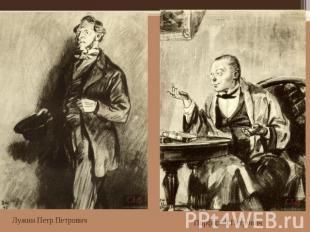
His “friend” Luzhin, perhaps the most despicable character in the novel, sniggers at Lebezyatnikov’s lectures on the utilitarian: “Everything that is useful to humanity is honorable, I understand only one word, useful!” (Part 5, Ch. 1). But Luzhin preaches the same utilitarian principles, using them to justify his own utter selfishness: “by the very act of devoting my gains solely and exclusively to myself, I am at the same time benefitting the whole community” (Part 2, Ch. 5).

Russian radicalism of the mid-1860s had advanced beyond the principles of Utopian Socialism. Utilizing the ideals of Utilitarianism and a love for the scientific method (positivism), the new radicals had arrived at so-called “Nihilism.’ The first important Nihilist in Russian literature was Bazarov in Turgenev’s Fathers and Sons, a man who has no great love for the common man, or for anyone else as well. He disdains what he sees as the sentimentality of Utopian Socialism; he sneers at over-idealization of the common man. He is an elitist who worries little about whose feelings he tramps on in his single-minded effort to change the social and political system.

While brought up with a Christian view of brotherly love, Raskolnikov has long since left the Orthodox religion behind. At the moment that C and P begins he is an atheist who has already gone beyond socialism and utilitarianism to his own nihilistic theory of the amoral “great man,” who can change the world if he is willing to trample upon generally accepted human morals.

Of course, one of Raskolnikov’s motivations for the crime is strictly utilitarian. He claims that he will make good use of the money he steals upon committing murder, devoting his life to serving humanity and changing the world for the better. But the error of his thinking—this being only one of many errors in his confused mind—is apparent in his own subconscious when he tells Luzhin what Luzhin’s doctrines of utilitarian “rational egoism” will lead to ultimately: “Carry to its logical conclusion what you were preaching just now, and it emerges that you can cut people’s throats” (Part 2, Ch. 5).

Such is the confusion of radical ideas that were in the air in the middle of the Russian nineteenth century, ideas that battle for ascendancy in the deranged mind of the main protagonist of C and P. The author Dostoevsky viewed all of these ideas as alien and dangerous. His great hope was that Russia and Russians could return to their roots, embracing the Russian earth and the Russian Orthodox doctrine of love, suffering their way through to a non-rational enlightenment.


"Cuts Both Ways" Caricature of Dostoevsky Sitting on an Axe, by Eugene Ivanov


                                                        Luzhin and Porfiry Petrovich


Saturday, June 30, 2018

Notes on CRIME AND PUNISHMENT Gogol Conjures up Raskolnikov Before He Exists


                                             Raskolnikov Conjured Up in "Dead Souls"

Sometimes it’s amazing how much influence Nikolai Gogol had on Dostoevsky. There’s a passage in Gogol’s Dead Souls, describing Chichikov’s return to the provincial town where he is staying, feeling in high spirits after his recent purchase of dead souls from the landowner Plewshkin.
So typical of Gogol’s style in his masterpiece, the action suddenly veers off out of Chichikov’s carriage, and we find ourselves in St. Petersburg, making the acquaintance of a young romantic dreamer who sticks his nose into the novel only this one time, and then vanishes like the wind.

“The thunderous rattling of the carriage and its leaps into the air made the occupant [Chichikov] notice that it had reached a paved way. The street lamps were not yet lit; only here and there had lights begun appearing in windows of the houses, while in the lanes and the blind alleys scenes and conversations were taking place inseparable from this time of day in all towns where there are many soldiers, cabbies, workmen, and beings of a peculiar species who look like ladies, wearing red shawls and shoes without stockings and who dart like bats over the street crossings at nightfall.

“Chichikov did not notice them, nor did he notice even the exceedingly slim petty officials with slender canes who, probably after taking a stroll beyond the town, were now returning to their homes. At rare intervals there would come floating to Chichikov’s ears such exclamations, apparently feminine, as ‘You lie, you drunkard, I never let him take no such liberties as that with me!’ or: ‘Don’t you be fighting, you ignoramus, but come along to the station house and I’ll show you what’s what!’ In brief, [and here we are suddenly in the northern capital, URB] such words as will suddenly scald, like so much boiling water, some youth of twenty as, lost in reveries, he is on his way home from the theater, his head filled with visions of a Spanish street, night, a wondrous feminine image with a guitar and ringlets.

“What doesn’t he have in that head of his and what dreams don’t come to him? He is soaring in the clouds and he may have just dropped in on Schiller for a chat, when suddenly, like thunder, the fatal words peal out over his head, and he perceives that he has come back to earth once more, and not only to earth, but actually to the Haymarket, and right by a pothouse, at that; and once more life has taken to strutting its stuff before him in its workaday fashion” [Dead Souls, Part I, near end of Ch. 6; I use the Guerney translation here].

Note the image of Friedrich Schiller (1759-1805), the German poet whom Russians of the nineteenth century considered the embodiment of romantic idealism. Schiller is mentioned several times in Crime and Punishment; at one point Svidrigailov calls Raskolnikov “a Schiller,” and in the hero’s mixed up personality there is certainly something of the romantic idealist.

Most fascinating about the Gogolian passage, however, is the way it seems to conjure up—some twenty years before Dostoevsky invented him—the dreamer Raskolnikov, wandering the Haymarket in a daze, amidst all the drunken squalor, trying to concentrate on the dreams and murderous schemes in his deranged head.


Raskolnikov Ascending 


Thursday, June 28, 2018

Notes on CRIME AND PUNISHMENT Going to America "Я, брат, еду в Америку."


Going to America

At several different points in the action of C and P the characters mention going to America. At one point the perverse Svidrigailov tells Dunya, Raskolnikov’s sister, that he is willing to save her brother, even offering to take him to America. At another he offers to give Raskolnikov money: “If you are so sure that one can’t listen at doors, but any old woman you like can be knocked on the head, then you’d better be off at once to America somewhere. Run away, young man! . . . . You haven’t any money, is that it? I’ll give you enough for your journey” (Part 6, Ch. 5).

Svidrigailov later uses the metaphor of America as a way of alluding to his suicide: “’Sofya Semyonovna,’ he said, ‘I may, perhaps, be going to America, and as this is probably the last time we shall see each other, I have come to complete some arrangements’” (Part 6, Ch. 6). When he arrives at the actual act of suicide, Svidrigailov comes upon a Jewish man who is working as a watchman:

“’Well, what do you want here, already?” [asks the watchman]
‘Nothing, brother. Good morning to you!’ answered Svidrigailov.
‘So go somewhere else.’
‘I am going to foreign parts, brother.’
‘Foreign parts?’
‘To America.’
‘America?’
Svidrigailov took out the revolver and cocked it.
‘What now, this is not the place for jokes!’
‘Why shouldn’t it be the place?’
‘Because it isn’t.’
‘Well, brother, it doesn’t matter. It’s a good place . . . If you are asked, say I said I was off to America.’
He lifted the revolver to his right temple” (Part 6, Ch. 7).

Why the allusions to America? Because the idea of the country on the shining hill had a special mythological force in Russia for several centuries, roughly the eighteen through the twentieth. Russians saw America as a place of refuge, a place where you could begin life all over and live very well, a magical realm of milk and honey. Despite the Cold War, any American in the Soviet Union had a special status. In the unwritten ranking of countries in the Russian/Soviet mind, the U.S. was always at the very top.

Caught in the Soviet trap, unable to travel abroad, Russians dreamed some day of visiting the magic country. Then, when the Soviet Union fell apart, they finally had their chance. And by the early years of the twenty-first century the old myth was dead. When Russians arrived, finally, at the paradisal land, they found it much lacking in many ways. As it turned out, the country has attracted large numbers of Russian immigrants. Some three hundred thousand Russians still live in the U.S. today. But they no longer live the magic dream.

They are here because this country still provides economic opportunities unavailable in the homeland. Ask them, however, about the fairyland kingdom shining bright on the hill, the land envisioned by Russians for three centuries. They’ll give you their honest opinion about the country they have chosen to live in. Don’t expect to hear a lot of encomiums. You won’t. For Russians the end of communism and the chance to travel killed the myth of the American Dream, which, even in the minds of native Americans, appears to shine much more dimly these days than it once did.


D. Shmarinov

Svidrigailov


DOSTOEVSKY AND SOCIALISM


Dostoevsky’s Notes from the Underground is often considered the prologue to his five long novels. The first of these is Crime and Punishment. Intellectually Notes is primarily a polemic with Western ideas fashionable among Russian intellectuals of the nineteenth century, ideas that, logically developed, led eventually to Vladimir Lenin, the Socialist Revolution of 1917, and the victory of communism.

Dostoevsky himself was so much influenced as a young man by utopian socialist ideas that he joined the most radical wing of the Petrashevsky Circle, which was a kind of club of intellectuals who met to discuss social and economic issues in St. Petersburg. In April of 1849 the Petrasheskyites were all arrested, imprisoned and interrogated. In December of that year they were subjected to a mock execution, after which they were sent to Siberian labor camps.

During his years in Siberia Dostoevsky changed his views on socialism; in addition, he re-embraced the Russian Orthodox religion, in which he had been raised but which had taken a back seat to atheistic socialism in his mind. When he was released and eventually allowed to return to European Russia he was a different person. For the rest of his life, both in his journalistic writings and in his fiction, he battled against what he saw as the oversimplified and naïve left-wing ideas so fashionable with Russian intellectuals.

Dostoevsky’s literary work as a whole amounts to a thorough dismantling of the Socialist edifice before it was even built. Despite that monumental effort the building was built all the same. Forty years after Dostoevsky’s death, upon the cornerstone of leftist utopian ideas, the U.S.S.R. was constructed. Here is a letter that Dostoevsky wrote to M.N. Katkov (Apr. 25, 1866):

“All nihilists are socialists. Socialism (particularly in its Russian form) demands especially the severing of all connections. They are completely certain that on the tabula rasa they will immediately build a paradise. Fourier was convinced that all it will take is to build one phalanstery and the whole world will immediately be awash in phalansteries; those are his own words [ideas of the French utopian socialist Charles Fourier (1772-1837) were much in vogue with Russian intellectuals; a phalanstery is a dormitory intended for communal living]. 

"And our Chernyshevsky said that he need only talk to the people for a quarter hour and immediately he would convince them to convert to socialism [Dostoevsky’s narrator in Notes from the Underground thoroughly demolishes the naïve ideas of Nikolai Chernyshevsky, expressed most widely in his novel of 1863, What Is To Be Done? Notwithstanding that demolishment, Chernyshevsky became a hero of the Russian Revolution in the twentieth century, and an exemplar of glorious Socialism for anyone who lived in the Soviet Union].

“Moreover, in our poor little defenseless Russian boys and girls, there is one more, eternally persisting, fundamental point upon which socialism will base itself for a long time to come: enthusiasm for the good, and the purity of their hearts. Frauds and foul people there are many among them. But all those high school students, schoolboys of whom I have seen so many, have converted to nihilism so purely, so selflessly in the name of honor, truth, and true welfare. They are defenseless against these absurdities and accept them as if they were perfection itself. Sound science, of course, will eradicate it all. But when will it happen? How many victims is socialism going to swallow until then?” [letter cited in Norton Critical Edition of C and P, p. 478-79]

As it turned out, the socialist myth persisted in the U.S.S.R. for roughly seventy years, wreaking havoc on innocent people, killing untold millions, as does any utopian idea put into practice. All of Dostoevsky’s mighty intellectual forces were powerless to prevent the logical development of what were, essentially, misguided notions. Of course, if you look at the “revolution” of the sixties in the U.S. you see an eerie repetition of what was happening in Russian exactly a hundred years before that. With the same  oversimplifications. We are well into a new century now, but the ideas of the sixties still reverberate in the U.S.—naïve ideas, stupid ideas, such as “political correctness,” that attempt to regulate free flow of words and ideas.

Now that socialism is dead or moribund worldwide, what do we have to replace it? Unfortunately, the triumph of capitalism has been far from successful in solving basic human problems. But, then again, Dostoevsky might have predicted this failure as well. He was already castigating incipient capitalism in Russia (see the despicable Luzhin in Crime and Punishment). He knew that the culprit was, as always, human nature, with its beastly proclivities. Whatever social and political system you impose, human nature remains the same. 

I wonder what Dostoevsky would think of D.J. Trump, the moron/clown who is our current president, whose misguided followers voted for him, at least in part, as a way of rejecting some of the more bizarre leftist ideas that came out of the sixties?

                               Part of the Cast of Characters in Crime and Punishment


Wednesday, June 27, 2018

Notes on Dostoevsky's CRIME AND PUNISHMENT Преступление и наказание The Marmeladov Subplot


[Note: I rely in my blog posts here largely on the Jessie Coulson translation of C and P, in the Norton Critical Edition of the novel. At times I translate short passages myself from the Russian original.]

The Marmeladov Subplot

Note: marmelad (мармелад) in Russian is a sweet jellied candy, and has nothing to do with orange marmalade.


Dostoevsky published Crime and Punishment in 1866; the action takes place in St. Petersburg in the summer of the previous year. A characteristic feature of the great 19th century Russian realists is their social obligation, the imperative to treat broad social and political issues. 

The original title of C and P was The Drunkards, and apparently the main focus was to be the Marmeladov family. Later on the Marmeladov subplot became one of many melodramatic plotlines that fuse together the main ideas and themes, and that revolve around the central dilemma of the novel’s main character, Rodion Romanovich Raskolnikov, the twenty-two-year-old student—whose crime (the murders of an old woman and her sister) and punishment (his suffering, largely moral and spiritual for the crime) provide the title of the novel.

In the novel’s first important scene (Part I, Ch. 2), Raskolnikov meets Semyon Zakharovich Marmeladov by chance in a squalid tavern. The word ‘squalid’ is of special importance here, inasmuch as the whole atmosphere of C and P teems with squalor. Everything about St. Petersburg stinks, the air is foul, the water is practically undrinkable, and the underclass people who provide a constant background chorus for the plot are filthy and vulgar. If you cannot tolerate vulgarity and filth, both physical and psychic, you probably should not try reading Dostoevsky.

The self-denigrating Marmeladov, in the final throes of alcoholism when he appears, is one of those abject characters so frequently met in Dostoevsky’s works—all of them originating in his first novel, Poor People. His life is bankrupt, his self-respect gone, and he has turned to drink in desperation. Here we have again the social theme of poverty, but Dostoevsky always links his social issues and themes to broader psychological and religious issues.

In terms of psychology Marmeladov is a masochist, a man who finds a perverse joy in his own debasement and humiliation. The great psychologist Dostoevsky often makes it clear that if pleasure is not to be found anywhere else, the human animal will find pleasure in pain. As so frequently in Dostoevsky’s works Marmeladov’s tragic condition is described partially in comic terms. In telling his sad story to Raskolnikov upon their first meeting, he says, in his mock-lofty way of speaking (much of this style is lost in translation): “осмелитесь ли вы, взирая в сей час на меня, сказать утвердительно, что я не свинья? (dare you, in beholding me at this very selfsame moment, assert with conviction that I’m not a pig?)” Meanwhile, a chorus of sneering laughers in the tavern provide the background music for Marmeladov’s tale.

He later takes pleasure when his raving wife Katerina Ivanovna physically abuses him, dragging him by the hair about their squalid hovel: “’This is sweet satisfaction to me! This gives me not pain, but plea-ea-sure, my dear sir!,’ he exclaimed, while he was shaken by the hair and once even had his forehead bumped on the floor.”

Another frequent feature of Dostoevsky’s narratives is the issue of human pride debased. Dostoevsky’s poverty stricken characters are always touchy, always seeking for ways to repair their injured pride. Katerina Ivanovna has only her green shawl to remind her of one glorious moment in her life: the day when she performed a shawl dance for the governor upon her graduation from a fashionable school for young ladies. She clings to that shawl and the memory of that dance because it is all she has to remind her that she was once somebody. The shawl, in fact, makes it all the way through this novel of almost five hundred pages, ending up on Sonya’s shoulders in Siberia.

Katerina Ivanovna’s pride cannot stand the condition of being a nobody, of nonentity. Once again here, we have the ontological malaise that destroyed Dostoevsky’s hero Devushkin in his first novel, Poor People. A character is so debased that he/she begins doubting her/his own existence. Katerina Ivanovna ends up going insane later in the novel. In Part I her wounded pride drives her to behave cruelly toward those around her, especially toward her stepdaughter Sonya, whom she taunts unmercifully and drives to prostitution.

Of course, when Sonya returns with her first earnings, thirty pieces of [biblical] silver, Katerina Ivanovna prostrates herself before the angelic Sonya and kisses her feet. As so often in Dostoevsky’s works, pride, love, cruelty, and hatred are all mixed up in a character’s insides. The thirty silver roubles also suggest, of course, the religious overtones of the tavern scene, which find full expression in Marmeladov’s invocation of Christ: “He will pity us, He who pitied all men and understood all men and all things . . . . . . And He will say, ‘Come unto Me! I have already forgiven thee’ . . . . . . And He will forgive my Sonya, He will forgive her.”

Therefore, very early in the book Dostoevsky provides his ultimate religious message in the words of the abject alcoholic Marmeladov. This is the message that Raskolnikov will have to learn if he is to be forgiven, and forgive himself, for his crime. Later on, when Marmeladov has died, Sonya takes over the role as spokesperson for Christianity in the novel.

In sum, the subplot of the Marmeladov family, basically melodramatic in the way it is presented, suggests, at least obliquely, all the major themes of the novel: psychological themes, religious and philosophical themes, socio-political themes.


D. Shmarinov                                                         
                                                         Marmeladov in the Tavern


Saturday, June 23, 2018

More Suffering Horses in Russian Literature IVAN BUNIN, "Петлистые уши" "NOOSIFORM EARS"


Statue of Ivan Bunin in Yelets, Russia


More Suffering Horses in Russian Literature

Probably the two most well-known descriptions of oppressed horses in all of Russian literature are (1) The mare in Tolstoy’s Anna Karenina, Frou-Frou who, owing to her rider Vronsky’s fatal mistake in the steeplechase, falls while leaping a barrier and has to be shot; and (2) the mare beaten to death by drunken peasants in Raskolnikov’s dream (Part I of Crime and Punishment).

Ivan Bunin’s short story “Петлистые уши (Noosiform Ears),” set in St. Petersburg and written as a travesty of Crime and Punishment, has two other incidences of suffering horses. Here is the first of them:

“The resplendence of illuminations on Nevsky Prospekt was smothered by the dense haze, which was so penetrating and cold that a policeman’s mustache had acquired a whitish tint, seemed to have gone gray as he stood at the corner of Vladimirskaya, directing the maelstrom of carriages, sleighs, and goggle-eyed automobiles whirling toward one another. Near Palkin a sloe black stallion who had fallen on his side, onto the shaft, desperately thrashed about, flailing his hooves against the slippery roadway, struggling to right himself and get back up; hastily and frantically bustling about, looking outlandish in his monstrous overskirt, a foppish cabman was attempting to help him, while a red-faced giant of a constable, who had trouble moving his cold, benumbed lips, was screaming, waving a hand in its cotton glove, driving away the crowds” [Ivan Bunin, Night of Denial, Northwestern University Press, 2006, p. 274-75].


              Statue of Tsar Aleksandr III, in Courtyard of the Marble Palace, St. Petersburg


The second incidence of the horse theme in “Noosiform Ears” is the mention, twice, in the story of the equestrian statue of Tsar Aleksandr III, on his “hideous, stout horse.” St. Petersburg is full of statues of tsars on horses, including The Bronze Horseman (Peter the Great mounted high), emblematic of the city itself and probably the most famous monument in all of Russia. But perhaps the most distinctive equestrian statue in the city is that of Aleksandr III.


Unveiled May 23, 1909, on Znamensky Square, next to what is now the Moscow Railway Station, the monument honored Tsar Aleksandr for his role in constructing the Trans-Siberian Railway. Almost immediately this odd statue—stout rider on exhausted stout horse—was received with derision. The sculptor, P.P. (Paolo) Trubetskoj is supposed to have said, privately, “I don’t know what all the fuss is about; I just depicted one animal sitting on another.” Publicly he defended his work of art as a serious depiction of Russian might embodied in the figure of the tsar, but it is hard not to see this statue as deliberately mocking. The fat tsar so seems to weigh down the poor horse that it appears about to fall.

For more on this monument see Ivan Bunin, Night of Denial, notes to the stories, p. 577-79.